Kenya and the World Bank Group: Taking stock 2015

From the Kenya – World Bank Group Taking stock 2015 report.

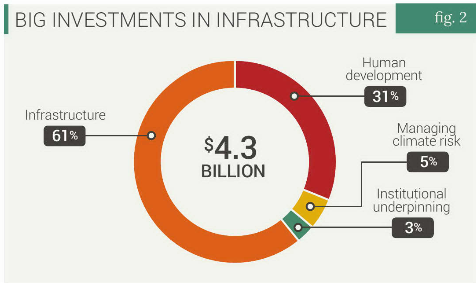
In fiscal year 2015 alone, some $1.3 billion of Kenya - investmentsnew IDA resources – the Bank’s finance at concessional rates – were committed: the largest in Kenya’s history. The value of the overall portfolio of 27 projects of about $4.3 billion as of June 2015 is almost double what it was just five years ago. Investments are spread across many key sectors, ranging from hard infrastructure (roads and energy) to human development (health and community development) to managing climate risk (agriculture and coastal management) to strengthening institutions delivering public services (judicial reform). Continue reading →

eConsultant2: competitiveness assessment of the Colombian Palm Oil in international trade

The Dutch (RVO) funded Colombia palm oil project is gaining speed and the team has now published a call for expressions of interest. Given the RVO funding the IFC would very much welcome Dutch consultants.

The aim of this assessment is to identify and examine the factors affecting the performance of Colombian palm oil-based products in the international market, and analyze the gap between the current and possible future conditions in the Colombian industry. The following topics need to be considered: Continue reading →

DR Congo – Quality and Relevance of Secondary and Tertiary Education Project

The World Bank Board of Directors has recently approved the Quality and Relevance of Secondary and Tertiary Education Project in the Democratic Republic of the Congo. The project, worth a total of $200 million, is partly financed by an IDA grant ($70m) and partly by an IDA loan ($130m).

The focus is on Secondary education (40%), Tertiary education (25%) and Vocational training (35%).

The project’s objectives are to: (i) improve the teaching and learning of mathematics
and science in general secondary education, and (ii) enhance the relevance of TVET in priority sectors at secondary and tertiary education levels.

Continue reading →

Haiti – Sustainable Rural and Small Towns Water and Sanitation Project

Haiti has been provided with an IDA Grant by the World Bank Board of Directors. This grant, worth a total of $50 million, was awarded in March for the Sustainable Rural and Small Towns Water and Sanitation Project.

The proposed objectives of the Project are to: (i) increase access to improved water supply and sanitation in targeted rural areas and small towns in zones affected by cholera; (ii) strengthen the Recipient’s water and sanitation service delivery mechanism at the deconcentrated level; and (iii) improve the Recipient’s capacity to respond promptly and effectively to an Eligible Emergency.

This will be done through the following components: Continue reading →

Senegal – Stormwater Management and Climate Change Adaptation Project (AF)

The World Bank Board of Directors has approved additional financing for the Senegal Stormwater Management and Climate Change Adaptation Project. The additional financing amounts to a total of $38 million, of which $35 million is provided by the World Bank.

The proposed project will improve stormwater drainage and flood prevention in peri-urban Dakar for the benefit of local residents. The specific goal of the additional financing is to improve flood prevention management in peri-urban areas of Dakar and to promote city sustainability management practices, including climate resilience, in two selected urban areas.
This is to be achieved through the following components:

Continue reading →

India Bihar Kosi Basin Development Project

On August 6, the World Bank Board of Directors will be discussing the India Bihar Kosi Basin Development Project. This project is worth a total of $375 million, of which $250 million is provided by the World Bank, and $125 by the borrowing country.

The project development objective is to enhance resilience to floods and increase agricultural production and productivity in the targeted districts in the Kosi River Basin, and to improve the Government of Bihar’s capacity to respond promptly and effectively to an eligible crisis or emergency.
This is to be achieved through the following components:

Continue reading →

Tunisia Road Transport Corridors – Update

On June 29 we reported about the Tunisia Road Transport Corridors. This project, worth a total of $231 million, has now been approved by the World Bank Board of Directors.

The Project Development Objectives are (i) to reduce transportation cost and time and improve road safety on select road corridors between lagging regions in Tunisia and more developed areas and (ii) strengthen the Ministry of Equipment’s capacity in road asset management.
This is to be achieved through the following two components: Continue reading →

World Bank to spend up to $2.1 billion to rebuild Nigeria’s northeast

Article published by Reuters on July 21, 2015.

(Updates with World Bank comment)

By Julia Payne

ABUJA, July 21 (Reuters) – Nigeria’s presidency said on Tuesday the World Bank had pledged to spend up to $2.1 billion to rebuild the northeast of the country that has been devastated by Boko Haram militants.

President Muhammadu Buhari met with representatives of the World Bank, the Bill and Melinda Gates Foundation, and the World Health Organization during a trip to Washington.

A World Bank spokeswoman said that during the meeting, the bank said the sum of $2.1 billion could be lent to Nigeria from its development agency and that support could also come from the International Bank for Reconstruction and Development. Continue reading →

Morocco – Large Scale Irrigation Modernization Project

On July 8, the World Bank Board of Directors approved the Morocco Large Scale Irrigation Modernization Project, worth a total of $187.5 million, of which $150 million is provided by the World Bank.

The development objectives of the Large Scale Irrigation Modernization Project for Morocco are: (i) for the Doukkala Regional Agricultural Development Office (ORMVA), the Gharb ORMVA, the Haouz ORMVA, and the Tadla ORMVA, to provide improved water service to farmers; and (ii) for targeted farmers in the project area, to have better access to improved irrigation technologies.

The project comprises of three components. Continue reading →

eConsultant2: Training materials related to Integrated Urban Water Management

Formulation of financial and economic analysis training materials related to Integrated Urban Water Management

The selection is to contract the work for the development of training materials based on an in-depth assessment of financial and economic analysis tools and options related to Integrated Urban Water Management.

Integrated Urban Water Management (IUWM) is a holistic mode of strategic planning. It seeks to develop efficient, flexible urban water systems by adopting an integrated view of all components of the urban water cycle (water supply, sanitation, storm water management), in the context of the urban environment and the wider watershed (land use planning, urban planning and development, water users, environmental services). Continue reading →