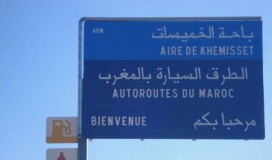
Urban Logistics in the Moroccan traditional sector

Full article in Dutch, only excerpt in English.

In developing countries the traditional marokko-272x160channel plays a very large rol, with often 50% of all commercial trade being conducted through these channels. To develop a city sustainably, city logistics is an important topic in policy and rules. However, policy also needs to be evaluated in the context of the city in question, with proper data as the basis.

Below a case-study in Casablanca, Morocco, by Alain Broft.

Continue reading

eConsultant2: International STC to support Lao PDR Nam Ou River Basin Profile Development and Training

IFC seeks to recruit a short term international consultant to support their Environmental and Social Hydropower Advisory Services Program in Lao PDR. The assignment aims to provide capacity building and training through the development and production of a river basin profile for the Nam Ou River Basin. The production of the river basin profile will be undertaken in collaboration with the Ministry of Natural Resources and Environment (MONRE), Provincial Natural Resources and Environment Offices (PONRE), District Natural Resources and Environment Offices (DONRE) in the provinces of Phongsaly, Oudomxay and Luang Prabang and IFC (constituting the Core Team) as well as other relevant stakeholders where required.

Continue reading

eConsultant2: Lessons from Linking SMEs to Lead Firms in Agribusiness

The Trade and Competitiveness Global Practice of the World Bank Group (WBG) assists governments and the private sector in exploring and enabling market opportunities in agribusiness. One of the key areas of focus of T&C is to support the growth of small and medium enterprises, from serving local and domestic markets to entering and upgrading in global value chains (GVCs). This is done by building marketing competence, facilitating market linkages, extending access to early-stage finance and appropriate technologies, and building managerial capacity. This work often entails supporting the development of aggregators or intermediaries. A key example for the agribusiness sector is infoDevs pilot program on the use of local intermediaries to effectively deliver financial and technical assistance that enable the growth of agro-processing SMEs. These intermediaries are referred to as Agribusiness Innovation Centers (AICs). Continue reading

eConsultant2: Nigeria – Monitoring and Learning, Programmatic Approach to Support Nigeria Pilot Projects

The selected firm will provide World Bank task teams with a combination expertise and experience in beneficiary feedback collection and analysis, organizational performance management survey design and analysis and in coordinating new knowledge to inform learning internally and externally.

There are two interdependent objectives and tasks that will be fulfilled via the solicitation of the international firm(s). Continue reading

East Africa Public Health Laboratory Networking Project – Additional financing

The development objective of the East Africa Public Health Laboratory Networking Project for Africa is to establish a network of efficient, high quality, accessible public health laboratories for the diagnosis and surveillance of tuberculosis and other communicable diseases.

Laboratory

Picture courtesy of Business Daily Africa

The $50 million additional financing (AF) for Burundi, Kenya, Tanzania, and Uganda will assist to: (a) scale up successful activities to additional facilities in cross border areas, further expanding geographic coverage; and (b) broaden and deepen the range of interventions to be funded Continue reading

Jamaica – Improving Climate Data and Information Management Project

On July 28 the Board of Directors of the World Bank will be processing the Improving Climate Data and Information Management Project for Jamaica. This will be done on an Absence of Objection basis, with the project expected to be adopted without trouble.

The project involves a total of $7.5 million in support of the meteorological data gathering, of which $6.8 million is provided by the World Bank. The goal of the project is to improve the quality and use of climate related data and information for effective planning and action at local and national levels.

This goal is to be achieved through the following four components: Continue reading

Lesotho – Systematic Country Diagnostics published

The World Bank has recently published the Lesotho Systematic Country Diagnostic. A Systematic Country Diagnostic (SCD) informs each new country partnership. The diagnostic identifies the most important challenges and opportunities in a country, and serves as the basis for the World Bank’s engagement with a country.

Abstract from the World Bank Systematic Country Diagnostic for Lesotho:

Lesotho is one of the poorest and most unequal countries in the world. It is a small, mostly mountainous, and largely rural country of about 2 million people, completely surrounded by South Africa. The persistence of poverty and rising inequality are striking for an economy that grew at annual rates of 4 percent per capita over the past decade. Continue reading

Global Financing Facility Launched with Billions Already Mobilized to End Maternal and Child Mortality by 2030

New partnership to raise resources from private capital markets to help close global financing gap for investments in maternal, adolescent and child health.

ADDIS ABABA, Ethiopia, July 13, 2015—The United Nations, the World Bank Group, and the Governments of Canada, Norway and the United States joined country and global health leaders today to launch the Global Financing Facility (GFF) in support of Every Woman Every Child, and announced that $12 billion in domestic and international, private and public funding has already been aligned to country-led five-year investment plans for women’s, children’s and adolescents’ health in the four GFF front-runner countries of the Democratic Republic of the Congo, Ethiopia, Kenya and Tanzania.

Launched at the Third International Financing for Development Conference, the GFF is a key financing platform in support of the United Nations Secretary-General’s Global Strategy for Women’s, Children’s and Adolescents’ Health and the Sustainable Development Goals.

Continue reading

Ecuador Sustainable Family Farming Modernization Project – Update

On Tuesday, June 30 we reported about the Ecuador Sustainable Family Farming Modernization Project that would be discussed in the Board of Directors. The project is now approved.

The Project development objective is to enhance incomes of small and medium sized farm households by supporting more productive and climate-smart use for land and water.

Component 1: Investments for climate-smart sub-projects – $106.80m
Component 2: Capacity building for institutional stakeholders and beneficiaries’ organizations – $6.30m
Component 3: Project Management – $15.5m Continue reading

Egypt – Sustainable Rural Sanitation Services Program-for-Results

In two weeks, the World Bank Board of Directors will be discussing the Egypt Sustainable Rural Sanitation Services project. This project, financed under Program-for-Results financing, is expected to be accepted by the Board and involves a total of $1.25 billion, of which $550 million is provided by the World Bank, $170 million is provided by the Government of Egypt, and $530 million is provided by other donors.

The objective of the Sustainable Rural Sanitation Services project is to strengthen institutions and policies for increasing access and improving rural sanitation services in the Governorates of Beheira, Dakahliya, and Sharkiya in Egypt.

There are three results areas under this objective: Continue reading