
The World Bank’s COVID-19 response and its implications on Procurement 
As part of the response to the COVD-19 crisis, the World Bank Group has announced that it expects to deploy up to $160 billion over the next 15 months by boosting health spending, strengthening social safety nets, supporting the private sector, and countering financial disruptions. It was announced that World Bank Group emergency operations to fight COVID-19 have reached over 100 developing countries.
Tag Archives: World Bank Group
How is the World Bank tackling COVID-19 in fragile and conflict-affected settings?
The COVID-19 (coronavirus) crisis has caused thousands of deaths and shaken the  world’s richest countries to their core. What happens when it makes its way to low-and middle-income countries, which could face destabilizing and lasting shocks from its health and economic impacts? This is especially true for countries impacted by fragility, conflict and violence (FCV), where cases of COVID-19 infection are increasing. Nearly one-third of our total project investments in 100 countries so far have focused on countries impacted by fragility and conflict —from Afghanistan and Iraq to Somalia and Haiti — to help them face a multi-layered crisis of a magnitude no one has faced before.
COVID-19 in fragile settings: Ensuring a conflict-sensitive response
, as seen in the recent resurgence of polio in Syria, cholera outbreaks in the conflict zones in Yemen, and the persistence of Ebola in insecure eastern regions of the Democratic Republic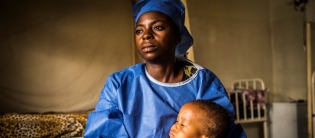 of Congo (DRC). Between 2009 and 2017, in fact, there were 364 disease outbreaks in 108 refugee camps. Fragility and conflict reverse hard-won development gains and stunt opportunities for children, youth, and the poorest people. In the process, they deeply weaken health systems, leaving societies more vulnerable to disease outbreaks.
Global economy expected to shrink by 5.2% in 2020 due to COVID-19
The swift and massive shock of the coronavirus pandemic and shutdown measures to  contain it have plunged the global economy into a severe contraction. According to World Bank forecasts, the global economy will shrink by 5.2% this year.
People Peace Prosperity

The Fragility Forum is underway! After it was postponed due to concerns around  COVID-19, it has been transformed into a Virtual Series that will take place through August 31, 2020.
- For more details and registration: Fragility Forum 2020 website
- Follow all sessions through the Online Learning Campus and subscribe to the Forum Youtube channel for live panel discussions
- Replay: Opening Session: When Everything is a Priority: How Leaders Sequence Reform During Crises
Support to the Development of Lao PDR’s PPP Framework and Management of Unsolicited Proposals and Fiscal Commitments and Contingent Liabilities
Deadline: 25-Jun-2020 at 11:59:59 PM (Eastern Time – Washington D.C.) 
The Government of Lao PDR (GOL) has established a policy direction for poverty alleviation and graduation from the list of Least Developed Countries. To achieve this goal, GOL will need to continue to expand and improve infrastructure to support social and economic development and prepare a strong basis for industrialization and modernization. To help mobilize private sector investment and commercial lending GOL has revised its Investment Promotion Law and recently approved a PPP Decree as a secondary law to supplement the Investment Promotion Law. However, further actions will be needed to strengthen the enabling environment for PPPs in Lao PDR. Therefore, GOL has requested support from the World Bank to help strengthen the PPP enabling environment and support capacity building across the PPP lifecycle, including support on managing Unsolicited Proposals and PPP related Fiscal Commitments and Contingent Liabilities.
eC2: MARKET STUDIES ON SOLAR TECHNOLOGIES FOR AGRICULTURE VALUE CHAINS
Deadline: 15-Jun-2020 at 11:59:59 PM (Eastern Time – Washington D.C.)
The target countries: Uganda, DRC, Madagascar and Cote D Ivoire or Senegal. Covering the following technology groups:
(1) solar pump and drip irrigation;(2) solar refrigeration 3) solar distributed generation and (4) any other investment worthy solar technologies in the sector.
Broadcast Series & Virtual Events

Top COVID-19 (coronavirus) last week
As daily infection rates in South and Central America are increasing significantly, Haiti  faces specific health challenges in battling the coronavirus pandemic. A new report outlines how the pandemic may look different in rich versus developing countries, and how the latter may experience more severe health impacts. As our daily routines now include checking new COVID-19 numbers, data experts are exploring how more timely data could contribute to stronger development outcomes.
In the pandemic, cities are scrambling to expand cycling infrastructure: Big Data can help
The coronavirus (COVID-19) and lockdown measures have created immense challenges  for urban transport. But they also provide an opportunity for cities to rethink the future of mobility. Cycling, in particular, is enjoying renewed attention. This is not surprising, as biking offers many advantages that make it an attractive form of urban transport both during and after the pandemic: bicycles can ease the pressure on public transit systems, allow for easy social distancing, contribute to better public health, and reduce air pollution.


You must be logged in to post a comment.