
Published on http://www.worldbank.org, June 19, 2019
STORY HIGHLIGHTS
- Resilient infrastructure is about people. Particularly in developing countries,
 infrastructure disruptions are an everyday concern that affects people’s well-being, economic prospects, and quality of life.
- There is a significant economic opportunity from investing in resilient infrastructure: the overall net benefit of doing so in developing countries would be $4.2 trillion over the lifetime of new infrastructure.
- For infrastructure investors, governments, development banks and the private sector the message is clear: rather than just spending more, also spend better
Infrastructure is at the heart of lives and livelihoods. It can enable schools and hospitals, businesses and industry, and access to jobs and prosperity. In developing countries, however, disruptions to infrastructure are an everyday concern, reducing opportunities for employment, hampering health and education, and limiting economic growth.
In low and middle-income countries, direct damages from natural hazards to power generation and transport alone cost $18 billion a year, cutting into the already scarce budget of road agencies and power utilities. But the main impact of natural shocks on infrastructure is through the disruptions they impose on people and communities, for instance, businesses unable to keep factories running or use the internet to take orders and process payments; or on the households that don’t have the water they need to prepare meals or on people unable to go to work, send children to school, or get to a hospital.
 among poor people and communities can achieve outcomes that promote poverty reduction, enhanced welfare and create new and expanded employment opportunities. The final output would cover, the potential role of CE in development; case studies and assessment of market potential; different policy approaches for scaling CE, and; recommendations to governments. The consultancy will be based on desk review, economic modeling and detailed case studies that will be selected collaboratively. This EOI was tender for a smaller amount and is now being retendered with an updated amount and TOR.
 obesity and the quest for better public health. Interest in discouraging consumption through higher taxes is growing as more jurisdictions impose them and as we learn more from their experiences. Sugar-sweetened beverage taxes are one of three taxes for health highlighted in a recently published report by the
  –
–  productive environments to attract investments, increase economic efficiency, and create livable environments that prevent urban costs from rising with increased population densification. What are the central obstacles that prevent African cities and towns from becoming sustainable engines of economic growth and prosperity? Among the most critical factors that limit the growth and livability of urban areas are land markets, investments in public infrastructure and assets, and the institutions to enable both. To unleash the potential of African cities and towns for delivering services and employment in a livable and environmentally friendly environment, a sequenced approach is needed to reform institutions and policies and to target infrastructure investments. This book lays out three foundations that need fixing to guide cities and towns throughout Sub-Saharan Africa on their way to productivity and livability.
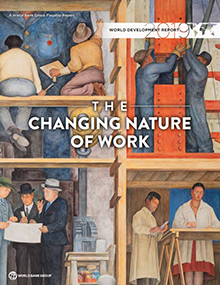 the nature of work is changing as a result of advances in technology today. Fears that robots will take away jobs from people have dominated the discussion over the future of work, but the World Development Report 2019 finds that on balance this appears to be unfounded. Work is constantly reshaped by technological progress. Firms adopt new ways of production, markets expand, and societies evolve. Overall, technology brings opportunity, paving the way to create new jobs, increase productivity, and deliver effective public services. Firms can grow rapidly thanks to digital transformation, expanding their boundaries and reshaping traditional production patterns.
 selected settlements. Services must conform to appropriate standards, but also be affordable. Infrastructure development must allow for population growth, be resilient to natural hazards, climate change effects (e.g. increased rainfall and sea level rise), and environmental impacts (e.g. soil erosion, concentration of flow, and waste contamination).
 The start-up scene in the Middle East and North Africa region is booming. The growing number of incubators and accelerators that can be found from


You must be logged in to post a comment.