eConsultant2: GAFSP Rwanda Evaluation

IFC would like to invite firms meeting the following criteria to submit an expression of interest for this consultancy:

Experience with conducting rigorous impact evaluations in developing countries;
Experience in the agribusiness sector a strong plus. Continue reading

eConsultant2: Malawi GAFSP Evaluation – Survey Firm – DEADLINE AUGUST 13

IFC is looking to hire a survey firm to manage all aspects of a baseline household data collection, entry and management for a prospective, rigorous impact evaluation of two interventions: an outgrower scheme and employment of unskilled labor at a commercial farm. The purpose of the household surveys is to estimate the baseline wellbeing of smallholder farmers in the Salima province of Malawi, where the company operates. The baseline will be used to better understand the context of these farmers, and to measure the effects of their engagements with the company over time by comparing the results against a midline (September 2017) and an endline (September 2019) data collection. Continue reading

Tender: Eastern Africa Agricultural Productivity Program (EAAPP-APL1A)

Tender posted on DevBusiness website (www.devbusiness.com). Log on to DevBusiness to review full tender.

DB Reference number: WB3621-08/15

Country: Uganda

Deadline: August 21, 2015

Supply of One (1) Set of a Diary Processing Equipment-Lot.1 and Fibre/Nitrogen Analyser Equipment and Hummer Mill-Lot.2 Continue reading

From ‘Aid to Trade’ agenda in Kenya: an embassy perspective (in Dutch)

This blog was published on the Ministry of Foreign Affairs website for entrepreneurs in developing countries (www.ondernemeninontwikkelingslanden.nl) on July 28, 2015 and written by First Secretary Robert van der Hum of the Netherlands embassy in Nairobi, Kenya.

Almost summer vacation, almost a year that I have lived – with family – and worked in Kenya. A beautiful country to live in, also exciting and adventurous. And certainly very dynamic to work in Kenya: the developments occur rapidly and there is so much to do! A good moment to look back on a first year of working on the ‘Aid to Trade’ agenda, at the economic department of the embassy in Nairobi. -Remainder of article in Dutch-
World Bank Approves Largest Ever Guarantees for Ghana’s Energy Transformation

Article originally posted on the World Bank website on July 30, 2015. The project website for the Ghana Sankofa Gas Project can be found here, which also features the detailed Project Appraisal Document.

The World Bank’s Board of Directors today approved a record investment of $700 million in guarantees for Ghana’s Sankofa Gas Project – a transformational project that will help address the country’s serious energy shortages by developing new sources of clean and affordable natural gas for domestic power generation.

The Board approved a unique combination of two guarantees for the Project – an IDA Payment guarantee of $500 million that supports timely payments for gas purchases by Ghana National Petroleum Corporation and an IBRD Enclave Loan guarantee of $200 million that enables the project to secure financing from its private sponsors. Together, the guarantees are expected to mobilize $7.9 billion in new private investment for offshore natural gas, representing the biggest foreign direct investment in Ghana’s history.

The exploration and commercialization of the gas will be carried out by two private investors, Eni of Italy and Vitol Group of the Netherlands

Continue reading

Kenya and the World Bank Group: Taking stock 2015

From the Kenya – World Bank Group Taking stock 2015 report.

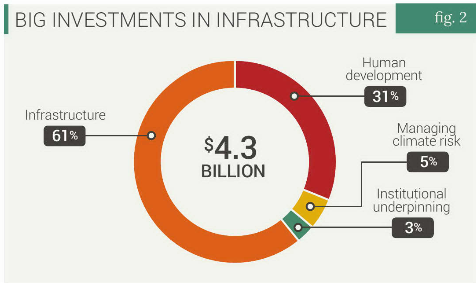
In fiscal year 2015 alone, some $1.3 billion of Kenya - investmentsnew IDA resources – the Bank’s finance at concessional rates – were committed: the largest in Kenya’s history. The value of the overall portfolio of 27 projects of about $4.3 billion as of June 2015 is almost double what it was just five years ago. Investments are spread across many key sectors, ranging from hard infrastructure (roads and energy) to human development (health and community development) to managing climate risk (agriculture and coastal management) to strengthening institutions delivering public services (judicial reform). Continue reading

DR Congo – Quality and Relevance of Secondary and Tertiary Education Project

The World Bank Board of Directors has recently approved the Quality and Relevance of Secondary and Tertiary Education Project in the Democratic Republic of the Congo. The project, worth a total of $200 million, is partly financed by an IDA grant ($70m) and partly by an IDA loan ($130m).

The focus is on Secondary education (40%), Tertiary education (25%) and Vocational training (35%).

The project’s objectives are to: (i) improve the teaching and learning of mathematics
and science in general secondary education, and (ii) enhance the relevance of TVET in priority sectors at secondary and tertiary education levels.

Continue reading

Senegal – Stormwater Management and Climate Change Adaptation Project (AF)

The World Bank Board of Directors has approved additional financing for the Senegal Stormwater Management and Climate Change Adaptation Project. The additional financing amounts to a total of $38 million, of which $35 million is provided by the World Bank.

The proposed project will improve stormwater drainage and flood prevention in peri-urban Dakar for the benefit of local residents. The specific goal of the additional financing is to improve flood prevention management in peri-urban areas of Dakar and to promote city sustainability management practices, including climate resilience, in two selected urban areas.
This is to be achieved through the following components:

Continue reading

Tunisia Road Transport Corridors – Update

On June 29 we reported about the Tunisia Road Transport Corridors. This project, worth a total of $231 million, has now been approved by the World Bank Board of Directors.

The Project Development Objectives are (i) to reduce transportation cost and time and improve road safety on select road corridors between lagging regions in Tunisia and more developed areas and (ii) strengthen the Ministry of Equipment’s capacity in road asset management.
This is to be achieved through the following two components: Continue reading