The following Dutch representatives of the Africa Improved Foods Program are interviewed by CNBC.
Feike Sijbesma (Royal DSM) minute 2.36
Linda Broekhuizen (FMO) minute 3.28
Anup Jagwani (IFC) minute 4.14

The following Dutch representatives of the Africa Improved Foods Program are interviewed by CNBC.
Feike Sijbesma (Royal DSM) minute 2.36
Linda Broekhuizen (FMO) minute 3.28
Anup Jagwani (IFC) minute 4.14
Despite West Africa’s enormous investment potential, its integration into the global  economy is low. One sign of this is that the region captures only 5% of Africa’s total Foreign Direct Investment (FDI). The main hurdles for national, regional, and foreign investors are cross-border constraints. Small businesses and service providers are especially affected.
“In Nigeria, burdensome and non-transparent administrative procedures, land, the clearance of goods and services at ports and airports, and access to finance are some of the obstacles hampering investors,” said Bala Bello, Deputy Director for Policy and Advocacy at the Nigerian Investment Promotion Commission.
 two decades at 3.5% per year. This growth rate is expected to hold into 2050. With this growth, street food is going to become one of the most important components of African diets. The formal sector will just not be able to keep up!
Enter my company, Musana Carts, which tackles the #FoodRevolution challenge from the end of the food value chain. Musana Carts, which currently operates in Uganda, streamlines and improves the production and consumption of street food.
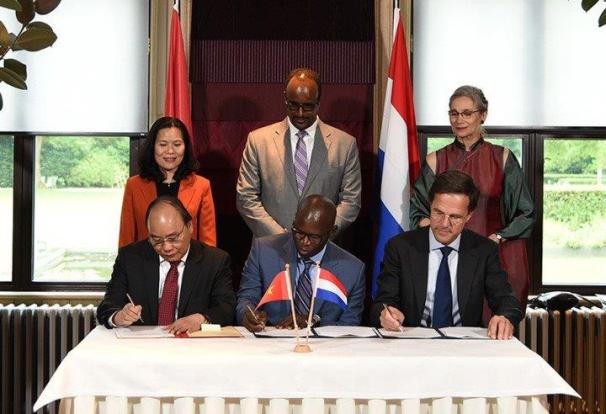
Attached a picture of Ousmane Dione and Nathan together with the Prime Ministers Phuc of Vietnam and Rutte of the Netherlands this Monday at the Catshuis (local equivalent of the White House) in The Hague, signing a trilateral MoU regarding collaboration on food safety. A spin-off under the WBG-NL Food for All Partnership. Great work by the Country Office and the Dutch Embassy Hanoi.
HAMBURG, Germany, July 8, 2017—On the occasion of the G20 leaders’ summit, the 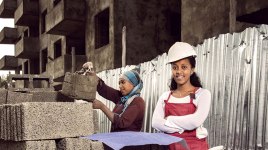 World Bank Group today announced the creation of an innovative new facility that aims to enable more than $1 billion to advance women’s entrepreneurship and help women in developing countries gain increased access to the finance, markets, and networks necessary to start and grow a business.
The United States initiated the idea for the facility and will serve as a founding member along with other donor countries.
WBG Blog: Franck Bousquet
I had the opportunity recently to participate in the Third Edition of the World Reconstruction Conference, where I was reminded once again of a sobering reality – that we live in an increasingly interconnected world where multiple cr ises overlap in complex ways, from the impacts of climate change to a spike in violent conflict, historically high levels of forced displacement, and the worst famine in 70 years.
At the same time, I was encouraged by how the international community is coming together, breaking silos to forge a comprehensive response. While the Conference focused on the role of post-crisis recovery and reconstruction for resilience building and disaster risk reduction, partners recognized the complexity of this effort. The joint communique noted that conflict and fragility require special attention as it can aggravate the impact of natural disasters and make the recovery process more challenging.
Milka Losia knew it was the river’s fault that her brother died. The culprit was the dirty  brown water they had no choice but to drink.
‘Our village needs a hospital, people are dying,” said Benson Naitalima, a farmer.
Of course hospitals are important, Milka thought. But if it wasn’t for the dirty river water, they wouldn’t have needed a hospital in the first place. People like her brother would be alive and, Milka wouldn’t be caring for his orphaned children.

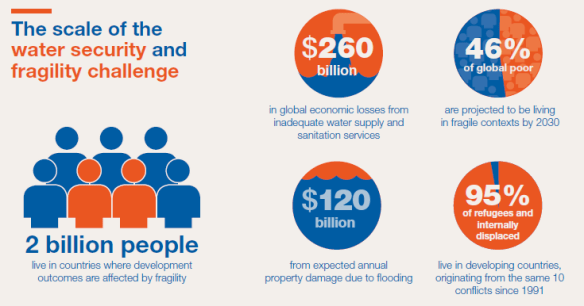
Water touches nearly every aspect of development. It drives economic growth, supports healthy ecosystems and is fundamental for life. However, this critical resource can harm as well as help. Water-related hazards such as floods, storms, and droughts are responsible for 9 out of 10 natural disasters. Climate change is expected to increase this risk and place even greater stress on scarce water supplies.
MIGA a member of the World Bank Group came to the Netherlands the 21st of June to  give a presentation about their activities. MIGA contributes to the World Bank Group’s goals of ending extreme poverty and promoting shared prosperity by facilitating private investment into developing member countries and supporting projects that bring broad developmental impact. MIGA-supported investments help bring jobs, innovation, technology, and skills transfer.


You must be logged in to post a comment.