
The force of digitalization is driving the global economy, creating distinct groups of  leaders and laggards. Through institutional reform that leverages the advantages of digitalization, the Mashreq can become a vital hub in international data networks. Furthermore, digital transformation can assuage pressing challenges. It can deliver higher transparency, accelerate lackluster productivity and increase economic opportunities for all, especially the youth of this region. A new report, Mashreq 2.0, charts the roadmap for the region to capitalize on this rapidly emerging opportunity, and assesses the prospect of a digitally integrated regional market.
eC2: Training for e-commerce and export advisors in Lebanon, Djibouti, and Tunisia
Deadline: 17-Jul-2019 at 11:59:59 PM (Eastern Time – Washington D.C.)
This assignment specifically focuses on increasing women-led SMEs access to domestic 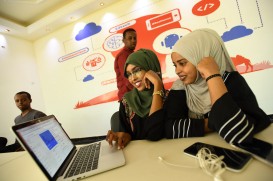 and export markets through e-commerce, and to increase their sales from e-commerce in Lebanon.
There are two main sub-activities envisaged: (1) scoping and market analysis to understand where are the key challenges and constraints to e-commerce for womens SMEs; and (2) develop and deliver a package of support services to women-led SMEs, in partnership with local stakeholders, that will increase sales, markets and profits via e-commerce.
eC2: Assessment of economic circularity options in the plastics sector in Nigeria
Deadline: 17-Jul-2019 at 11:59:59 PM (Eastern Time – Washington D.C.)
The objectives of the market assessment are to understand the plastics sector in Nigeria,  as well as scope out opportunities for impactful private sector interventions structured around circular supply chain for plastics. The assessment will specifically focus on the food & beverage and textile/garment value chains and associated packaging activities in Nigeria. It will look into overall market size for applicable types of plastics, current practices for the use of plastics material, as well as recycling, reuse and disposal practices. The study will scope out value chain players and opportunities to increase the circularity linkages, including through offset of the virgin raw materials.
High-Performance Health-Financing for Universal Health Coverage: Driving Sustainable, Inclusive Growth in the 21st Century
Just over a decade out from the SDG deadline of 2030, many developing countries are not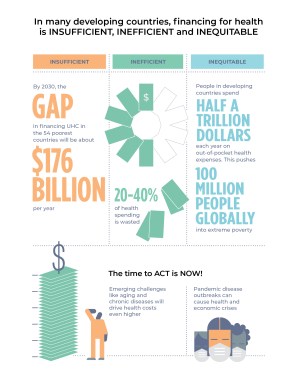 on track to meet Universal Health Coverage (UHC) targets to ensure access to quality, affordable health services to all. People in developing countries pay over half a trillion dollars annually out-of-pocket for health services, which is pushing about 100 million people into extreme poverty each year. The evidence is strong that progress towards UHC would spur not just better health but also inclusive and sustainable economic growth, yet this report estimates that in 2030 there will be a UHC financing gap of $176 billion in the 54 poorest countries. This threatens decades-long progress on health, endangers countries’ long-term economic prospects, and makes them more vulnerable to pandemic risks. This report, launched to inform the first-ever G20 Finance and Health Ministers session in Osaka, Japan in June 2019, lays out an action agenda for countries and development partners to bridge the UHC financing gap, and makes a strong case for a focus on innovation in health financing over the next decade.
Download Full report and Executive summary
Fighting climate change by planting trees in the sea
I started reading about the Aral Sea disaster in 1989 ahead of my first visit, as a student  and tourist, to Uzbekistan, then still a Soviet republic. In Karakalpakstan, the autonomous republic in current-day Uzbekistan, the Aral Sea has all but disappeared. Where fishing communities once thrived, all that remains is a scarred, desert landscape. Rusted ships are perched precariously on piles of sand and salt, along with a potent, unhealthy mix of toxic pollutants from industrial agriculture.
Why measuring poverty impacts is more difficult than simply using score cards
Ending poverty is not only one of the twin goals of the World Bank, but also one of the  Sustainable Development Goals. To design and optimize projects for poverty reduction, we need to measure their impact on poverty. This is quite difficult because changes in the poverty rate might take some time, and it is usually hard to attribute the impact to a particular project, especially without conducting a randomized controlled trial (RCT). But even if we manage to overcome these challenges, we need to measure poverty before the start of the project – as a baseline and to understand whether the project adequately targets the poor – and at the end of the project to assess its impact. And that is also not easy.
Lifelines for Better Development
STORY HIGHLIGHTS 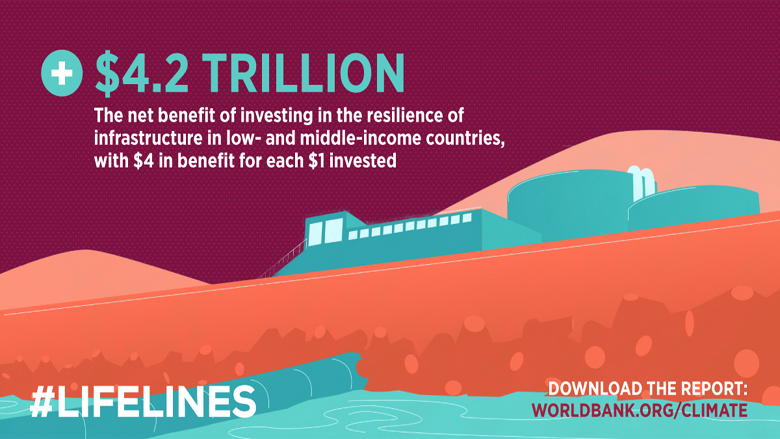
- Resilient infrastructure is about people. Particularly in developing countries, infrastructure disruptions are an everyday concern that affects people’s well-being, economic prospects, and quality of life.
- There is a significant economic opportunity from investing in resilient infrastructure: the overall net benefit of doing so in developing countries would be $4.2 trillion over the lifetime of new infrastructure.
- For infrastructure investors, governments, development banks and the private sector the message is clear: rather than just spending more, also spend better
Save the Date:Climate-Smart Energy Solutions Business Opportunities Fair
Image
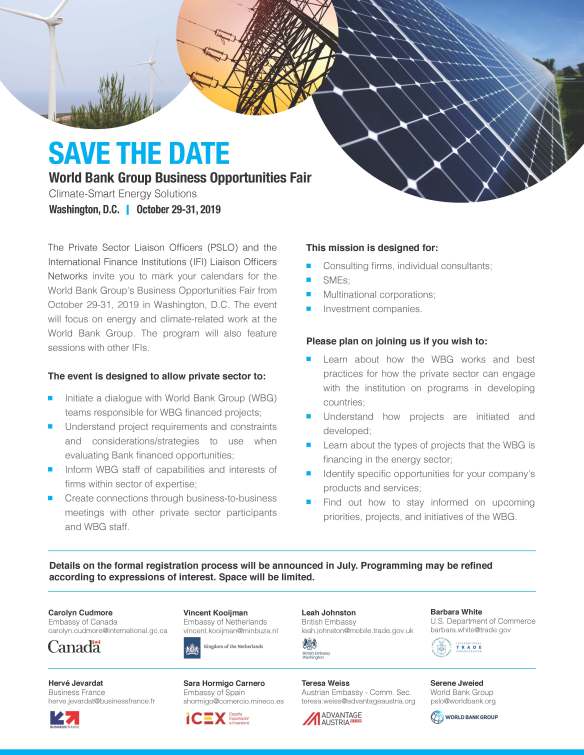
Chart: 47 million people are connected to a mini grid
A mini grid is an electric power generation and distribution system that provides electricity to a localized community. Mini grids will be critical in achieving universal electricity access by 2030. According to a new World Bank report “Mini Grids for Half a Billion People: Market Outlook and Handbook for Decision Makers”, mini grids are often the most economically viable solution for remote areas with high population density and demand and where extending the main grid is prohibitively expensive.

Afghanistan, Myanmar, India and Nepal have the highest number of mini grids, followed by China, Philippines, Indonesia. Analysis by the Energy Sector Management Assistance Program (ESMAP) shows that
Mini Grids for Half a Billion People: Market Outlook and Handbook for Decision Makers
STORY HIGHLIGHTS 
- Mini grids have the potential to provide electricity to as many as 500 million people by 2030, with the right policies and about $220 billion of investment to build around 210,000 mini grids.
- Over the past decade, mini grid costs have declined significantly, while the quality of service has increased. The per kWh cost of mini grid electricity is expected to decrease by two thirds by 2030.
- Significantly more mini grids will need to be deployed in the top 20 electricity access deficit countries – from 10-50 mini grids currently deployed each year per country to over 1,600.


You must be logged in to post a comment.