Reforming the Bank’s Procurement Framework

Today, on July 21, 2015, the World Bank Board of Directors will be discussing, and hopefully approving, the proposed new set of procurement rules and procedures. To give you the context, please find below an interview with the World Bank Chief Procurement Officer, Mr. Chris Browne.

In 2012, the World Bank started a review of the procurement rules and procedures that regulate how borrowing governments can use Bank money for buying goods, services, works, and for hiring consultants. The goal – to reform procurement in Bank operations to better support clients to achieve value for money and to produce sustainable development, while upholding the highest fiduciary and integrity standards. The review process included two global multi-stakeholder consultations. The Bank engaged with more than 4,000 stakeholders from governments, the private sector and civil society to develop a procurement framework that is fit for purpose for development.

Continue reading

World Bank Report: Public-Private Partnerships – Promise and Hype

Paper authored by Michael Klein and published by the World Bank Open Knowledge Repository (OKR) in June 2015 at http://hdl.handle.net/10986/22223.

This paper provides perspectives on patterns of public-private partnerships in infrastructure across time and space. Public-private partnerships are a new term for old concepts. Much infrastructure started under private auspices. Then many governments nationalized the ventures. Governments often push infrastructure providers to keep prices low. Continue reading

Lesotho – Systematic Country Diagnostics published

The World Bank has recently published the Lesotho Systematic Country Diagnostic. A Systematic Country Diagnostic (SCD) informs each new country partnership. The diagnostic identifies the most important challenges and opportunities in a country, and serves as the basis for the World Bank’s engagement with a country.

Abstract from the World Bank Systematic Country Diagnostic for Lesotho:

Lesotho is one of the poorest and most unequal countries in the world. It is a small, mostly mountainous, and largely rural country of about 2 million people, completely surrounded by South Africa. The persistence of poverty and rising inequality are striking for an economy that grew at annual rates of 4 percent per capita over the past decade. Continue reading

Global Financing Facility Launched with Billions Already Mobilized to End Maternal and Child Mortality by 2030

New partnership to raise resources from private capital markets to help close global financing gap for investments in maternal, adolescent and child health.

ADDIS ABABA, Ethiopia, July 13, 2015—The United Nations, the World Bank Group, and the Governments of Canada, Norway and the United States joined country and global health leaders today to launch the Global Financing Facility (GFF) in support of Every Woman Every Child, and announced that $12 billion in domestic and international, private and public funding has already been aligned to country-led five-year investment plans for women’s, children’s and adolescents’ health in the four GFF front-runner countries of the Democratic Republic of the Congo, Ethiopia, Kenya and Tanzania.

Launched at the Third International Financing for Development Conference, the GFF is a key financing platform in support of the United Nations Secretary-General’s Global Strategy for Women’s, Children’s and Adolescents’ Health and the Sustainable Development Goals.

Continue reading

Heineken & IFC collaborate to expand Rwanda’s Bralirwa Brewery

On April 22, the World Bank Board of Directors approved a $25 million IFC investment in Brasserie et Limonaderies du Rwanda Ltd. (“Bralirwa”). Bralirwa is the leading beer brewer in Rwanda with more than six beer brands and seven Coca-Cola brands, and is owned for 75% by Heineken N.V., one of the largest brewers in the world.

The IFC’s senior loan is part of a larger Bralirwainvestment of $50 million that supports the company’s capacity expansion program over the next few years.

Continue reading

Where Does the World Stand in Reaching Sustainable Energy Objectives?

progress on sust energy


STORY HIGHLIGHTS
  • Moving in the right direction, but far from reaching universal access to modern energy, doubling energy efficiency and doubling share of renewable energy in global energy mix;
  • Annual global investments must triple to $1.25 trillion to reach sustainable energy goals;
  • Right policies and access to latest technology are important to spur country-level action.

Continue reading

FMO & IFC Partnership to Mainstream Resource Efficiency in Building Construction

Original article published by FMO on June 4th on the FMO Website.

A New Partnership between FMO and IFC to Help Mainstream Resource Efficiency in Building Construction

FMO signed a partnership Memorandum of Understanding with IFC, International Finance Corporation to encourage emerging markets to mainstream resource-efficient building construction with the EDGE (“Excellence in Design for Greater Efficiencies”) certification system.

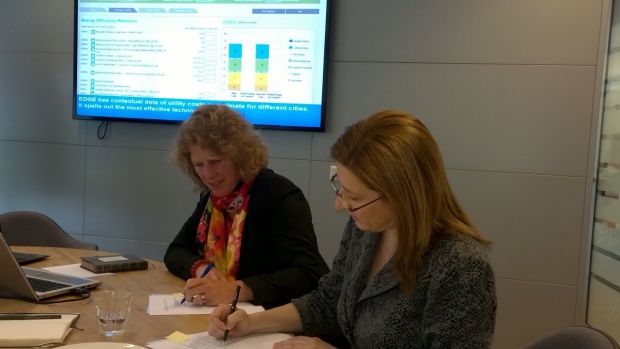
An innovation of IFC, EDGE shows Signing+EDGEproperty developers how fast and affordable it is to construct resource-efficient buildings, enabling them to pass value directly to building owners and tenants. The complimentary EDGE software can be used to determine the viability of a project at the design stage, leading to a set of solutions that reduce energy, water, and the energy used to make building materials by at least 20 percent.

Continue reading

Leading role for the Netherlands in World Bank food investments

Original article published on Dutch Government website.

The Netherlands is to take a leading role at the World Bank in tackling severe hunger. Because of the prominent position of Dutch businesses and knowledge institutes in the area of efficient and sustainable food production, the Netherlands has been asked to advise the Bank on food projects in developing countries. Development cooperation minister Lilianne Ploumen will be signing an agreement this Thursday with the World Bank at a summit conference in Rotterdam.

rwandan farmers‘Everyone should have access to a sufficient supply of healthy and safe food,’ Ms Ploumen said. ‘The Dutch agriculture and horticulture sector has the know-how to boost crop yields and cut costs, while lightening the burden on the environment. Together with the World Bank, we can deploy our solutions worldwide.’ Much of the partnership will focus on knowledge-sharing by the business community, knowledge institutions, civil society organisations and government. Dutch experts will also be enlisted in an array of projects and the Netherlands will provide training courses and workshops on topics like safe food chains and sustainable farming.

Continue reading

World Bank Group Finances Mobile Application

The World Bank Group Finances free mobile application allows users to quickly access its portfolio of projects, finances, and procurement data.

appstore_badge Google Play badge

Transparency and accountability are essential to the development process at the World Bank Group and central to achieving the bank’s mission to alleviate poverty. The mobile app complements the World Bank Group Finances website.
Continue reading

World Bank wants to stop anonymous firms winning contracts

Original article posted by Reuters.

WASHINGTON (Thomson Reuters Foundation) – The World Bank wants all corporate bidders on bank-funded projects to publicly reveal their true owners as a way of tackling fraud and cronyism in government contracts, a senior official said.

The proposal is part of sweeping reforms to modernize contracting at World Bank for the first time in roughly 50 years, which are due for board consideration next month, Chris Browne, chief procurement officer at the bank, told the Thomson Reuters Foundation in an interview on Monday.

“We are very committed to transparency and integrity. We are very keen to take this to the next level,” Browne said.

Continue reading