Deeper Integration Vital for Growth in Latin America and the Caribbean, World Bank Report Says

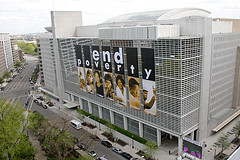
WASHINGTON, March 14, 2017 – A deeper economic integration among Latin American World Bank buildingand Caribbean countries will make the region more competitive in international markets and boost long-term growth, according to a new World Bank report.
Better Neighbors: Toward a Renewal of Economic Integration in Latin America, argues that a renewed integration strategy that takes advantage of the complementarities between regional and global economic integration can contribute to growth with stability. This is particularly relevant for a region that is just coming out of two years of recession.

Continue reading

Every Day We Need to Take Action to Be Bold for Change

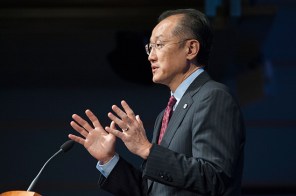
Every Day We Need to Take Action to Be Bold for Change | Jim Kim | Pulse | LinkedInJim Kim Speech

The first Women’s Day was organized in 1909 to protest working conditions for women in New York City’s garment industry. It has since grown into a global movement to advance women’s equality, commemorated every year on International Women’s Day.

What was true more than a century ago holds true today: no country, organization or economy can achieve its potential without the full and equal participation of women and men. Eliminating barriers that discriminate against women not only leads to economic growth, it also benefits men and boys, families, businesses, and entire communities.

Continue reading

Keeping score

When we think of scorecards, we think of football or other sports where we want to keep track of how our favorite players and teams are doing. We at the World Bank are also a team – a team battling a very tough opponent; in fact, two opponents: poverty and inequality. While this not a “game” by any means – the stakes are high as the lives and livelihoods of millions of people around the world are on the line – we also want to keep track of how we’re doing.As a former Country Director, and in my travels before and since, I’ve had the privilege of meeting many, many people whose lives have changed thanks to the support we’re lending to countries. There’s the farmer in Malawi who now has access to a rural road and can take his produce to market; the single mother in Bolivia who is making a living now thanks to her small sewing business; and the young girl in Myanmar that now has access to school and a brighter future. I’ve seen their faces, I’ve heard their stories first-hand, and I’ve witnessed the impact we make through our efforts.

Continue reading

Announcing funding for 10 Development Data Innovation projects

In July of 2016, the Global Partnership for Sustainable Development Data (GPSDD), Data collectionsannounced a new multi-million dollar funding initiative to support collaborative data innovations for sustainable development. Today, the Partnership, working in close collaboration with the World Bank’s Development Data Group, is delighted to announce the recipients of the pilot round of this initiative.
Continue reading

eC2: IFC-Cargill Program in Cote dIvoire Endline Study

Deadline: 29-Mar-2017 at 11:59:59 PM (Eastern Time – Washington D.C.) 

The primary objective of this evaluation are to assess the development impact of the Cargill-IFC programs (ScopeInsight, Coop Academy, and Doni Doni) and to provide information, lessons, and recommendations that can be used to improve the design of future programs.

Continue reading

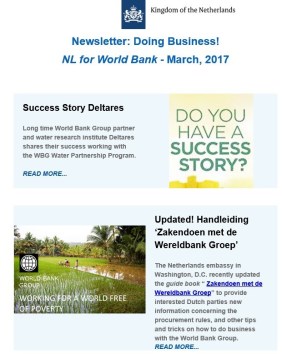
Newsletter March 2017: Doing Business!

On March 7th the FIRST edition of  2017 of NL4WorldBank newsletter  was published.Doing Business

In this edition the focus is on the success of Deltares, a long term partner of the World Bank.
You can also find a new World Bank presentation on the Corporate Procurement, the updated version of the handleiding “zaken doen met de Wereldbank Groep” and the 2017 World Development Report focused on Goverance and the Law. We have also created a complaints guide to answer any and all questions you may have. Last but not least we have our top blog posts, interesting tenders and a couple of important upcoming events! 
Those subscribed to the newsletter automatically received it in their inbox. If you did not receive the newsletter, you will find it here.
If you would like to automatically receive the next newsletter when it is published, please subscribe here.

Women in Agriculture: The Agents of Change for the Global Food System

Women are the backbone of the rural economy, especially in developing countries. They scale-750x750.jpgmake up almost half of the world’s farmers, and over the last few decades, they have broadened their involvement in agriculture. The number of female-headed households has also increased as more men have migrated to cities. As the primary caregivers to families and communities, women provide food and nutrition; they are the human link between the farm and the table.

Continue reading

eC2:Consultancy Assignment on Developing a Conceptual Design for the Establishment of a National and Regional Crisis Management Centers

Deadline:  27-Mar-2017 at 11:59:59 PM (Eastern Time – Washington D.C.)

The overall purpose of this Assignment is to develop a conceptual design for the establishment of a National Crisis Management Center (NCMC), and a standardized type for Regional (Republic of Karakalpakstan, provinces and Tashkent city) Crisis Management Centers (RCMCs) with streamlined communications and information systems for crisis management with improved functions and capabilities

Continue reading

To Unlock Potential of Digital Age, Europe Must Go Beyond Internet Access, Says World Bank

BUCHAREST, March 7 2017− Countries in the European Union (EU) must enact policies indexdesigned to better help workers adapt to new jobs being created by the internet if they want to avoid increasing inequality and exclusion in the region, notes a new World Bank Report. According to Reaping Digital Dividends: Leveraging the Internet for Development in Europe and Central Asia, launched in Bucharest today, affordable and nearly universal access to the internet has not been enough for countries in the EU to fully benefit from opportunities being created by digital technologies and more needs to be done to develop a policy environment that can better leverage this access by linking workers to digital jobs.

Continue reading

Building institutional capacity for rural sanitation: India’s Uttar Pradesh State

Uttar Pradesh (UP), India’s most populous state with about 200 million people, has up2historically not performed well on sanitation. According to census figures from 2001 and 2011, the proportion of rural UP dwellers with a toilet increased slightly during the first decade of this century. However, the population grew as well, meaning that, overall, 13 million more people were defecating in the open in 2011.

Factors which have held back UP’s progress on sanitation include poverty, absence of a robust sanitation strategy, and lack of focus and determination from decision-makers.

Continue reading