
 While reading a newspaper over the holidays, one of us came across an article with an often common story: “car collision causes mass fatalities on mountain road”. The collision resulted in 51 deaths, after a bus–one of the vehicles involved, plunged down a cliff in Peru. Many of the dead were returning to Lima after celebrating the New Year’s holiday with family outside the city.
Category Archives: WBG News & Reports
Reducing Greenhouse Gas Emissions through Energy Efficiency – and Learning from One’s Peers
China, India, Indonesia, the Philippines, Pakistan, and Vietnam are critical for global climate action. Why? Among other reasons, because three-fourths of all new coal-fired power plants to begin operations before 2020 globally will be in these six Asian countries. Fostering more energy efficiency will be imperative in the countries’ efforts to adopt a low carbon energy path.
One initiative that supports efforts to scale up energy efficiency and clean energy – and lower greenhouse gas emissions – in these six countries is the Energy Transition in Asia program managed by the Energy and Extractives Global Practice.
Working Together to Weather Future Storms
 STORY HIGHLIGHTS
- Meteorological and hydrological services – hydromet – play a vital role in mitigating the impacts of weather and climate extremes
- Hydromet is not only about early warning systems, but also giving countries, regions, communities, and individuals weather information and reliable predictions to make informed decisions for many sectors of the economy – from agriculture to logistics to hydropower, and many more
- The World Bank and the Global Facility for Disaster Reduction and Recovery (GFDRR) are supporting efforts to strengthen collaboration in global weather monitoring across the public and private sectors
Meet the Human Faces of Climate Migration
STORY HIGHLIGHTS 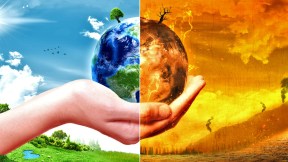
- A new World Bank report has found that by 2050 the worsening impacts of climate change in three densely populated regions of the world could see more than 140 million people move within their countries’ borders.
- With concerted action, however, including global efforts to cut greenhouse gas emissions and robust development planning at the country level – this worst-case scenario could be dramatically reduced, by as much as 80 percent, or 100 million people.
- The report identifies “hotspots” of climate in- and out-migration. These include climate-vulnerable areas from which people are expected to move, and locations into which people will try to move to build new lives and livelihoods
Artificial intelligence for smart cities: Insights from Ho Chi Minh City’s spatial development
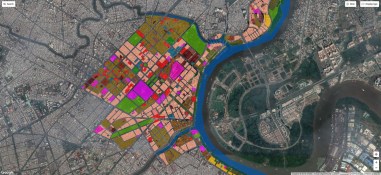 It’s amazing to see what technology can do these days! Satellites provide daily images of almost every location on earth, and computers can be trained to process massive amounts of data generated from them to produce insightful analysis/information. This is just one of the demonstrations of artificial intelligence (AI). AI can go beyond just reading images captured from space, it can help improve lives overall.
For billions without formal land rights, the tech revolution offers new grounds for hope
Many of today’s increasingly complex development challenges, from rapid urban  expansion to climate change, disaster resilience, and social inclusion, are intimately tied to land and the way it is used. Addressing these challenges while also ensuring individuals and communities are able to make full use of their land depends on consistent, reliable, and accessible identification of land rights.
To unlock student potential in East Asia Pacific, be demanding and supportive of teachers
 Among the 29 countries and economies of the East Asia and Pacific region, one finds some of the world’s most successful education systems. Seven out of the top 10 highest average scorers on internationally comparable tests such as PISA and TIMSS are from the region, with Japan, Republic of Korea, Singapore, and Hong Kong (China) consistently among the best.
For billions without formal land rights, the tech revolution offers new grounds for hope
Many of today’s increasingly complex development challenges, from rapid urban  expansion to climate change, disaster resilience, and social inclusion, are intimately tied to land and the way it is used. Addressing these challenges while also ensuring individuals and communities are able to make full use of their land depends on consistent, reliable, and accessible identification of land rights.
Let’s work together to prevent violence and protect the vulnerable against fragility
 Last week, in a gathering of governments and organizations at the World Bank-hosted 2018 Fragility Forum, the international community took an important step forward in fighting fragility
 by sharpening our understanding of it, hearing directly from those affected by it and thinking collectively through what we must do to overcome it.
We all agreed, acting on a renewed understanding of fragility and what it means to vulnerable communities represents an urgent and collective responsibility. We’ve all seen the suffering. In places like Syria, Myanmar, Yemen and South Sudan, the loss of life, dignity and economic prosperity is rife. With more than half of the world’s poor expected to live in fragile settings by 2030, we can’t end poverty unless we promote stability, prosperity, and peace in these places ravaged by conflict and crisis.
Newsletter March 2018: Creating a Better World
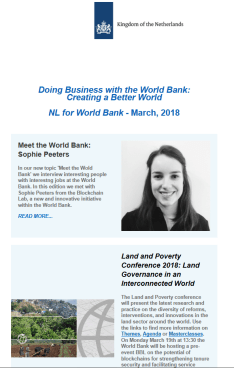 We are excited to bring you the first 2018 edition of the NL4WorldBank newsletter, Creating a Better World which was published the on the 14th of March.
In this edition we feature a ” meet and greet “ with Sophie Peeters who works for the Blockchain Lab at World Bank Group. The Lab will be prominent in future articles and newsletters because we will be highlighting innovation which entails Blockchain, AI and Cyber Security.
And for your convenience we have updated and listed all the NL relevant events for the year, enjoy!
 Netherlands for the World Bank
You must be logged in to post a comment.