
Many of today’s increasingly complex development challenges, from rapid urban  expansion to climate change, disaster resilience, and social inclusion, are intimately tied to land and the way it is used. Addressing these challenges while also ensuring individuals and communities are able to make full use of their land depends on consistent, reliable, and accessible identification of land rights.
Yearly Archives: 2018
To unlock student potential in East Asia Pacific, be demanding and supportive of teachers
 Among the 29 countries and economies of the East Asia and Pacific region, one finds some of the world’s most successful education systems. Seven out of the top 10 highest average scorers on internationally comparable tests such as PISA and TIMSS are from the region, with Japan, Republic of Korea, Singapore, and Hong Kong (China) consistently among the best.
For billions without formal land rights, the tech revolution offers new grounds for hope
Many of today’s increasingly complex development challenges, from rapid urban 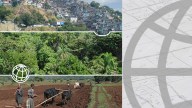 expansion to climate change, disaster resilience, and social inclusion, are intimately tied to land and the way it is used. Addressing these challenges while also ensuring individuals and communities are able to make full use of their land depends on consistent, reliable, and accessible identification of land rights.
eC2: Open Cities Participatory Mapping in Saint-Louis, Senegal
Deadline: 02-Apr-2018 at 11:59:59 PM (Eastern Time – Washington D.C.)
Objective: Open Cities Africa will be carried out in 8-10 cities in Sub-Saharan Africa, to engage local government, civil society, and the private sector to develop the information infrastructures necessary to meet 21st century urban resilience challenges. Each project will: 1) Create and release open spatial data about the built environment, critical infrastructure, and natural hazards; 2) Develop targeted products and/or tools to assist key stakeholders to utilize risk information towards addressing natural disaster risk in the selected city; 3) Enhance the local capacity and institutional development necessary to support the design and implementation of evidence-driven urban resilience interventions; and 4) Promote peer mentorship and build regional networks across cities.
eC2: Open Cities Participatory Mapping in Kinshasa
Deadline: 29-Mar-2018 at 11:59:59 PM (Eastern Time – Washington D.C.)
Objective: Open Cities Africa will be carried out in 8-10 cities in Sub-Saharan Africa, to engage local government, civil society, and the private sector to develop the information infrastructures necessary to meet 21st century urban resilience challenges. Each project will: 1) Create and release open spatial data about the built environment, critical infrastructure, and natural hazards; 2) Develop targeted products and/or tools to assist key stakeholders to utilize risk information towards addressing natural disaster risk in the selected city; 3) Enhance the local capacity and institutional development necessary to support the design and implementation of evidence-driven urban resilience interventions; and 4) Promote peer mentorship and build regional networks across cities.
Let’s work together to prevent violence and protect the vulnerable against fragility
 Last week, in a gathering of governments and organizations at the World Bank-hosted 2018 Fragility Forum, the international community took an important step forward in fighting fragility
 by sharpening our understanding of it, hearing directly from those affected by it and thinking collectively through what we must do to overcome it.
We all agreed, acting on a renewed understanding of fragility and what it means to vulnerable communities represents an urgent and collective responsibility. We’ve all seen the suffering. In places like Syria, Myanmar, Yemen and South Sudan, the loss of life, dignity and economic prosperity is rife. With more than half of the world’s poor expected to live in fragile settings by 2030, we can’t end poverty unless we promote stability, prosperity, and peace in these places ravaged by conflict and crisis.
Newsletter March 2018: Creating a Better World
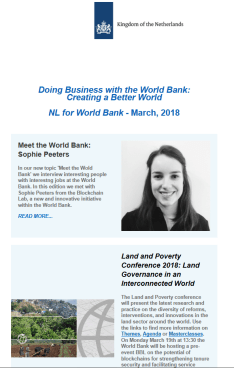 We are excited to bring you the first 2018 edition of the NL4WorldBank newsletter, Creating a Better World which was published the on the 14th of March.
In this edition we feature a ” meet and greet “ with Sophie Peeters who works for the Blockchain Lab at World Bank Group. The Lab will be prominent in future articles and newsletters because we will be highlighting innovation which entails Blockchain, AI and Cyber Security.
And for your convenience we have updated and listed all the NL relevant events for the year, enjoy!
Report: Policy Guidelines for Managing Unsolicited Proposals in Infrastructure Projects – Volume 1
 When it comes to infrastructure projects, “unsolicited proposals” (USPs) represent an alternative to the traditional project initiation method where the private sector, rather than the government, takes the leading role in identifying and developing a project. In practice, many public authorities across the world resort to USPs motivated by the perspective of solving the challenges brought by their lack of capacity to identify and develop projects. However, many projects that originate as USPs experience challenges, including diverting public resources away from the strategic plans of the government, providing poor value for money, and leading to patronage and lack of transparency, particularly in developing countries. To ensure governments can mobilize the strengths of the private sector while protecting the public interest, USPs, when accepted, should be managed and used with caution as an exception to the public procurement method.
eC2: GIS- Based electrification Study for the ECOWAS Regional Access Project
 Deadline: 21-Mar-2018 at 11:59:59 PM (Eastern Time – Washington D.C.)
Objective: The objective of this assignment is to prepare a geospatial analysis and present the least cost options for electrification for villages located within the radio of 100 km of the substations of the OMVG in The Gambia and Guinea Bissau, and the Substations of the OMVS in Mali. The analysis will provide detailed estimation of investment and operating cost requirements.
Continue reading
eC2:Piloting sensor driven precision irrigation technology in Rice based farming system
Deadline: 20-Mar-2018 at 11:59:59 PM (Eastern Time – Washington D.C.) 
Objective: The firm should provide services by installing suitable equipment’s for: 1. measuring standing water level in rice crop using suitable sensor and to measure moisture content of soil using soil suction sensors for all crops; and subsequently to determine irrigation schedule (both timing and quantity of irrigation) using algorithms; 2. Mobile based pump control system and a decision support system to implement irrigation scheduling and monitor the pump operation remotely using mobile. 3. Monitor the groundwater levels, rainfall and volume of water extracted using automatic instruments 4. Provide cloud based application, mobile apps, training modules and videos for dissemination to the farmers.
Continue reading
 Netherlands for the World Bank
You must be logged in to post a comment.