
As public and private financial institutions innovate and expand the range of financ ial products that households and firms use, questions about how these services are affecting consumers, providers, and the economy as a whole have become central. A new policy brief by Abraham, Schmukler, and Tessada explores how evaluating the “additionality” of financial services can help answer such questions.
Author Archives: NL4WorldBank

Remarks from World Bank Group President David Malpass at the G20 Leaders Summit, Osaka, Japan
Thank you, Prime Minister Abe, for being such a gracious host. 
It is a great pleasure to be here during the new era of Reiwa, “Beautiful Harmony.” And it’s a true pleasure that the World Bank and Japan have maintained harmony since the early 1960s, notably when the World Bank made a loan to help fund the construction of the bullet train ahead of the 1964 Tokyo Olympics. I’ll ride that train tonight as I go to Tokyo. The bullet train and Japan’s many other advances enhanced connectivity and helped lead to Japan’s fast growth and its successful graduation from World Bank lending soon after the Olympics in 1966.
How important are Global Value Chains for development? Read the new WDR2020 draft report and comment
Following an intense research and writing process over the last 10 months, I am pleased  to announce that a draft of the World Development Report (WDR) 2020 – Trading for Developing in the Age of Global Value Chains is now available online for public comment.
Why Global Value Chains (GVCs) and why now?
The World Bank’s last report on trade was more than thirty years ago – WDR 1987 Industrialization and Foreign Trade. In the meantime:
Healthy people drive strong economies
Dieynaba Nioula Kane remembers vividly when, for the first time in her life, she was 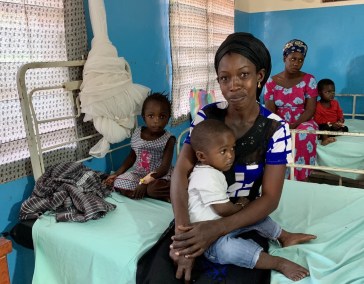 forced to ask friends and family for money. It was out of desperation after the birth of her fifth child, a little boy with a life-threatening condition that needed specialist treatment in the capital. Dieynaba was forced to leave her job teaching French and hurriedly relocate to Dakar, where she was able to find the health services he needed.
forced to ask friends and family for money. It was out of desperation after the birth of her fifth child, a little boy with a life-threatening condition that needed specialist treatment in the capital. Dieynaba was forced to leave her job teaching French and hurriedly relocate to Dakar, where she was able to find the health services he needed.But the expenses quickly piled up. Hospital bills, a tracheostomy, medicines, dressings, fees for nurses and doctors, plus the cost of food and transportation to and from the hospital. As she took a break from paid employment for four years to focus on her son’s health her family’s economic conditions deteriorated. It took the family years to recover.
eC2: Logistics Market and Business Analysis in Indonesia
Deadline: 16-Jul-2019 at 11:59:59 PM (Eastern Time – Washington D.C.)
Assignment of developing:
A) A market overview of the logistics sector in Indonesia (traditional plus e-logistics) including a demand-supply analysis now and in the next 5 years.
B) A market share estimation for the Platform with estimated revenues, which necessarily includes an estimation of fares and Average Order Value (AOV) evolution.
C) An overall assessment of the Platform business plan, including growth assumptions, estimated necessary resources, Capex and Opex to achieve the objectives, like facilities, fleet, human resources and systems.
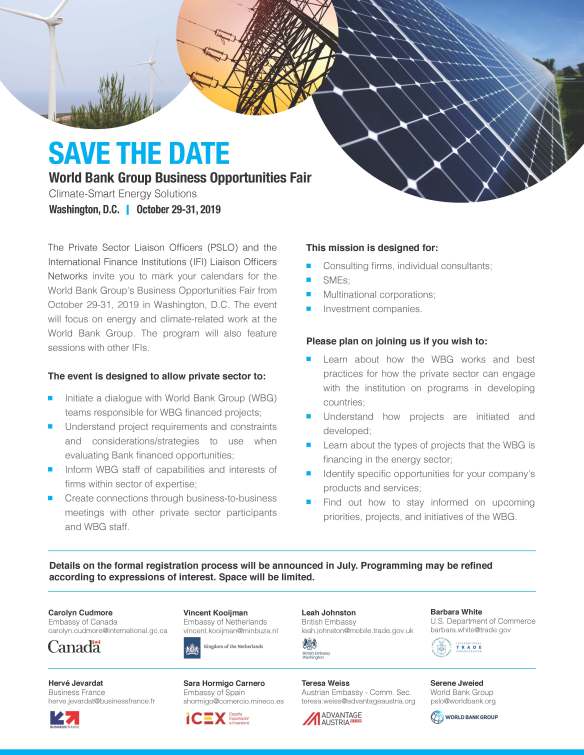
Save the Date: Climate-Smart Energy Solutions Business Opportunities Fair
Image
Money sent home by workers now largest source of external financing in low- and middle-income countries (excluding China)
Article by Donna Barne & Florina Pirlea| www.worldbank.org.
The money workers send home to their families from abroad has become a critical part of many economies around the world. Based on the most recent data, remittances, as this money is called, will only grow in importance. Officially recorded remittances amounted to a record $529 billion in 2018, and are on track to reach $550 billion in 2019.
This money is flowing at about the same levels as foreign direct investment (FDI), but if China is excluded, they are the largest source of foreign exchange earnings in low- and middle-income countries, according to Migration and Remittances Brief 31, published by the World Bank Group and KNOMAD, the Global Knowledge Partnership on Migration and Development. In other words, if China is excluded from the analysis, remittances have already overtaken FDI as the biggest source of external financing.
Mashreq 2.0: Boosting growth & creating jobs through digital transformation
The force of digitalization is driving the global economy, creating distinct groups of  leaders and laggards. Through institutional reform that leverages the advantages of digitalization, the Mashreq can become a vital hub in international data networks. Furthermore, digital transformation can assuage pressing challenges. It can deliver higher transparency, accelerate lackluster productivity and increase economic opportunities for all, especially the youth of this region. A new report, Mashreq 2.0, charts the roadmap for the region to capitalize on this rapidly emerging opportunity, and assesses the prospect of a digitally integrated regional market.
eC2: Training for e-commerce and export advisors in Lebanon, Djibouti, and Tunisia
Deadline: 17-Jul-2019 at 11:59:59 PM (Eastern Time – Washington D.C.)
This assignment specifically focuses on increasing women-led SMEs access to domestic 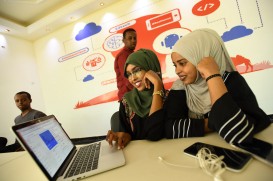 and export markets through e-commerce, and to increase their sales from e-commerce in Lebanon.
There are two main sub-activities envisaged: (1) scoping and market analysis to understand where are the key challenges and constraints to e-commerce for womens SMEs; and (2) develop and deliver a package of support services to women-led SMEs, in partnership with local stakeholders, that will increase sales, markets and profits via e-commerce.
eC2: Assessment of economic circularity options in the plastics sector in Nigeria
Deadline: 17-Jul-2019 at 11:59:59 PM (Eastern Time – Washington D.C.)
The objectives of the market assessment are to understand the plastics sector in Nigeria,  as well as scope out opportunities for impactful private sector interventions structured around circular supply chain for plastics. The assessment will specifically focus on the food & beverage and textile/garment value chains and associated packaging activities in Nigeria. It will look into overall market size for applicable types of plastics, current practices for the use of plastics material, as well as recycling, reuse and disposal practices. The study will scope out value chain players and opportunities to increase the circularity linkages, including through offset of the virgin raw materials.


You must be logged in to post a comment.