
Our world is very different than our grandparent’s. In 1950, there were about 2.5 billion  people; today, there are more than 7 billion. Overall, people are healthier, wealthier, and more secure.
But this has come at a cost. The stress on our planet has been immense. Human beings have dramatically altered the climate, changed the chemistry of the oceans, and triggered mass extinctions. The impact has been so great as to define an entirely new geological era — the Anthropocene, turbo charged by a “great acceleration” of population, economic growth and natural resource consumption since the 1950s.

 you can enjoy an Impossible Burger (meat industry disrupted) delivered by Caviar (food delivery disrupted) to your AirBnB (hotel industry disrupted) while you’re on FaceTime (telecommunication industry disrupted) urging your teenager to get back to lessons on Khan Academy (education industry disrupted). And all the while, you’re leaving a trail of digital data points.
 five years. Take transport and climate, for instance: although data on the carbon footprint of major transport modes had been available for a long time, it was not until COP21 in 2015 that mobility became a central part of the climate agenda. The good news is that, during that same period, the space of solutions expanded as well. For example, data sharing is now viewed as an obvious way to promote better integration between urban transport modes in cities.

 to address resource scarcity, wastage, and the associated environmental effects, but also for incentivising innovation and modernisation towards a circular economy. Resource efficiency essentially means doing more with less, as it allows us to create more value using fewer natural resources. This transition can contribute to sustainable economic growth that generates welfare, while limiting harmful impacts on the environment and hence future generations.” Ángel Gurría, Secretary General, OECD (from Preface,

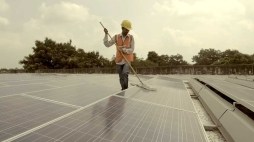 in one of India’s most remote tribal areas—a place so isolated that it’s not just off the power grid, it’s also absent from most maps. She and her community, the Asur tribe, are based in the eastern state of Jharkhand. Nearly half of the people in this isolated territory lack access to electricity—the highest percentage of any state in India.

You must be logged in to post a comment.