
Deadline: 17-Sep-2018 at 11:59:59 PM (Eastern Time – Washington D.C.)
Assignment Description: For each of the Emission Reduction Programs in the ISFL:
Ensure the information provided in the ER Program Document Review is correct and complete (ie not leaving out information that might affect the opinion of the reader)
Conduct an independent assessment of the compliance against the approved ISFL ER Program Requirements and associated guidelines. Apply expert judgement to evaluate the feasibility of program design aspects and identify areas of improvement to inform the World Banks and Contributors review of the ISFL ER Program.
 far and are apparently different is less common. However, both Turkey and Peru have had the highest growth in their respective regions in recent years, aspire to become high-income economies in the next decade, depend on trade. Both countries face downside risks if structural changes—in the education and training system, and the economy more broadly—are not made to ensure that contributions to economic growth come from improvements in productivity. Both countries recognize there is a large gap between their productivity levels and the global productivity frontier, and both have growing populations that are not adequately equipped to meet labor market needs, with average productivity levels. Given these (similar) challenges, both countries have as their development goal, central to their development agenda, to improve productivity to continue growing in a sustainable manner.
 a
a  2012 in Niger, women traveled an hour, on average, to fetch water. Worldwide, 4.5 billion people lack access to safely managed sanitation services and 2.1 billion people lack access to safe drinking water services.
![medical-appointment-doctor-healthcare-clinic-health-hospital-medicine[7]](https://nl4worldbank.org/wp-content/uploads/2015/09/medical-appointment-doctor-healthcare-clinic-health-hospital-medicine7.jpg?w=180&h=120) provoke shockwaves. Happily, the principle that “… everyone having access to the health care they need without suffering financial hardship” is now widely recognized and documented. And although few countries have achieved this goal in practice, it is clearly
provoke shockwaves. Happily, the principle that “… everyone having access to the health care they need without suffering financial hardship” is now widely recognized and documented. And although few countries have achieved this goal in practice, it is clearly 


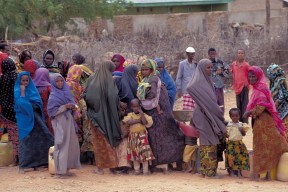 researcher, I was trying to understand the complex issue of how young men get recruited into rebel groups in war-torn regions of central Africa. What I learned was both surprising and heartbreaking: a person who experienced war violence as a child could be more likely to engage in conflict as a young adult. Young men who had experienced extreme war violence in their past would often state this as a reason to take up arms. Even more tragically, these same young men would often struggle to reintegrate peacefully into their communities when hostilities ended. The violence they had experienced their whole lives through war persisted within their homes and communities even when formal peace was declared.

You must be logged in to post a comment.