
Tag Archives: World Bank Group
Nutrition: The key to achieve Universal Health Coverage and unleash Human Capital
This blog is part of a series on Universal Health Coverage (UHC). The series  includes contributions from external bloggers and reflects their views. Follow the conversation on Twitter #healthforall.
eC2: Social Protection and Forced Displacement Research
Deadline: 15-Aug-2019 at 11:59:59 PM (Eastern Time – Washington D.C.)
The fundamental question to be answered in this exercise is: What are the possible and feasible alternatives and combinations for the alignment of SSN and Humanitarian assistance, what are their potential advantages and disadvantages, under what circumstances, and for what ends, are the various alternative arrangements likely to be most suitable and effective? Develop and validate a model to describe and understand the effectiveness of possible options and entry points for the alignment of SSN and Humanitarian assistance.
Understanding the new rurality in Latin America: how can we respond to it in the water sector?
As development practitioners, a common mistake we may fall into is devising well-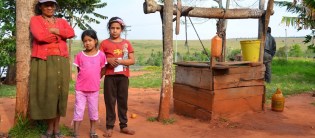 intentioned solutions based on an “outdated” understanding of the country or sectoral context.
In the previous blog, we discussed the water supply and sanitation (WSS) sector challenges which are persistently looming over rural areas in Latin America and the Caribbean (LAC). In this piece, we continue to sketch the “new rurality” by considering new trends and developments witnessed which are altering the rural landscape—and which may require new or revised sector reforms to achieve the Sustainable Development Goal 6.
The Future of Work in Africa: Making Productive Investments for More and Better Jobs
There are uncertainties and misconceptions about the impact of digital technologies on the future of work. Will robots replace humans in the work place? Will digital technologies create a new “digital divide” and widen inequalities between the higher-educated connected and lower-educated unconnected people? Will new opportunities open up for African countries to create jobs, improve incomes, reduce poverty and climb up the development ladder?
eC2: DRONE TECHNOLOGY FOR MONITORING INDEPENDENT PALM OIL SMALLHOLDERS PRODUCTION
Deadline: 31-Jul-2019 at 11:59:59 PM (Eastern Time – Washington D.C.) 
The overall goal of this project is to establish new method on monitoring independent palm oil smallholder. The selected vendor is expected to recommend a method for smallholder monitoring using drone image advice and data service for smallholders, including develop an effective data distribution to smallholder farmers, cost per farmers, and payment collection system from smallholder farmers.
Specifically, the project will conduct aerial mapping of a minimum 15,000 hectares of smallholder farmland (each with approximately one to three hectares of land) and distribute image data to a minimum 1000 of independent smallholder farmers.
This will include:
– aerial mapping of a minimum 15,000 hectares of smallholder farmland,
– image analysis and interpretation of the image captured by the aerial mapping
– Provide report and recommendation for scale up the use of drone for smallholder monitoring, cost per farmer, effective data distribution and payment collection system from smallholders.
IMF Reports World Economic Outlook, July 2019
 till Sluggish Global Growth
New Findex notes showcase digital financial inclusion in Sub-Saharan Africa
We’re thrilled to release five new data notes in collaboration with the International 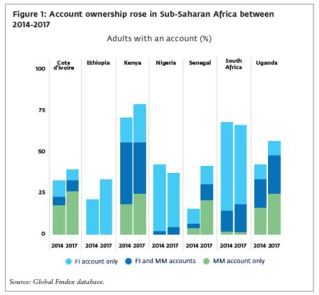 Finance Corporation and Mastercard Foundation Partnership for Financial Inclusion outlining Sub-Saharan Africa’s successes and challenges in building digital financial inclusion. The notes—all of which are available for download at our homepage—draw on tens of thousands of surveys to explore how adults in the region use accounts, digital payments, and savings to manage their financial lives.
Sub-Saharan Africa leads one of the most exciting development innovations of our time—the rise of mobile money. Our first note explains how this technology can expand the use of financial services and describes how it has spread over time.
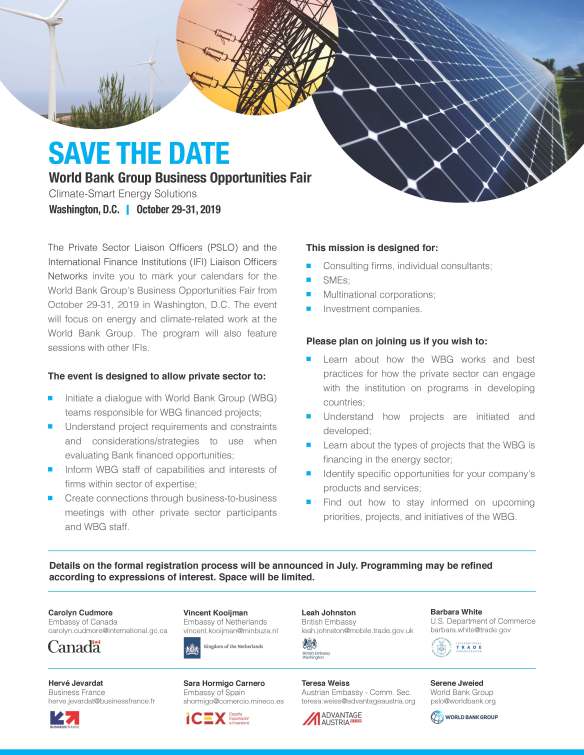
Save the Date:Climate-Smart Energy Solutions Business Opportunities Fair
Image
eC2: Eastern Caribbean Disaster Preparedness and Response Capacity Support and Technical Assistance Program
Deadline: 05-Aug-2019 at 11:59:59 PM (Eastern Time – Washington D.C.) 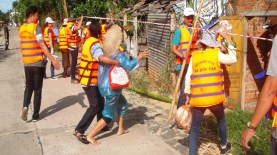
Across the eastern Caribbean sub-region many disaster agencies are under capacitated and institutionally weak due to limitations in human and financial resources. The World Bank is looking for qualified consulting firms to support 5 countries in the Eastern Caribbean and the Caribbean Disaster and Emergency Management Agency (CDEMA) in undertaking institutional assessments and strategic investment planning supporting the national and regional architecture for emergency preparedness and response. Work will be done in coordination with beneficiary Governments and CDEMA. The consulting services include (i) assessment of institutional arrangements in place and recommendations for institutional restructuring and organizational change; (ii) support for strategic planning and development of an investment roadmap based on each country’s hazard risk, organizational capacity and resources; and (iii) stakeholder engagement activities.
Continue reading


You must be logged in to post a comment.