
“Mother, you shall not fear as long as your sons live in Germany” goes a popular folk  song in Kosovo. Its equivalent in Bosnia and Herzegovina says “I am from Bosnia, take me to America” and in Albania the most famous morning show goes by the motto “Love your country, like Albania loves America”. In these countries, migration and remittances are synonyms of economic prosperity in the homeland. More than 40 percent of the population of these countries lives and works abroad for decades, and regularly sends money to their families back home. Remittance inflows in 2018 are estimated to range from $1.3 to $2.3 billion in these countries, exceeding foreign direct investment and accounting for 10 to 16 percent of the GDP.[1]
Tag Archives: Wereldbank Groep
eC2: Insights in the business case for non-financial services to Women-owned SMEs – FMO -IFC Research
Deadline: 17-Jan-2019 at 11:59:59 PM (Eastern Time – Washington D.C.)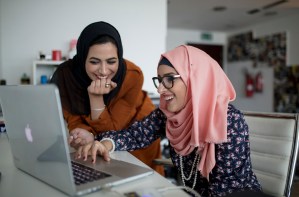
Assignment Description
1. Gain insights into the banks business case for offering non-financial services (NFS) to SMEs broadly and in particular to women-SMEs and its impact on FI business growth and sustainability.
2. Understand how entrepreneurs usage of non-financial services offered by financial institutions (i) have an impact on the businesses as well as on family in the case of women entrepreneurs and (ii) how it translates into portfolio expansion and enhanced quality, business growth and profitability for the financial institution.
3. The study will include review of a broad set of banks and financial institutions that serve SMEs to capture practices that have been successful for SMEs in general which can be adapted and applied to benefit women SMEs/womens markets.
Tackling climate change in the poorest countries
How can we help the poorest countries deal with climate change? The challenge is huge. Globally, the last three years were the hottest on record. Emissions of carbon dioxide from fossil fuels and industry started rising again in 2017 after briefly leveling off. Many regions are experiencing more severe and frequent storms, floods, and drought. According to the latest Intergovernmental Panel on Climate Change report, the climate consequences of a 2°C warmer world are far greater than for a rise of 1.5°C, and we are not on track for either.
Recognizing the urgent need for more action, the World Bank Group announced new and ambitious targets for our climate work with developing countries at COP24, this month’s global climate change conference in Katowice, Poland.
eC2: Next generation drought index conceptual study
Deadline: 09-Jan-2019 at 11:59:59 PM (Eastern Time – Washington D.C.) 
Assignment Description
The proposed study consists in taking stock of current existing datasets and technologies, identifying their potential and limitations and enhancing or developing new, robust index or set of indicators specifically for crop insurance (or financial) applications. Latest satellite technology will in particular be explored.
Riding the Climate Storm in Patagones, Argentina
When 31-year old Hipolito de Carmony, a third-generation farmer, wants to explain why 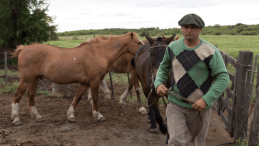 he introduced change in the management of his family’s land, he pulls out a picture of a giant dust storm that swept through the area of Patagones, about 1,000 km south of the city of Buenos Aires, in January 2010.
“We couldn’t see from one house to the other. Even with the doors and windows shut, we had to constantly sweep layers of fine dust,” he said.
The ongoing impact of ‘nudging’ people to pay their taxes
Sustainability is the holy grail of development. There are many interventions that yield  positive results in the short term but somehow fail to be sustained over time. This is why the experience in Guatemala that we are about to describe is worth paying attention to. In short, it shows that behavioral insights can lead to lasting change.
Newsletter December 2018: Impacting Development
NL4WorldBank December 2018 edition of the NL4WorldBank newsletter is out! 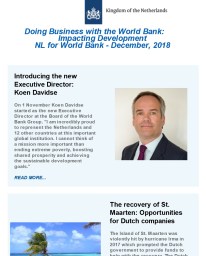
Impacting Development which was published on the 18th of December.
Get creative: Join the World Bank Group and Financial Times’ blog writing competition for high school students
Do you often wonder what kind of job you will have when you grow up? Do you think 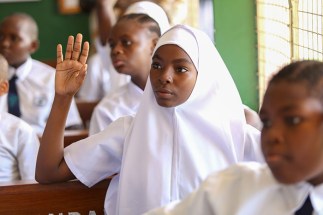 your school is preparing you for the work you may do in the future? What will classrooms and teachers of the future be like? Do you think there are better ways to learn? Do you have inspired and imaginative ideas to re-invent education? Are you between the ages of 16 and 19 and currently enrolled in high school or a secondary education institution?
Lack of Health Care is a Waste of Human Capital: 5 Ways to Achieve Universal Health Coverage By 2030
When Cecilia Rodriguez was diagnosed with rheumatoid arthritis, an autoimmune  disease that causes inflammation and pain in the joints, eight years ago, she had a major revelation. She realized that what she was promoting as director of a primary health care facility in Chile was very different than what she actually needed as a patient.
In response, she founded the nonprofit Fundación Me Muevo with her sister, who also has rheumatoid arthritis, to support people affected by the chronic condition. She also became a patient advocate — Me Muevo is part of a growing movement of patient-led organizations in Chile. “Health care systems tend to be geared towards treating acute illnesses and are rarely organized to help patients with lifelong diseases,” Cecilia says. “We called the NGO Me Muevo (‘I move’) because we learned that with this condition you have to keep your body moving, but also because ‘I move’ means ‘I take action.’”
eC2: FLOOD RISK AND COASTAL ASSESSMENT OF THE TOCUMEN RIVER
Deadline: 20-Dec-2018 at 11:59:59 PM (Eastern Time – Washington D.C.)
This consultancy assignment focuses on the carrying out of a comprehensive flood and coastal risk assessment for the Tapia and Tocumen River basins. The flood hazard and risk analysis should provide information that could help inform urban planning, including options for identifying areas unsuitable for urban expansion. It is important to note that this work will produce a general overview assessment of flood risk and an analysis of risk mitigation options. Further detailed site-specific analysis will be conducted by the country authorities when determining specific vulnerability, risk and mitigation actions, as well as cost estimate as and when they decide to pursue further action.


You must be logged in to post a comment.