eC2: Executive Education: Disaster Risk Financing and Insurance

Deadline: 30-Nov-2017 at 11:59:59 PM (Eastern Time – Washington D.C.) vn-communitybased-disasterrisk-780x439

Objective: The objective is to develop a 4-day modular capacity building program on Disaster Risk Financing(DRF)to enhance understanding of DRF strategies and instruments for protection from natural disasters, embedded in the broader Disaster Risk Management and fiscal risk management frameworks, and build the skills of stakeholders to design and implement such strategies.

Continue reading →

Insights: How Do Policymakers Learn and Adapt Today?

Deadline: 26-Nov-2017 at 11:59:59 PM (Eastern Time – Washington D.C.)

Objective: The goal of this work is to re-assess and update CGAPs understanding of how policymakers in low capacity and low income countries take in information and knowledge that helps them perform and adapt. This work would help CGAP and its partners re-affirm and/or update our assumptions about how regulators, supervisorspolitics and other policy-makers build their capacity and how organizations supporting capacity building can or should reach this audience. The task would be to undertake a well-constructed perspective gathering exercise through needs analysis of a carefully selected group of policymakers representing different regional, hierarchical and demographic profiles that reflect well CGAPs and its partners target audience(s) in Latin America, Sub-Saharan Africa, Middle East, South Asia and East Asia. This perspective gathering conducted through desk research, surveys, interviews and the like would be further complemented by insights collected from a range of partners and other stakeholders.
Continue reading →

Commodity prices likely to rise further in 2018: World Bank

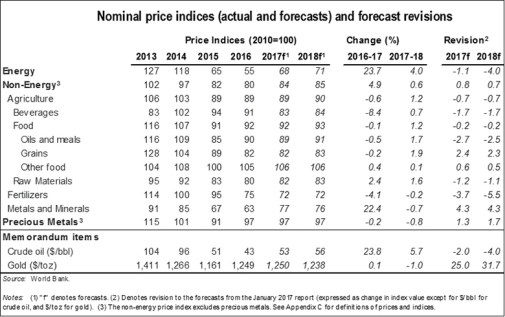
CMO2017c_PR_table01Oil prices to average $56 a barrel in 2018, up from 2017 average of $53/bbl

WASHINGTON, October 26 – Oil prices are forecast to rise to $56 a barrel in 2018 from $53 this year as a result of steadily growing demand, agreed production cuts among oil exporters and stabilizing U.S. shale oil production, while the surge in metals prices is expected to level off next year, the World Bank said on Thursday.

Continue reading →

Data for Development: An Evaluation of World Bank Support for Data and Statistical Capacity

Data-for-Development_cover-image_webData and evidence are the foundation of development policy and effective program implementation, and countries need data to formulate policy and evaluate progress.
At the global level, the World Bank has a strong reputation in development data and has been highly effective in data production. It produces influential, widely used data and cross-country indicators that fill important niches, benchmark countries, and stimulate research and policy action.

Continue reading →

How Should Governments and Development Institutions Engage the Private Sector?

TonyElumeluBlog post by Tony Elumelu ( Entrepreneur and philanthropist )

Across the globe, the private sector has an important role to play in the achievement of the SDGs. With slow global growth and the end of the commodity supply cycle, many governments do not have resources required to fully pursue their development goals. And this is where the resources of the private sector become very critical. Through partnerships, the private and public sector can discover areas of alignment, especially in critical areas such as infrastructure, power, and agriculture, to mention but a few.

Continue reading →

World Bank warns of ‘learning crisis’ in global education

World Bank buildingWorld Development Report 2018 calls for greater measurement, action on evidence


WASHINGTON, September 26, 2017 – Millions of young students in low and middle-income countries face the prospect of lost opportunity and lower wages in later life because their primary and secondary schools are failing to educate them to succeed in life. Warning of ‘a learning crisis’ in global education, a new Bank report said schooling without learning was not just a wasted development opportunity, but also a great injustice to children and young people worldwide.

Continue reading →

Dar es Salaam Flood Risk Evaluation and Scenarios Dashboard

Deadline: 07-Nov-2017 at 11:59:59 PM (Eastern Time – Washington D.C.) water

Objective:  Design and implement a probabilistic flood loss evaluation for the city of Dar es Salaam and Flood Hazard and Risk Scenarios Dashboard for use by basin and municipal authorities as well as local universities. The risk model is expected to evaluate hazard, vulnerability and losses to flooding including storm surges at river basins and possibly ward administrative boundaries for the entire metropolitan area. This is expected to cover 400km2 with more details areas of interest to be defined in the terms of reference. The scenarios dashboard is intended as a decision making and planning tool for local authorities and universities to visualize and query the hazard and risk information and generate selected flood risk scenarios include reference climate scenarios. Design and development is expected to follow an iterative process with government stakeholders and academia and include a strong focus on training and knowledge transfer. Outputs will include detailed loss evaluations reports for the municipal authorities as well as the training in and handover of a locally appropriate Scenarios Visualization Dashboard.


Continue reading →

eC2: Geohazard risk management and resilient road asset management in Nepal

Deadline: 06-Nov-2017 at 11:59:59 PM (Eastern Time – Washington D.C.)

Objective: The main objectives of the proposed technical assistance are to inform the prioritization of future climate and seismic resilient investments in road assets in Nepal. The objective will be achieved through applying a climate and seismic vulnerability assessment on Jumla-Surket road and bridges in central Nepal, proposing mitigation measures and improving climate and seismic resilient design, construction and maintenance standards for national roads and local roads.

maxresdefault.jpg

Continue reading →

eC2: Assessing the current losses and improving the economic analysis of the costs of the on-going climate related catastrophic forestry events based on international experience

climate.jpgDeadline: 16-Oct-2017 at 11:59:59 PM (Eastern Time – Washington D.C.)

Objective: The World Bank seeks consultant services to carry out two analytical activities under Component 1: a. Review the amount of damage in terms of damaged and destroyed forest stock and other losses (e.g. erosion, soil loss, loss of non-timber forest products, impact on wildlife and game), how the clear up, salvage and recovery operations were planned and are being implemented. b. Improve the economic analysis of the costs of on-going climatic related catastrophic forestry events, e.g. fire, wind, snow, ice.

Continue reading →

Annual Meetings 2017: join the World Bank Live!

Next week, the Annual Meetings of the World Bank Group and the International Monetary Fund (IMF) take place from upcoming October 10 to October 14  in Washington DC. During this meetings the Board of Governs of the attentive organizations will debate in the field of topics associated with poverty reduction, international economic development and finance.

AM17-logo

In order to make these meetings accessible for the wide audience, World bank Live will daily stream several events in different languages such as English, Spanish, French and Arabic.  The subjects of the Flagship events of the Annual Meetings vary from Human Capital Summit to digital economy and education. If you are interested within accompany the dialogues through the broadcast of Worldbank live, check out the whole program here and join the World Bank’s Live online event. You are also able to submit questions before the events. Below you will find a short selection of these upcoming events concurrently with the Annual Meetings 2017.

Continue reading →