eConsultant2: Review and analysis of current forestry-related legislation, institutional and administrative structure

Deadline: 08-Dec-2015 at 11:59:59 PM (Eastern Time – Washington D.C.)

Current assignment suggests: Forestry
Review the existing forestry and main related legislation and regulations in order to identify existing gaps, conflicts and discrepancies; Identify options for changes and amendments based on findings; Prepare a set of recommendations to serve as a base for the Ministry to further draft the amendments for various related legislation to the Ministry of Agriculture, which will be in charge of presenting the amendments for the Parliaments approval;
Review the existing institutional arrangements of the responsible forest authority (Hayantar SNCO), identify strengths and weaknesses, as well as possible duplications with various state forest authorities; and prepare a set of recommendations on how to improve the existing institutional arrangements for the forest agency.

Continue reading

IFC and Dutch investment banks team up… again!

IFC and the DutchData released by the International Finance Corporation (IFC), the private sector arm of the World Bank Group, shows that three Dutch banks were among the largest co-investors of the IFC in Fiscal Year 2015. Additionally, of the entire IFC portfolio, two of the five largest co-financiers were Dutch. Continue reading

Sustainable Agricultural Development

Technology Drives Sustainable Agricultural Development in China

Below an interesting and enlightening story about farmers in China who are able to raise their income through sustainable farming. The sustainable farming has been made possible by a World Bank project which is geared towards subsidizing certain purchases made by farmers.

_DSC8598

Read the full article here.

eConsultant2: Tender extended: Competitive Assessment of Colombian Palm Oil in International Trade

Deadline: 06-Nov-2015 at 11:59:59 PM (Eastern Time – Washinsouth_africagton D.C.)

The Dutch (RVO) funded Colombia palm oil project is gaining speed and the team has now published a call for expressions of interest. Given the RVO funding the IFC would very much welcome Dutch consultants.

The aim of this assessment is to identify and examine the factors affecting the performance of Colombian palm oil-based products in the international market, and analyze the gap between the current and possible future conditions in the Colombian industry.

Continue reading

Investing in agricultural risk management

By any measure, agriculture is risky senegal_sdgs_blogbusiness. It is also vital to ensuring food security and providing employment for 2.6 billion people worldwide, the vast majority of whom are subsistence farmers. Producing more than two-thirds of all food consumed worldwide on roughly half of the world’s arable land, these farmers are also the poorest, the most vulnerable, the most food insecure on earth.

The World Bank is spearheading a global initiative to promote a better understanding of agricultural risks, as well as effective pathways to improved risk management. In addition to enabling agriculture risk knowledge sharing through the FARMD platform, the Bank has worked with nearly 20 countries to help agricultural stakeholders better comprehend the complexity of risks. This knowledge aids the selection of risk mitigation, transfer, and coping investments.

Based on this experience, the Bank has developed the Agricultural Sector Risk Assessment (ASRA), Continue reading

IFC Reengagement with the Central African Republic’s Private Sector

This article was originally published on the IFC website.

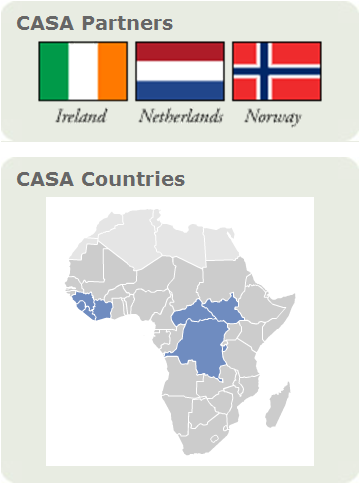
As part its efforts to re-engage with the CASACentral African Republic, IFC, a member of the World Bank Group, supported the organization of a five-day national forum on private sector development presided over by Catherine Samba-Panza, the country’s transitional Head of State. The forum was co-financed by IFC’s Conflict Affected States in Africa Initiative (CASA), which is supporting private sector growth in nine fragile countries in Africa (Burundi, CAR, Côte d’Ivoire, DR Congo, Guinea, Liberia, Mali, Sierra Leone, South Sudan). CASA is supported by donor partners Ireland, the Netherlands, and Norway.

Workshops during the forum focused on forestry, mining and agriculture as key development sectors, and introduced a public-private partnership (PPP) model to infrastructure development. Other key issues discussed included taxation, investment incentives, women entrepreneurship, and inclusion in the regional economy. IFC has previously worked with public and private sector partners in the CAR to improve the investment climate and support small business growth, particularly in and around the capital, Bangui.

Jean Christophe Carret, World Bank Country Manager for the CAR, said, “The World Bank Group is open to re-engagement with key internal and external stakeholders in the CAR to promote private sector-led growth through support to the health and infrastructure sectors, including transport and energy.” The forum’s goals included identifying bottlenecks hindering the development of the private sector, and nurturing a new economic development approach for the country


Building Resilience: Agribusiness Feeding the World Sustainably

Article originally published in the IFC’s Annual Report 2015.

By 2050, the worldwide demand Agrabusiness-Story-Bannerfor food and crops will double. That poses a formidable challenge for the global community: how to feed the world’s expanding population without depleting its already scarce resources.

IFC is partnering with the private sector to address the challenge. Through our agribusiness investments, we aim to increase the supply of affordable and nutritious food, and ensure it is available to those who need it most.

In FY15, our agribusiness-related investments across the food supply chain totaled $3.2 billion, including funds mobilized from other investors. These investments in production, food processing, logistics, and distribution helped benefit 3.4 million farmers worldwide.

Continue reading

Ethiopia – Second Agricultural Growth Project signed

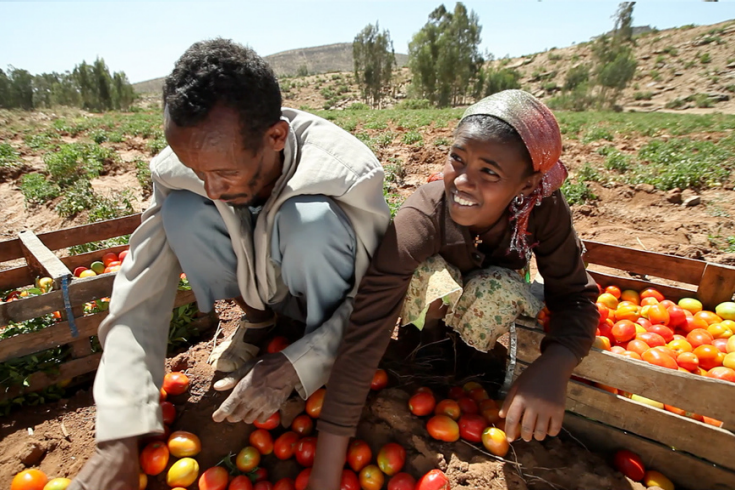
Ethiopia’s second agricultural growth Ethiopia agproject, which was adopted by the World Bank Board of Directors on March 31, 2015, has now been signed. The project involves a total of $365 million, of which $350 million is provided by the World Bank.

The development objective of the Second Agricultural Growth Project for Ethiopia is to increase agricultural productivity and commercialization of small holder farmers targeted by the project. The project comprises of five components: Continue reading

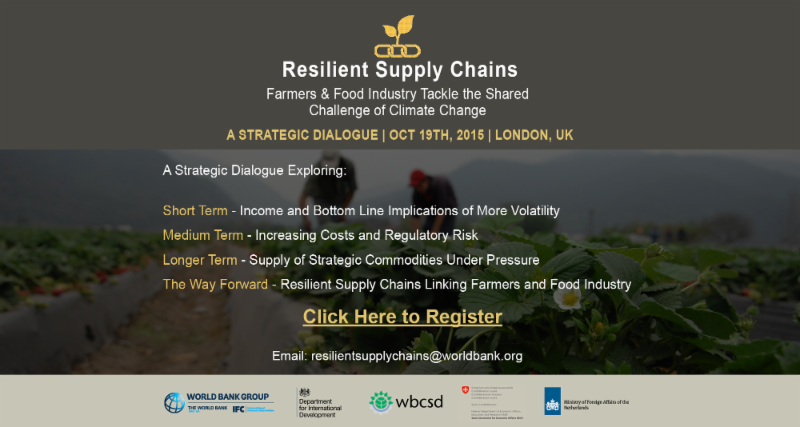
Resilient Supply Chains – A Strategic Dialogue (London, 19 October 2015)

Resilient Supply Chains – Farmers & Food Industry Tackle the Shared Challenge of Climate Change – A Strategic Dialogue (London, 19 October 2015)

Climate change brings significant, resilient supply chainsconcrete and near-term impacts for farmers and food companies’ bottom lines alike. The objective of this strategic dialogue is to bring leaders from both groups together to discuss their shared climate change challenges: Continue reading

eConsultant2: Let’s Work Zambia – Strengthening Value Chains for Jobs

As part of the wider Lets Work program in production__south_africa_2Zambia, which aims to support job creation in partnership with the private sector, the World Bank intends to contract a consultancy to carry out a series of jobs-focused value chain studies in Zambia. This program will be managed by the Lets Work Program through the Jobs CCSA. Lets Work is a global partnership dedicated to providing effective solutions to the jobs challenge by harnessing the private sectors role in creating more, better jobs that are inclusive.

Expression of Interest Deadline: 21-Sep-2015 at 11:59:59 PM (Eastern Time – Washington D.C.)

Continue reading