
There are about 68.5 million forcibly displaced people in the world today, of which more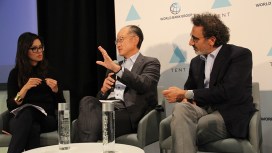 than 25 million are considered refugees.
 Almost 85 percent of them are hosted by low or middle countries with limited resources such as Jordan, Ethiopia, Uganda, Turkey, and Bangladesh. These countries face enormous challenges in meeting the needs of refugees while continuing to grow and develop themselves.
eC2: Developing financial product(s) to address the needs of agri value chain actors, in partnership with a Bank.
Deadline: 15-Oct-2018 at 11:59:59 PM (Eastern Time – Washington D.C.)
Assignment Description: Through this assignment, IFC seeks to create a synergy of all the Banks subsidiary (Banks, Microfinance, Insurance) institutions, to develop an integrated solution for addressing the financing, payment, and insurance needs of value chain actors, especially cooperatives and farmers. The product development firm will be expected to define and lead the entire product(s) development cycle including needs assessment, product(s) concepts design and evaluation, business modelling, actual product(s) development, product(s) documentation, testing, training design, and commercialization strategy framework.
Powering New Markets for Battery Storage
STORY HIGHLIGHTS
- A new, first-of-its-kind $1 billion World Bank Group program aims to help fast-track investments in battery storage, so it can be deployed affordably and at scale in middle-income and developing countries, including some of the fastest growing economies in the world.
- Battery storage allows for wind and solar energy to be used at a much greater scale by making it possible to store electricity and use it when it is needed most.
- The program, which is expected to mobilize another $4 billion, will help countries leapfrog to a new era of energy technology and improve their energy security and grid stability while bolstering global efforts to transition to clean energy.
eC2: Development of quantitative and actuarial tools for disaster risk financing and insurance
Deadline: 22-Oct-2018 at 11:59:59 PM (Eastern Time – Washington D.C.)
The Disaster Risk Financing and Insurance Program (DRFIP) is seeking support from a firm in the specification, development and validation of quantitative and actuarial tools (likely in MS Excel). The tools will be used in disaster risk financing and insurance capacity building and decision making. The tools should draw on current international best practice in user interface design, user experience, visualization, transparency and quality in coding, and probabilistic financial and actuarial and economic analysis.
eC2: BANGLADESH RURAL ELECTRIFICATION PROGRAM: FINANCIAL SUSTAINABILITY REVIEW
Deadline: 11-Oct-2018 at 11:59:59 PM (Eastern Time – Washington D.C.)
Assignment Description: Assess financial sustainability of BREB and PBSs; develop pathways and actions plans to meet universal access target by 2021; and ensure financial sustainability of the institutions going forward.
eC2: Impact Evaluation of Ethiopia Resilient Landscapes and Livelihoods Project
Deadline: 11-Oct-2018 at 11:59:59 PM (Eastern Time – Washington D.C.)
Assignment Description: The WB research team is seeking to contract a survey firm that will carry out an initial data collection exercise that will form part of the impact evaluation. This initial data collection will comprise a listing of all households in a selected subset of kebeles this will serve as a sampling frame for future data collection activities in the study. The listing will collect basic information on household characteristics and will include approximately 12,000 households. Each household interview is expected to last 30-45 minutes.
eC2: Water footprint assessment for clients in India MAS agribusiness advisory
Deadline: 09-Oct-2018 at 11:59:59 PM (Eastern Time – Washington D.C.) 
Assignment Description
IFC is seeking to recruit a specialist agency for conducting water footprint assessment in the value chains of three companies in India under the IFC MAS South Asia agribusiness advisory projects.
eC2: INDONESIA Health Security Financing Assessment
Deadline: 08-Oct-2018 at 11:59:59 PM (Eastern Time – Washington D.C.)![medical-appointment-doctor-healthcare-clinic-health-hospital-medicine[7]](https://nl4worldbank.org/wp-content/uploads/2015/09/medical-appointment-doctor-healthcare-clinic-health-hospital-medicine7.jpg?w=219&h=146)
Indonesia has made substantial progress on implementing the International Health Regulation (IHR) 2005 and just conducted a Joint External Evaluation (JEE) which identified priority gaps to improve its IHR core capacities. Recognizing the need for sustainable financing for health security, Indonesia is committing to taking part on a health security financing assessment. The World Bank is providing technical assistance to the Government of Indonesia to implement the health financing security assessment tool (HSFAT) that has been developed for countries conduct the assessment. The assignment is focusing on the following (i) quantitative analysis of the Financing for Health Security Components, especially at the sub national level (Province and District level); (ii) qualitative information on planning and budgeting processes, organization arrangement, and (iii) case study on recent outbreak in Indonesia. Data collection will be done in selected provinces (probably 2) and one district from each selected province.
For this assignment, the firm will be working in close coordination with the World Bank team currently working on the Central level health security financing.
The firm will work with the Technical Task Force (TTF) to involve other relevant agencies in both the public, private sectors and community based organization that need to be included in the assessment.
eC2: Agri-processing resource efficiency in South Africa – Stakeholder mapping and needs assessment
Deadline: 10-Oct-2018 at 11:59:59 PM (Eastern Time – Washington D.C.) 
IFC seeks to procure the services of a consulting firm to conduct stakeholder mapping and needs assessment as part of work that aims to improve water efficiency in South Africa’s agri-processing sector by promoting water and energy efficiency technologies and practices, alternative water resource development, water reuse and recycling, and improved wastewater management. The stakeholder mapping and needs assessment will result in mapping of firms, identification of opportunities for improving water efficiency (and related energy efficiency), an assessment of knowledge needs and gaps, an assessment of the policy and regulatory environment, and prioritization of interventions to support an enabling environment for water efficiency (expected to focus at the municipal level).
 Netherlands for the World Bank
You must be logged in to post a comment.