
 When it comes to infrastructure projects, “unsolicited proposals” (USPs) represent an alternative to the traditional project initiation method where the private sector, rather than the government, takes the leading role in identifying and developing a project. In practice, many public authorities across the world resort to USPs motivated by the perspective of solving the challenges brought by their lack of capacity to identify and develop projects. However, many projects that originate as USPs experience challenges, including diverting public resources away from the strategic plans of the government, providing poor value for money, and leading to patronage and lack of transparency, particularly in developing countries. To ensure governments can mobilize the strengths of the private sector while protecting the public interest, USPs, when accepted, should be managed and used with caution as an exception to the public procurement method.
Category Archives: WBG News & Reports
Save the Date: Water Mission, Washington, DC, June 4-6, 2018
 The Private Sector Liaisons of Spain, Germany, Austria, and the Netherlands invite you to mark your calendar for June 4-6, 2018 for a joint mission focusing on the Water sector opportunities at the International Financial Institutions: World Bank Group (WBG), Inter-American Development Bank (IADB), and the Millennium Challenge Corporation (MCC).
Meet the World Bank- Sophie Peeters
 What is your role within the World Bank?
In 2016, I moved from the Netherlands to work as a consultant with the Information & Technology Solutions (ITS) Department, which delivers transformative information technologies to World Bank Group staff. I am a core team member of the newly launched Technology & Innovation Lab that experiments with innovative technologies that have the potential to improve the World Bank Group’s internal operations and operational work in client countries. We are developing use cases and proof of concepts for the use of blockchain technology and artificial intelligence (AI) in areas like health, cross-border payments, agriculture, and land administration, among others. I support the Innovation Leads by meeting with clients and performing business analysis for each use case, but I also lead some external partnerships with experienced leaders in this area, like the Dutch Blockchain Coalition. It has been an exciting journey and incredible experience to work with a close and diverse team in exploring these new technologies together with different units across the World Bank Group.
Land and Poverty Conference 2018: Land Governance in an Interconnected World
 Every year the Netherlands is represented by NGO’s , Universities , Government Institutions and the private sector at the Land and Poverty conference organized by the World Bank. The conference has become one of the largest international events on land governance, attracting over 1,300 participants in 2017 from governments, academics, civil society, and the private sector. The topic of land governance is an area the Dutch have been worldwide leaders, represented and leading the way at the conference are Kadaster and the University of Maastricht. The 2018 conference theme will be: Land Governance in an Interconnected World the aforementioned organizations will be presenting on the use of Block chain technology.
The 2018 Fragility Forum: Managing risks for peace and stability
 In just under two weeks, about 1,000 people will gather in Washington D.C. for the 2018 Fragility Forum
 . Policy makers from developed and developing countries, practitioners from humanitarian agencies, development institutions and the peace and security communities, academics and representatives of the private sector will come together with the goal of increasing our collective impact in countries affected by fragility, conflict and violence (FCV).
Demystifying technologies for digital identification
 With more than 1.1 billion individuals without official proof of identity, a myriad of technologies is advancing at a faster speed than ever before and becoming more affordable, making it possible for nations to leapfrog paper based approaches of the past. Yet, it is becoming a challenge to understand and keep up with the various technologies and advancements that are especially relevant for digital identification systems. Identification for Development (ID4D) launches a new Technology Landscape report providing an overview of current and emerging technology trends in digital identity.
Solar Pumping 101: the what, why, and the how
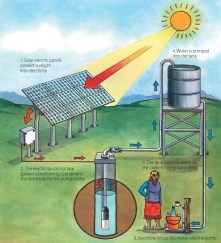 Access to a safe, sustainable water supply is a growing concern in every region of the world. In many communities, groundwater is being pumped by diesel fueled systems, which are both expensive and can be difficult to maintain. In communities where electricity is scarce, solar can be a part of the solution.
The highest demand for solar pumps is among rural off-grid areas, currently underserved, or served by costly fuel-driven pumps. Solar pumping is most competitive in regions with high solar insolation, which include most of Africa, South America, South Asia, and Southeast Asia; but the technology can operate successfully in almost any regions of the world.
Off-grid bringing power to millions
 Picture an island in Bangladesh that is so remote that there is no way the traditional electricity could reach it. Not now, and probably not anytime soon. That was the situation in Monpura just a few years ago – but not today.
Today, Monpura is thriving, thanks to solar power. Markets are abuzz, households can power TVs, fans and even refrigerators, and streets are lit up at night. In fact, solar home systems have helped take electricity to more than 20 million people in rural Bangladesh.
Uniquely Human: The Centrality of Humanism in the Future Workforce
 My nephew Reuben was born on December 9, 2017. Reuben is a member of generation Alpha, a cohort that is younger than smartphones, cryptocurrency, and synthetic human cells. Reuben was born in Australia only a few short months after Sophia became the first robot citizen of Saudi Arabia. Reuben will take his first steps in a pair of self-tying shoes to walk into a world of self-driving (maybe even flying!?) cars, digital assistants, and augmented reality.
How much does it cost to create a job?
 Creating more and better jobs is central to our work at the World Bank and a shared goal for virtually all countries —developed and developing alike. But oftentimes the policy debate turns to the cost and effectiveness of programs and projects in creating jobs.
As an example, I recently found myself in the middle of a discussion regarding a development project aimed at creating employment: one of the reviewers objected given that the cost per job created was too high. “More than $20,000 per job,” he said, comparing it to much lower numbers (between $500 and $3,000 per job) usually associated with active labor market programs such as training, job search assistance, wage subsidies, or public works. Continue reading
 Netherlands for the World Bank
You must be logged in to post a comment.