
 The Private Sector Liaisons of Spain, Germany, Austria, and the Netherlands invite you to mark your calendar for June 4-6, 2018 for a joint mission focusing on the Water sector opportunities at the International Financial Institutions: World Bank Group (WBG), Inter-American Development Bank (IADB), and the Millennium Challenge Corporation (MCC).
Yearly Archives: 2018
Meet the World Bank- Sophie Peeters
 What is your role within the World Bank?
In 2016, I moved from the Netherlands to work as a consultant with the Information & Technology Solutions (ITS) Department, which delivers transformative information technologies to World Bank Group staff. I am a core team member of the newly launched Technology & Innovation Lab that experiments with innovative technologies that have the potential to improve the World Bank Group’s internal operations and operational work in client countries. We are developing use cases and proof of concepts for the use of blockchain technology and artificial intelligence (AI) in areas like health, cross-border payments, agriculture, and land administration, among others. I support the Innovation Leads by meeting with clients and performing business analysis for each use case, but I also lead some external partnerships with experienced leaders in this area, like the Dutch Blockchain Coalition. It has been an exciting journey and incredible experience to work with a close and diverse team in exploring these new technologies together with different units across the World Bank Group.
Land and Poverty Conference 2018: Land Governance in an Interconnected World
 Every year the Netherlands is represented by NGO’s , Universities , Government Institutions and the private sector at the Land and Poverty conference organized by the World Bank. The conference has become one of the largest international events on land governance, attracting over 1,300 participants in 2017 from governments, academics, civil society, and the private sector. The topic of land governance is an area the Dutch have been worldwide leaders, represented and leading the way at the conference are Kadaster and the University of Maastricht. The 2018 conference theme will be: Land Governance in an Interconnected World the aforementioned organizations will be presenting on the use of Block chain technology.
eC2: Formative research and social and behavioral change communication to promote improved water, sanitation and hygiene behaviors in rural
Deadline: 22-Mar-2018 at 11:59:59 PM (Eastern Time – Washington D.C.)
Objective: The objective of the assignment is to assist the MRD and key stakeholders in the rural WASH sector to develop a SBCC package to promote improved WASH behaviors, with a focus on child-centered behaviors that have the potential to reduce child stunting. The WASH behaviors to be included in the SBCC package consist of (i) promoting latrine adoption among rural households, (ii) promoting Handwashing with Soap (HWWS) among caretakers and children, and (iii) promoting correct Household Water Treatment and Safe Storage (HWTS) for drinking and for preparing infant formula and food. To achieve the above objectives, the assignment requires completion of the following tasks: 1) conducting spot research on behavior related to HWWS of caretakers and children; and HWTS for drinking and for preparation of infant formula and weaning foods; 2) developing an overarching umbrella concept and brand to be used for all future WASH campaigns; and 3) developing a package of behavior-specific SBCC materials to promote latrine adoption, correct HWWS and HWTS.
eC2:Agriculture sector and crop value chains mapping and finance gap assessment in Sierra Leone and Senegal
 Deadline: 21-Mar-2018 at 11:59:59 PM (Eastern Time – Washington D.C.)
Objective: The IFCs FIG aims to reduce the agribusiness finance gap in emerging markets and achieve large-scale food-supply impact in Sierra Leone and Senegal, by providing financial institutions (FIs) with Investment and Advisory Services. FIG would like to hire a consulting firm to carry out a mapping exercise of the agricultural sector and some pre-selected crop value chains, aligned to the agricultural development policy and/ or strategy of the country. This will include a detailed analysis of the value chain actors and facilitators, the role and impact of FIs (banks, micro-finance institutions, savings and credit co-operatives) and an assessment of the existing and potential financial services delivery channels, especially agency banking and DFS, with respect to rural smallholder farmers.
Continue reading
eC2:Agriculture sector and crop value chains mapping and finance gap assessment in Mozambique and Malawi
Deadline: 21-Mar-2018 at 11:59:59 PM (Eastern Time – Washington D.C.) 
Objective: The IFCs FIG aims to reduce the agribusiness finance gap in emerging markets and achieve large-scale food-supply impact in Mozambique and Malawi, by providing financial institutions (FIs) with Investment and Advisory Services. FIG would like to hire a consulting firm to carry out a mapping exercise of the agricultural sector and some pre-selected crop value chains, aligned to the agricultural development policy and/ or strategy of each country. This will include a detailed analysis of the value chain actors and facilitators, the role and impact of FIs (banks, microfinance institutions, Savings and Credit Co-operatives) and an assessment of the existing and potential financial services delivery channels, especially agency banking and DFS, with respect to rural smallholder farmers.
The 2018 Fragility Forum: Managing risks for peace and stability
 In just under two weeks, about 1,000 people will gather in Washington D.C. for the 2018 Fragility Forum
 . Policy makers from developed and developing countries, practitioners from humanitarian agencies, development institutions and the peace and security communities, academics and representatives of the private sector will come together with the goal of increasing our collective impact in countries affected by fragility, conflict and violence (FCV).
Demystifying technologies for digital identification
 With more than 1.1 billion individuals without official proof of identity, a myriad of technologies is advancing at a faster speed than ever before and becoming more affordable, making it possible for nations to leapfrog paper based approaches of the past. Yet, it is becoming a challenge to understand and keep up with the various technologies and advancements that are especially relevant for digital identification systems. Identification for Development (ID4D) launches a new Technology Landscape report providing an overview of current and emerging technology trends in digital identity.
Solar Pumping 101: the what, why, and the how
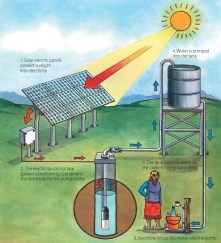 Access to a safe, sustainable water supply is a growing concern in every region of the world. In many communities, groundwater is being pumped by diesel fueled systems, which are both expensive and can be difficult to maintain. In communities where electricity is scarce, solar can be a part of the solution.
The highest demand for solar pumps is among rural off-grid areas, currently underserved, or served by costly fuel-driven pumps. Solar pumping is most competitive in regions with high solar insolation, which include most of Africa, South America, South Asia, and Southeast Asia; but the technology can operate successfully in almost any regions of the world.
Off-grid bringing power to millions
 Picture an island in Bangladesh that is so remote that there is no way the traditional electricity could reach it. Not now, and probably not anytime soon. That was the situation in Monpura just a few years ago – but not today.
Today, Monpura is thriving, thanks to solar power. Markets are abuzz, households can power TVs, fans and even refrigerators, and streets are lit up at night. In fact, solar home systems have helped take electricity to more than 20 million people in rural Bangladesh.
 Netherlands for the World Bank
You must be logged in to post a comment.