eC2: Formative research and social and behavioral change communication to promote improved water, sanitation and hygiene behaviors in rural

Deadline:  22-Mar-2018 at 11:59:59 PM (Eastern Time – Washington D.C.)

Objective:  The objective of the assignment is to assist the MRD and key stakeholders in the rural WASH sector to develop a SBCC package to promote improved WASH behaviors, with a focus on child-centered behaviors that have the potential to reduce child stunting. The WASH behaviors to be included in the SBCC package consist of (i) promoting latrine adoption among rural households, (ii) promoting Handwashing with Soap (HWWS) among caretakers and children, and (iii) promoting correct Household Water Treatment and Safe Storage (HWTS) for drinking and for preparing infant formula and food. To achieve the above objectives, the assignment requires completion of the following tasks: 1) conducting spot research on behavior related to HWWS of caretakers and children; and HWTS for drinking and for preparation of infant formula and weaning foods; 2) developing an overarching umbrella concept and brand to be used for all future WASH campaigns; and 3) developing a package of behavior-specific SBCC materials to promote latrine adoption, correct HWWS and HWTS.

Continue reading

eC2:Agriculture sector and crop value chains mapping and finance gap assessment in Sierra Leone and Senegal

pexels-photo-264537.jpegDeadline:  21-Mar-2018 at 11:59:59 PM (Eastern Time – Washington D.C.)

Objective: The IFCs FIG aims to reduce the agribusiness finance gap in emerging markets and achieve large-scale food-supply impact in Sierra Leone and Senegal, by providing financial institutions (FIs) with Investment and Advisory Services. FIG would like to hire a consulting firm to carry out a mapping exercise of the agricultural sector and some pre-selected crop value chains, aligned to the agricultural development policy and/ or strategy of the country. This will include a detailed analysis of the value chain actors and facilitators, the role and impact of FIs (banks, micro-finance institutions, savings and credit co-operatives) and an assessment of the existing and potential financial services delivery channels, especially agency banking and DFS, with respect to rural smallholder farmers.
Continue reading

eC2:Agriculture sector and crop value chains mapping and finance gap assessment in Mozambique and Malawi

Deadline: 21-Mar-2018 at 11:59:59 PM (Eastern Time – Washington D.C.) agriculture-youth

Objective: The IFCs FIG aims to reduce the agribusiness finance gap in emerging markets and achieve large-scale food-supply impact in Mozambique and Malawi, by providing financial institutions (FIs) with Investment and Advisory Services. FIG would like to hire a consulting firm to carry out a mapping exercise of the agricultural sector and some pre-selected crop value chains, aligned to the agricultural development policy and/ or strategy of each country. This will include a detailed analysis of the value chain actors and facilitators, the role and impact of FIs (banks, microfinance institutions, Savings and Credit Co-operatives) and an assessment of the existing and potential financial services delivery channels, especially agency banking and DFS, with respect to rural smallholder farmers.

Continue reading

The 2018 Fragility Forum: Managing risks for peace and stability

twittercard3c_002In just under two weeks, about 1,000 people will gather in Washington D.C. for the 2018 Fragility Forum. Policy makers from developed and developing countries, practitioners from humanitarian agencies, development institutions and the peace and security communities, academics and representatives of the private sector will come together with the goal of increasing our collective impact in countries affected by fragility, conflict and violence (FCV).

Continue reading

Demystifying technologies for digital identification

Fingerprint Binary MicrochipWith more than 1.1 billion individuals without official proof of identity, a myriad of technologies is advancing at a faster speed than ever before and becoming more affordable, making it possible for nations to leapfrog paper based approaches of the past. Yet, it is becoming a challenge to understand and keep up with the various technologies and advancements that are especially relevant for digital identification systems. Identification for Development (ID4D) launches a new Technology Landscape report providing an overview of current and emerging technology trends in digital identity.

Continue reading

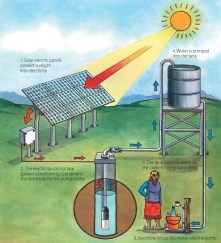
Solar Pumping 101: the what, why, and the how

solar-pumping-handbook-1Access to a safe, sustainable water supply is a growing concern in every region of the world. In many communities, groundwater is being pumped by diesel fueled systems, which are both expensive and can be difficult to maintain. In communities where electricity is scarce, solar can be a part of the solution.

The highest demand for solar pumps is among rural off-grid areas, currently underserved, or served by costly fuel-driven pumps. Solar pumping is most competitive in regions with high solar insolation, which include most of Africa, South America, South Asia, and Southeast Asia; but the technology can operate successfully in almost any regions of the world.

Continue reading

Off-grid bringing power to millions

solar-energyPicture an island in Bangladesh that is so remote that there is no way the traditional electricity could reach it. Not now, and probably not anytime soon. That was the situation in Monpura just a few years ago – but not today.

Today, Monpura is thriving, thanks to solar power. Markets are abuzz, households can power TVs, fans and even refrigerators, and streets are lit up at night. In fact, solar home systems have helped take electricity to more than 20 million people in rural Bangladesh.

Continue reading

eC2: Capacity Building for Integration of Variable Renewable Energy into ZESCO’s Grid Operations

Deadline: 19-Mar-2018 at 11:59:59 PM (Eastern Time – Washington D.C.) India Energy

Objective:  IFC is looking for a consulting firm (the Consultant) to support ZESCO in assessing the integration of variable renewable energy (VRE) into the power system of Zambia. ZESCO is a government-owned electricity utility in Zambia. The assignment aims to build the capacity of ZESCO in relation to the integration of VRE in order to: i) ensure the continued stability of the system as the penetration of variable renewable energy (VRE) increases and ii) ensure the efficient integration of VRE capacity. The scope of work will include a comprehensive review of ZESCO’s existing grid practices in order to determine the infrastructure and operational constraints that have to be addressed to facilitate the targeted levels of VRE penetration. The assignment also includes the identification and practical implementation of a range of measures and system upgrades. In addition, the assignment is to review and recommend improvements to the existing Grid Code for appropriateness for VRE integration.

Continue reading

eC2: Hydraulic study and Environmental Flows (EFlows) Assessment for the Mpatamanga Hydropower Project

HYDRODeadline: 22-Mar-2018 at 11:59:59 PM (Eastern Time – Washington D.C.)
Objective:  IFC is supporting the Government of Malawi (GOM) with the development of the 309 MW Mpatamanga Hydroelectric Project. IFC is proposing to procure a consultant to provide certain services in this regard. The main objective of the services is to confirm the adequacy of the proposed operation pattern for the Mpatamanga HPP. The study is aimed at 1) confirming / identifying acceptable minimum and maximum flow for the daily peaking operations and 2) better defining the extent and impacts of the water level and flow velocity daily fluctuations, especially on important natural ecosystems downstream.

Continue reading

Uniquely Human: The Centrality of Humanism in the Future Workforce

tk2My nephew Reuben was born on December 9, 2017. Reuben is a member of generation Alpha, a cohort that is younger than smartphones, cryptocurrency, and synthetic human cells. Reuben was born in Australia only a few short months after Sophia became the first robot citizen of Saudi Arabia. Reuben will take his first steps in a pair of self-tying shoes to walk into a world of self-driving (maybe even flying!?) cars, digital assistants, and augmented reality.

Continue reading