The newly launched WBG Analyst Program

The newly launched WBG Analyst Program is an early starting point for an exciting career in the World Bank Group (WBG).

The live Q&A will start here on February 24th at 10:00am ET.
young prof

On February 24th, WBG representatives from Human Resources as well as other junior staff currently working at the WBG will take your questions in this newly launched Program. Come and join us in this live chat and learn more about this exciting new employment opportunity.

Continue reading

Renewable Energy Program Investment Preparation – Bangladesh

Bangladesh has recently been selected as one of the 14 new countries for the Scaling up Renewable Energy Program in Low Income Countries (SREP) under the Climate Investment Funds. The objective of the SREP is to pilot and demonstrate the economic, social and environmental viability of development pathways in the energy sector by creating new economic opportunities and increasing energy access through the use of renewable energy.

Continue reading

Dar es Salaam Metropolitan Development Project – Tanzania

Tanzania has experienced strong and rapid economic growth, with its annual GDP growth averaging around seven percent in the last decade. It is expected that this growth trajectory will be sustained with the discovery of natural gas deposits. Tanzania is urbanizing rapidly and its economic development is and will be shaped by its rapid urbanization and its emerging role as a regional hub.
The Tanzania Country Economic Memorandum 2014 emphasized the importance of cities in the economic growth of the country as they are driving the growth of non-farm businesses and can be the gateways to export markets that Tanzania needs to grow.

Continue reading

Dairy Supply Chain Development – Pakistan

International Finance Corporation (IFC) has allocated funding to carry out the consulting assignment to support IFCs project in Punjab Province, Pakistan with the following objectives: Provide support to a selected group of medium size dairy farmers in improving their technical skills, and increase milk productivity levels in terms of quantity per milking animal, and quality of milk produced.

IFC is interested in hiring an international consulting firm, with global expertise in the dairy sector. More specifically, the selected firm should enjoy long standing experience in the area of developing technical content, financial models for dairy farming, and also in conducting farmers support, and training activities in developing countries. This will include group training event, and one-on-one specific engagements, and advice.

See full tender here: Dairy Supply Chain Development – Pakistan

Expression of Interest Deadline: 21 February 2015

WB E-institute course : Frontiers in Development Policy

Dates: February 16, 2015 – March 13, 2014
Application Ends On : February 12, 2015index

The world economy is undergoing a major transformation.The economic crises in Western economies, persistent poverty despite impressive GDP growth in a number of developing countries, and the emerging prominence of Brazil, China, and India hint at changing global dynamics.

Policymakers and development practitioners are facing an increasingly complex array of economic, social, and political challenges.They need a broad-based understanding of the functioning and complexities of the economy as well as an awareness of the latest thinking and approaches to development policy.

The Frontiers in Development Policy course helps address this need. It is designed for future leaders, policymakers, and change agents who are trying to meet the development challenges facing their countries. This practical policy course will distill and disseminate “what we know and don’t know” and will outline the “how to” of reform.

Target Audience:

Policy makers, academics, representatives of donor agencies and civil society organization, students of development economics.

Interested in learning more about development policy click here.

World Bank CFO Badré in the Netherlands

Last week, the World Bank’s Chief Financial Officer (CFO) Bertrand Badré was in the Netherlands for a roadshow covering banks and institutional investors. Accompanied by Frank Heemskerk, the Netherlands Executive Director, he visited potential creditors in the Netherlands. Part of the mission was to look for the financial firepower of Dutch pension funds that can possibly be leveraged by the World Bank Group.

‘We present to ABP and PGGM what we do’, Badré says. ‘Banking isBadre not about making money, but about dealing with future risks. Infrastructure, for instance, is an investment category for institutional investors. We are well-placed to finance infrastructure in developing countries and can leverage investment from institutional investors. Banks are cautious. So we have to turn to pension funds, but also the BlackRocks and AXAs of this world. They don’t come to us, so we go to them.’

Continue reading

Flood Forecasting – India

The World Bank Group is looking for a firm to assist in the development of Flood Forecasting for the Ganges and the Brahmaputra Basins using satellite based precipitation, ensemble weather forecasts, and remotely-sensed river widths and height.

The firm is assigned to implement long-lead time, public-access flood forecasting systems for the Ganges and Brahmaputra basins spanning India, Bangladesh and Nepal utilizing new satellite precipitation estimates and ensemble weather forecasts from multiple centers.

Continue reading

Water Quality Testing – Nigeria

The majority of Port Harcourt residents rely on provision from private boreholes and shallow wells. The water quality from boreholes and shallow wells is not regulated.

The Water and Sanitation Program (WSP) supported in 2013/2014 a Water Quality Testing Study. The water quality data collected were from a structured sample of the full range of water sources used in the city: privately constructed boreholes and shallow wells utility sources, utility water received by customers and vended water.

Continue reading

Fake Seeds Study – Kenya

One of the objectives of the Kenya Agribusiness IC Program is to support the enactment of competitive seed regulations in Kenya in order to unlock private sector led growth of the seed sector. The prevalence of fake seeds has negative consequences on competition in the industry as genuine seed proprietors shy away from the market, and farmers are disillusioned by the low value to their farming operation of the use of improved seed. It is therefore critical to assess the extent of faking of seeds in Kenya in order to be able to design effective interventions to reduce or completely eliminate fake seeds.

Continue reading

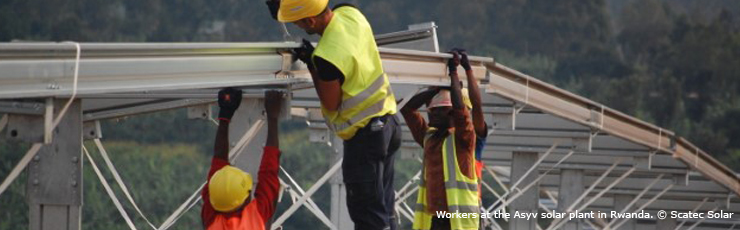
Boosting Solar Energy Capacity in Africa

Press release published on the World Bank website. 

The IFC prides its self on funding innovation, this makes for  interesting opportunities for Dutch companies developing innovative products who are looking for a strong partner.

“We take innovative approaches to our investments, supporting large, potentially transformative projects. We also help developing countries expand the use of cutting-edge technologies, such as concentrated solar power”-

powering-africa-inside-banner

Sub-Saharan Africa is rich in energy resources but its potential remains mostly untapped. Despite the abundance of sunlight, solar projects have been developed slowly and often inefficiently.

Weak competition and high transaction costs are some of the obstacles that hamper the progress of the technology.

Continue reading