
STORY HIGHLIGHTS
- With a national electricity access rate of 84%, Senegal is making progress towards universal energy access, yet more than 30 % of rural communities remain disconnected from the grid.
- As part of the Just Energy Transition Partnership, Senegal has committed to bold reforms to increase renewable energy to 40% of its generation mix by 2030 and expand total generation capacity by 70%.
- The Senegal Energy Access Scale-Up Project is building and rehabilitating nearly 4,000 kilometers of power lines and will bring electricity to 200,000 households, electrify 600 health clinics and 200 schools, and ensure that all distribution infrastructure is flood-resilient.
Seating in her bedroom in Ndorong Serere, a village located 100 kms from Senegal’s Capital Dakar, Khady studies her natural science textbook under the steady glow of an electric lamp. Her dream of becoming a doctor fuels her focus, the conditions around her now match her aspirations. Just weeks ago, the scene was starkly different – she had to ration her flashlight batteries carefully, limiting her study time each evening and often struggling to complete her homework before the batteries died completely.
“I can now study my lessons in better conditions at night”. Khady attributes her recent academic progress not only to her teachers and her commitment but also to the arrival of reliable lighting. “Last year at this same time, I had a grade of 10 in natural sciences. This year, I have a grade of 17,” she says with a proud smile.
I learned and practiced carpentry at 10 kilometers from Ndorong Serere, but when electricity came to this locality, I didn’t hesitate to return and open my first carpentry workshop.
Djaraf,
Carpenter
Electricity sparks change in a Senegalese village
Bridging the energy divide
Khady’s story reflects Senegal’s broader journey toward universal electricity access. The country has made significant strides, with a national access rate of 84% according to government sources. This progress has transformed millions of lives, yet the journey is far from over. While urban areas enjoy near-universal access, over 30 % of rural communities remain disconnected from the grid.
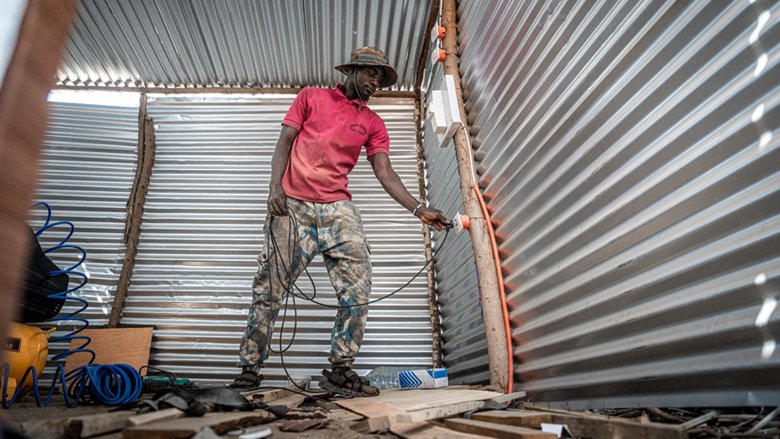
For Ndorong Serere, the arrival of electricity has been a catalyst for transformation. Djaraf, a skilled carpenter, is one of the many who seized new opportunities. “I learned and practiced carpentry at 10 kilometers from Ndorong Serere, but when electricity came to this locality, I didn’t hesitate to return and open my first carpentry workshop,” he explains.
Beyond economic opportunities, electricity has restored dignity and improved quality of life. Village elder Cheikh Diouf recalls past struggles: “When someone passed away, residents had to travel 10 kilometers to get ice to preserve the body while waiting for the deceased’s family to come.” Now such basic challenges are a thing of the past, as energy access has fundamentally reshaped the community’s daily reality.

Powering progress: Senegal’s ambition
Senegal’s commitment to universal electricity access is supported by innovative financing and strategic partnerships, including the Senegal Energy Access Scale Up Project with a $150 million financing from the International Development Association (IDA). The project aims to build and rehabilitate nearly 4,000 kilometers of power lines. It will bring electricity to 200,000 households, electrify 600 health clinics and 200 schools, and ensure that 100% of distribution infrastructure is resilient to climate related events. A least-cost geospatial electrification plan is also in development to optimize efforts. Senegal’s energy strategy prioritizes mobilizing $2 billion in private investments. Recognizing that achieving universal access cannot rely solely on public resources, the approach leverages private sector innovation and efficiency to meet ambitious targets.
Embracing a sustainable energy future
The Government’s vision for the sector goes beyond access to embrace sustainability. Exploiting its gas reserves, Senegal has embarked on an ambitious plan to convert its heavy fuel production to gas and increase its renewable energy share to 40% of its generation mix by 2030, while expanding total generation capacity by 70%. This effort is part the Just Energy Transition Partnership (JETP), a global financing initiative through which Senegal partners with France, Germany, the European Union, the United Kingdom, and Canada to achieve universal energy access and develop a sustainable, low-carbon energy system by promoting renewable energy technologies. Additionally, the country is accelerating access to clean cooking solutions, aiming for an annual growth rate of 11.3%, up from the current 3.25%.
This push for clean energy access would benefit more people, with particular focus on women and communities disproportionately burdened by traditional cooking methods. The initiative aligns with the broader “Mission 300” movement, which aims to connect 300 million Africans to electricity by 2030.
In Ndorong Serere, these national ambitions are already creating tangible change. It is a scene that Senegal hopes to replicate across every village and town, illuminating the path toward a more equitable and sustainable future.


 Summit which will take place in Nairobi, Kenya, on March 14, 2019. The Summit will bring together global leaders, entrepreneurs, international organizations, and civil society, to help accelerate and focus attention on climate investments in line with the Paris Agreement objectives. The Summit will focus on promoting renewable energies, fostering resilience and adaptation and protecting biodiversity in Africa. Follow #OnePlanet for live updates and tune in live on March 14.

You must be logged in to post a comment.