Improving Governance Is Key to Ensuring Equitable Growth in Developing Countries

WASHINGTON, January 30, 2017 – A new World Bank policy report urges developing World Bank buildingcountries and international development agencies to rethink their approach to governance, as a key to overcoming challenges related to security, growth, and equity.
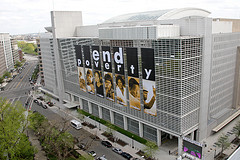
The 2017 World Development Report: Governance and the Law explores how unequal distribution of power in a society interferes with policies’ effectiveness. Power asymmetries help explain, for example, why model anti-corruption laws and agencies often fail to curb corruption, why decentralization does not always improve municipal services; or why well-crafted fiscal policies may not reduce volatility and generate long-term savings.
Continue reading

Listening to Africa: A New Way to Gather Data Using Mobile Phones


The proliferation of mobile phones has opened up new opportunities for conducting surveys in developing countries. Data about people’s lives can now be gathered much cheaper and faster. The World Bank’s Listening to Africa initiative is now collecting household data through mobile phone surveys in African countries.

Water, the economy, and development: New insights on a complex challenge

­

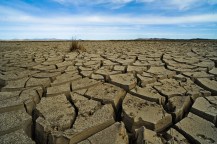
In the World Bank Water Practice, we often talk about how issues like flooding and drought_creative_commons.jpgdroughts threaten our mission to end poverty and boost shared prosperity. But how much do we actually know about how these floods and droughts – “water shocks” – impact farmers, firms, and communities? Perhaps adaptation in the economy has limited such impacts. Or maybe policies have led to economies being more vulnerable to such shocks.
Continue reading

Increasing Salinity in a Changing Climate Likely to Alter Sundarban’s Ecosystem

Story Highlightssundarbans_from_dr_danda
  • The salinity of river water and soil in Bangladesh’s low-lying southwest coastal region is increasing over time, and will aggravate further with sea-level rise in a changing climate.
  • The increase in salinity will reduce the Sunderbans’ key species Sundri, the forest’s highest-value timber species, and increase saline-tolerant species Gewa, Baen and Goran.
  • The progressive water salinization will change the availability of many freshwater fish species, thereby depriving the poor of their main source of protein, and adversely impacting the incomes of families. The poor populations that will lose freshwater fish species are about six times greater in number than those who will be gaining brackish fish species.


Continue reading

Testing water quality: When labs don’t work

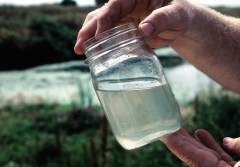
Drinking water utilities, water resource management agencies, and environmwater_quality_mason_jarental regulators across the world are required to establish laboratories to test water quality. Proper testing ensures that water is safe for its intended use, whether that be drinking, bathing, fishing, watering crops, or sustaining ecological health. Yet we routinely find poorly-functioning analytical labs. Failure to follow standardized procedures, maintain certification, and perform routine checks for quality assurance and quality control (QA/QC) compromises the reliability of lab results. As a result, the data are of limited use for managing water safety.

Continue reading

Basic Education in Sudan: The Long Road to Stability

STORY HIGHLIGHTSsd-basic-education-in-sudan-the-long-road-to-stability-780x439
  • The Basic Education Recovery Project is helping to ensure that children across Sudan have equal access to quality basic education
  • Supported by a grant from the Global Partnership for Education, the project has helped to improve the educational environment of hundreds of schools nationwide by building classrooms, training teachers, and distributing textbooks
  • Operating in all of Sudan’s 18 states, the project helps to provide access to basic education for some of the country’s most remote and isolated communities


Continue reading

Industrial Commodities Prices to Surge in 2017: World Bank

WASHINGTON, January 24, 2017— The World Bank is forecasting strong gains for
industrial commodities such as energy and metals WB HQin 2017, due to tightening supply and strengthening demand.

In its January 2017 Commodity Markets Outlook, the World Bank is holding steady its crude oil price forecast for the year at $55 per barrel, a 29 percent jump from 2016. The energy price forecast assumes members of the Organization of the Petroleum Exporting Countries (OPEC) and other oil producers will partially comply with an agreement to limit production after a long period of unrestrained output.

Continue reading

Tips on how to work with the World Bank Group

The World Bank Group project cycle takes years, getting involved in the proces requires a lot of patience; below a number of helpful tips:

  • Build a large network including all relevant stakeholders; local government project authority, (local) World Bank staff and offices, local business, and the Dutch embassies.
  • Follow projects and follow-up with (local) World Bank Staff on a regular basis.
  • Be patient and approach from a problem solving perspective within the country of execution.
  • If possible create a consortium with a local company in country of execution.
  • Maintain regular contact with local and federal government agencies discussing future projects.
  • Visit the World Bank Group HQ in Washington, D.C. with concrete deliverables and examples of executed projects.
  • When in Washington, D.C. be sure to be up to date on the recent developments concerning procurement, structure and general news.
  • Is something unclear? Don’t assume. Ask.


Updated! Handleiding ‘Zakendoen met de Wereldbank Groep’

The Netherlands embassy in Washington, D.C. recently updated the handleiding, “Zakendoen met de Wereldbank Groep,” to provide interested Dutch parties new information concerning the procurement rules, and other tips and tricks on how to do handleidingbusiness with the World Bank Group.

The handleiding will provide those who are interested in contracting with the World Bank a first impression of how this large organization works. It discusses the differences between consultations and goods and works, and explores the position of the World Bank as a contract party.

One aspect that is not always well understood is the project cycle of the World Bank, and which party is responsible for each phase of the cycle. Here, the role of borrowing countries becomes more important, which the handleiding explains in greater detail.

Lastly, the document shows you where you should go to find procurement notices, and where you will find the project pipeline. It finishes with a number of tips and tricks that have been shared with us over the years.

The publication is meant to be dynamic, and will be updated with feedback and new developments regularly. We would like to receive your feedback through was-ea@minbuza.nl. The handleiding is available in Dutch only.