
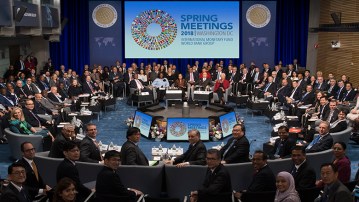
 Despite expectations that growth will be robust in the near term, developing countries face challenges to keep up the pace of progress and ensure inclusive, sustainable growth amid structural changes to the global economy. The World Bank Group is uniquely placed to address global challenges and help countries achieve their goals in today’s increasingly complex development landscape.
Category Archives: WBG News & Reports
Global Compact on Migration
 The Global Compact on Migration (GCM) – a global agreement being negotiated by over 200 countries –can promote safe, orderly and regular migration, but first it will need to address a number of challenges to non-migrants. These include maintaining national identity in the face of large immigration flows, perceived (and actual) job competition impacting native workers in host countries, and the difficulties faced by family members of migrants who are left behind in the country of origin. These are critical missing components, for which there are no simple answers, and which will be even more challenging in the coming decades.
While the final GCM agreement is expected to be signed at the end of 2018, there is much work to be done, and the draft could benefit from several improvements.
Spring Meeting 2018: World Bank Live

Top 7 disruptive technologies for cities
 Imagine you were working in development and poverty reduction in the early 1990s (I was!). Only one website existed in all the world in August 1991 (today there are over 1.5 billion). Mobile phones were expensive, rare, and clunky. Very few would anticipate a situation in which India would have more mobile phones than toilets.
To paraphrase Bill Gates: we tend to overestimate the changes that will happen in the short term and underestimate those in the long term. Technology is quietly but radically disrupting and transforming how cities deliver services to their citizens. It does that in a way that fundamentally alters not just the mode of delivery but its underlying economics and financing.
Breaking the vicious cycle of high inequality and slow job creation
 Growth is picking up in South Africa, and this is good news after two years of declining incomes per capita. Observers are revising their forecasts, and optimists foresee economic growth to exceed 2% in next years. In recent months, several events have indeed improved South Africa’s economic outlook: the smooth transition in power, the authorities’ reaffirmed adherence to principles of good governance and debt stability, and the upward revision in national accounts, revealing higher economic activity in 2017 than previously measured.
Keep up with the latest trends on PPPs
It seems like every week there are new reports being published about public-private  partnerships (PPPs) by different organizations around the world. How can you keep track of what’s new and what’s relevant for your work?
With over 4,000 documents on PPPs in seven different languages (English, Spanish, French, Portuguese, Arabic, Russian, and Chinese) in its searchable document library, the PPP Knowledge Lab has become a key resource for the PPP community to keep up to date with the latest on PPPs.
The State of Social Safety Nets 2018
 Safety nets protect vulnerable households from impacts of economic shocks, natural disasters, and other crises
- An estimated 36 percent of the very poor escaped extreme poverty because of social safety nets, providing clear evidence that social safety net programs are making a substantial impact in the global fight against poverty.
- In developing and transition countries, 2.5 billion people are covered by safety net programs. Of these, 650 million people are from the poorest quintile.
- Yet, in low-income countries, only 1 in 5 of the poorest are covered by safety net programs.
How Can Water Scarce Cities Thrive in a Resource Finite World? New World Bank Report Shares Strategies and Solutions
STORY HIGHLIGHTS 
- New report by the World Bank’s Water Scarce Cities Initiative (WSC) shares the experiences of cities worldwide that are building resilient water supply systems in increasingly water scarce environments.
- By collaborating with urban water practitioners, global thought leaders, and institutions, the report makes the case for shifting the existing paradigm, and demystifies solutions for improved urban water scarcity management.
- The report provides an up-to-date and innovative first-hand look into how water scarce cities are taking fate into their own hands, from exploring new ways to manage water to building resilience to severe droughts.
“Real governance” in Fragile, Conflict-affected and Violent States – What is that?
The Fragility Forum was held in Washington D.C. from March 5 to 7. More than 1,000 people from over 90 different countries attended. At one of the events, ‘Real Governance in FCV settings: Engaging State and Non-State Actors in Development’ practitioners and policy-makers discussed which actors to work with in complex FCV situations, and what the choice of actors would mean from a human rights and social accountability perspective.
Millennials Welcome! Young women are revolutionizing the startup scene despite conflicts in MENA
 The start-up scene in the Middle East and North Africa region is booming. The growing number of incubators and accelerators that can be found from Beirut, Ramallah, Gaza to Cairo and Casablanca have gained recognition beyond the region. Our team at the MENA Youth Platform has been studying the emerging trends, and one thing is clear: the next revolution will look very different, and young women are at the forefront of innovation such as artificial intelligence. Impressively, a new startup-ecosystem index shows how Tunis and Amman lead the MENA crowd based on an assessment of available human capital, access to finance, the vibrancy of the startup scene, available ICT infrastructure, an enabling macro-context, and global market access.
 Netherlands for the World Bank
You must be logged in to post a comment.