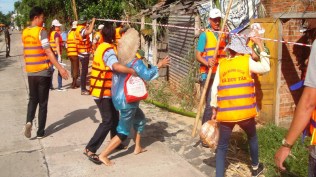
eC2: Dar es Salaam Community Disaster Response and Risk Reduction Plans

vn-communitybased-disasterrisk-780x439Deadline: 17-Feb-2018 at 11:59:59 PM (Eastern Time – Washington D.C.)

Objective: The objective of this assignment is to develop Municipal Disaster Response Plans, Community Disaster Response Plans, and Community Risk Reduction Plans in flood affected areas of Dar es Salaam. These fit into existing frameworks such as the Disaster Management Act of 2015, the Emergency Response Plan of the Dar es Salaam Multi-Agency Emergency Response Team (DarMAERT), the Tanzania Emergency Preparedness and Response Plan, and other local level initiatives. Expected outputs over the two-year contract period also include: creation of toolkits to support the development of the plans; onboarding of Subward Community Disaster Management Committees; and collection of monitoring and evaluation data. The assignment forms part of broader efforts to mainstream risk management principles across government and civil society stakeholders. The toolkits and plans developed are can serve as a template for other cities in Tanzania.

Continue reading →

A Smarter Way to Keep Teachers in Malawi’s Remote Schools

malawi_pictureAlberto Gwande and his students at Khuzi school in Malawi need more teachers. The school is severely understaffed, with only six teachers for nearly 800 students. “I was supposed to receive new teachers last year, but they never came,” recalls Alberto, the headteacher.
Khuzi is 20 kilometres away from Nathenje, the nearest large village with a trading center, and its Pupil-Teacher Ratio (PTR) is 131 pupils per teacher. In contrast, Chibubu school, located four kilometers from Nathenje, has a PTR of 65, while Mwatibu school, located inside the village, has a PTR of just 49. And yet, despite the shortage at Khuzi, it was Chibubu which received four new teachers last year.

Continue reading →

eC2: Scoping for gender & private sector engagement opportunities in three Sub-Saharan Africa countries- DRC, Cote d Ivoire, Mozambique

1_VKgpfpebYFgjXAUoKewFVgDeadline:  08-Feb-2018 at 11:59:59 PM (Eastern Time – Washington D.C.)

Objective: IFC would like to conduct a private sector gender analysis in three countries – Democratic Republic of Congo, Cote DIvoire and Mozambique. This work will interrogate the role of the private sector in enabling equal opportunities for women to participate in economic development and the gaps thereof. In doing so, it shall consider various gender dimensions in relation to the private sector. These diagnostics will feed into the design of a private sector focused multi-year, multi-sectoral gender program to be led by IFC.

Continue reading →

eC2: Analytical study for implementing Land Value Capture (LVC) instruments in Colombia

Deadline: 05-Feb-2018 at 11:59:59 PM (Eastern Time – Washington D.C.) pexels-photo-235829.jpeg

Objective:  1.Identify the technical legal and finance aspects for the implementation of LVC instruments including: i) relation of the instrument with the type municipality ii) regulatory framework of the municipality for its implementation (urban, tributary, and fiscal), iii) technical and institutional capacity of the municipalities to implement them, iv) destination (type of projects) of the instrument, v) effectiveness in the implementation and collection, and vi) lessons learned and recommendations. 2.Define recommendations to strengthen the capacity of national (Min. of Finance, National Planning Department, DNP, and Min.of Housing) and local governments to implement LVC instruments 3.Define recommendations for the selection and implementation of LVC instruments taking into account: i)national and sub-national legal framework, ii) typology of projects,iii) institutional framework, iv) fiscal and financial situation, v) type of projects, advantages/ disadvantage in its application.
Continue reading →

Global Economy to Edge Up to 3.1 percent in 2018 but Future Potential Growth a Concern

GEP2018a_Table1-1Current Slack in Global Economy Expected to Fade

WASHINGTON, January 9, 2018— The World Bank forecasts global economic growth to edge up to 3.1 percent in 2018 after a much stronger-than-expected 2017, as the recovery in investment, manufacturing, and trade continues, and as commodity-exporting developing economies benefit from firming commodity prices.

However, this is largely seen as a short-term upswing. Over the longer term, slowing potential growth—a measure of how fast an economy can expand when labor and capital are fully employed—puts at risk gains in improving living standards and reducing poverty around the world, the World Bank warns in its January 2018 Global Economic Prospects.

Continue reading →

eC2: Greener Transport Connectivity for the Six Eastern Partnership Countries

Deadline: 07-Feb-2018 at 11:59:59 PM (Eastern Time – Washington D.C.) general-transport-mosaic-main

Objective: The overall objective of this project is to promote enhanced transport connectivity in the Eastern Partnership countries (Armenia, Azerbaijan, Belarus, Georgia, Moldova and Ukraine) that delivers improved outcomes on energy efficiency and sustainability. With this overall objective, this assignment will include:

– Identifying relevant green transport policies and projects for the EaP region.

– develop transport connectivity/accessibility indicators for gauging the level of improvement that could be achieved by corridor improvement projects

– developing a user-friendly connectivity assessment tool

Continue reading →

Equality Means Business: Making the Business Case for Women Charity R. Hodzi-Sibanda’s picture

When early December was upon us—heralding the start of the month of annual festivities—a group of women executives met to put forward strategies for equality in business. They met against a background of the harsh reality of women’s exclusion from leadership positions in Zimbabwe, brought to the fore in a recently released Confederation of Zimbabwe Industries (CZI) Manufacturing Survey for 2017.

Continue reading →

What keeps the President of the World Bank up at night?

This year’s World Economic Forum Annual Meeting comes at a time of good news for the world economy. As we said in this month’s Global Economic Prospects report, for the first time since the financial crisis, the World Bank is forecasting that the global economy will be operating at or near full capacity. We anticipate growth in advanced economies to moderate slightly, but growth in emerging markets and developing countries should strengthen to 4.5% this year.

Continue reading →

Using technology to promote youth employment: How to develop digital solutions

How and when can we use technology to design and implement youth employment programs? We should ask ourselves whether investing in digital solutions is worth the time and money before deciding to include a digital component in our projects, because as much as technology can be transformative and help provide solutions, it is both expensive and time-consuming. Furthermore, we need to make sure we fully understand the problem that we are trying to solve.

Continue reading →

Infrastructure & Africa’s development—the PPP imperative

Africa is a continent rich in natural resources and boasts a large young, ambitious, and entrepreneurial-minded population. Harnessed properly, these endowments and advantages could usher in a period of sustained economic growth and increased well-being for all Africans. However, a lack of modern infrastructure is a major challenge to Africa’s economic development and constitutes a significant impediment to the achievement of the Sustainable Development Goals.

Continue reading →