
Just over a decade out from the SDG deadline of 2030, many developing countries are not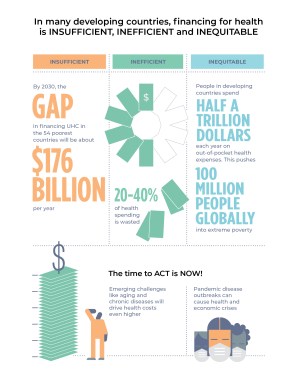 on track to meet Universal Health Coverage (UHC) targets to ensure access to quality, affordable health services to all. People in developing countries pay over half a trillion dollars annually out-of-pocket for health services, which is pushing about 100 million people into extreme poverty each year. The evidence is strong that progress towards UHC would spur not just better health but also inclusive and sustainable economic growth, yet this report estimates that in 2030 there will be a UHC financing gap of $176 billion in the 54 poorest countries. This threatens decades-long progress on health, endangers countries’ long-term economic prospects, and makes them more vulnerable to pandemic risks. This report, launched to inform the first-ever G20 Finance and Health Ministers session in Osaka, Japan in June 2019, lays out an action agenda for countries and development partners to bridge the UHC financing gap, and makes a strong case for a focus on innovation in health financing over the next decade.
Download Full report and Executive summary
 achieving sustainable RMNCAH results by strengthening the health systems and support progress towards universal health coverage (UHC).
![medical-appointment-doctor-healthcare-clinic-health-hospital-medicine[7]](https://nl4worldbank.org/wp-content/uploads/2015/09/medical-appointment-doctor-healthcare-clinic-health-hospital-medicine7.jpg?w=198&h=132)
 disease that causes inflammation and pain in the joints, eight years ago, she had a major revelation. She realized that what she was promoting as director of a primary health care facility in Chile was very different than what she actually needed as a patient.
![medical-appointment-doctor-healthcare-clinic-health-hospital-medicine[7]](https://nl4worldbank.org/wp-content/uploads/2015/09/medical-appointment-doctor-healthcare-clinic-health-hospital-medicine7.jpg?w=180&h=120) provoke shockwaves. Happily, the principle that “… everyone having access to the health care they need without suffering financial hardship” is now widely recognized and documented. And although few countries have achieved this goal in practice, it is clearly
provoke shockwaves. Happily, the principle that “… everyone having access to the health care they need without suffering financial hardship” is now widely recognized and documented. And although few countries have achieved this goal in practice, it is clearly  When the door closed behind her, Maria’s world seemed to collapse. The mother of a girl and two boys had just learned that her eldest son, the teenager who became the pillar of the family after their father died, was not only in a deep depression and increasingly using alcohol but he was gay. She had noticed him becoming moodier and even heard he received a warning at his job for not showing up, something totally unlike him at all. She felt helpless but knew his depression had to stay hidden from the rest of the family and the neighbors as mental health problems brought with them social stigma. But she was most afraid someone would find out he was gay, causing the family to be ostracized and endangering the future of the other children.
![medical-appointment-doctor-healthcare-clinic-health-hospital-medicine[7]](https://nl4worldbank.org/wp-content/uploads/2015/09/medical-appointment-doctor-healthcare-clinic-health-hospital-medicine7.jpg?w=264&h=176) Achieve 2030 Sustainable Development Goals
Achieve 2030 Sustainable Development Goals
 Netherlands for the World Bank
You must be logged in to post a comment.