
From Santiago to Abidjan, Milan to Dubai, the first half of 2025
brought a wealth of insight into how multilateral donors are
reshaping their funding strategies, procurement systems, and
development priorities. Assortis attended and monitored five of
the most influential events on the global development
calendar—those organised by the Inter-American
Development Bank (IDB), the African Development Bank
(AfDB), the Asian Development Bank (ADB), the European
Bank for Reconstruction and Development (EBRD), and the
Dubai International Humanitarian Aid & Development
Conference (DIHAD).
Across these gatherings, the message was clear: development
cooperation is entering a new phase—one that requires agility,
digital capacity, local engagement, and a deeper alignment with
ESG principles. In this report, we share our synthesis of key
messages, thematic takeaways, and practical implications for
professionals and organisations working across the development
spectrum
Tag Archives: Report
State and Trends of Carbon Pricing 2025
The World Bank’s annual State and Trends of Carbon Pricing report is aimed at providing an up-to-date overview of existing and emerging carbon pricing instruments around the world, including international, national, and subnational initiatives. It focuses on identifying key developments relating to all forms of direct carbon pricing – emissions trading systems, carbon taxes, and carbon crediting mechanisms. This year’s report will be the twelfth (in its current format) – building on many decades of World Bank Group’s work in this space.
Joint World Bank, UN Report Assesses Damage to Gaza’s Infrastructure
Damages to Physical Structures Estimated at $18.5 billion as of end January
WASHINGTON, April 2, 2024 – The cost of damage to critical infrastructure in Gaza is estimated at around $18.5 billion according to a new report released today by the World Bank and the United Nations, with financial support of the European Union. That is equivalent to 97% of the combined GDP of the West Bank and Gaza in 2022.
Continue readingUnlocking Clean Cooking Pathways : A Practitioner’s Keys to Progress (English)
Provision of clean cooking for all is recognized as a critical cross-sectoral development issue. The potential societal benefits are enormous, particularly for public health, women’s productivity and empowerment, and the environment. Along with electrification, clean cooking is an essential component to achieving Sustainable Development Goal (SDG) Target 7.1 – ensuring universal access to affordable, reliable, and modern energy services. However, the stark reality is that progress on clean cooking access has been stymied by past perceptions of the sector as orphaned, invisible, and expensive. Recent developments have opened a window of opportunity for driving scale. The World Bank’s Clean Cooking Fund, the largest dedicated fund for galvanizing political commitment, scaling up public and private investment, and catalyzing innovation is using innovative Results-Based Financing (RBF) designs and applications to promote long-term market development and advance access for all. Lessons and success stories from the World Bank’s recent operational experience in the sector show how making access to clean cooking a political priority, using people-centered approaches, can drive large development impacts for society. To unlock a country’s clean cooking pathways, stakeholders must carefully consider its overall enabling environment, including its institutional capacity to implement transformative solutions. In countries with a high access deficit, addressing the cooking poverty issue will initially require modernizing the biomass fuel sector and promoting integrated, cost-effective approaches. How does one make the case for clean cooking in countries with a high access deficit? What are the guiding principles for developing a clean cooking strategy? What building blocks are necessary to promote market development for long-term sustainability? This report attempts to answer these and other key questions.
See Less
IDA20 Replenishment: Public invited to review draft Deputies’ Report
Ahead of the IDA20 Replenishment pledging meeting in Tokyo next month, the proposed replenishment package is now at an advanced stage. At this meeting, the IDA20 Deputies’ Report will be tabled for endorsement by IDA Deputies and Borrower Representatives. Before this happens, the public is invited to review the draft IDA20 Deputies’ Report and provide comments before November 26.
Global Gas Flaring Tracker Report
Highlights
- Gas flaring, the burning of natural gas associated with oil extraction, takes place due to a range of issues, from market and economic constraints, to a lack of appropriate regulation and political will. The practice results in a range of pollutants released into the atmosphere, including carbon dioxide, methane and black carbon (soot).
- The Global Gas Flaring Tracker finds that oil production declined by 8% (from 82 million barrels per day (b/d) in 2019 to 76 million b/d in 2020), while global gas flaring reduced by 5% (from 150 billion cubic meters (bcm) in 2019 to 142 bcm in 2020).
- Russia, Iraq, Iran, the United States, Algeria, Venezuela and Nigeria remain the top seven gas flaring countries for nine years running. These seven countries produce 40% of the world’s oil each year, but account for roughly two-thirds (65%) of global gas flaring.
Incidence of COVID-19 and Connections with Air Pollution Exposure : Evidence from the Netherlands
The fast spread of severe acute respiratory syndrome coronavirus 2 has resulted in the  emergence of several hot-spots around the world. Several of these are located in areas associated with high levels of air pollution. This study investigates the relationship between exposure to particulate matter and COVID-19 incidence in 355 municipalities in the Netherlands. The results show that atmospheric particulate matter with diameter less than 2.5 is a highly significant predictor of the number of confirmed COVID-19 cases and related hospital admissions. The estimates suggest that expected COVID-19 cases increase by nearly 100 percent when pollution concentrations increase by 20 percent.
eC2: Key Factors for Successful Development of Offshore Wind in Emerging Markets
Deadline: 19-Mar-2020 at 11:59:59 PM (Eastern Time – Washington D.C.)
The scope of the assignment shall cover the major topics that need to be considered by  policymakers and regulators when establishing a new market for offshore wind development. These shall include, but not be limited to, the following points:
1. Policy discussion on successful policy measures including drivers, targets;
2. Pre-development geospatial planning and technical studies, including zoning;
3. Stakeholder identification and consultation;
4. Legal key legislation to facilitate project development and delivery;
5. Environmental and social policies to ensure sustainable offshore wind development
6. Health & safety referencing best practice from Europe and related sectors (e.g. oil and gas);
7. Consenting roles and responsibilities between agencies and building public sector capacity;
8. Transmission models for development, financing and ownership of transmission;
9. Grid integration best practice in integration of offshore wind into grids
10. Tariff and bankability offtake mechanisms to ensure bankable revenue;
11. Project solicitation identification of sites, competitive methodologies for awarding rights;
12. Supply chain approaches to support and encourage local supply chain and infrastructure development (e.g. ports);
13. Financing project structures to minimize risk (both on public and private elements)
Full Terms of Reference (TOR) will be included in a future Request for Proposals (RFP) which will be issued to Consultants that are shortlisted from this REOI.
eC2: Evaluation of the 2030 Water Resources Group Model & Lessons Learned for Achieving the SDGs
Deadline: 02-Mar-2020 at 11:59:59 PM (Eastern Time – Washington D.C.) 
Launched in 2008, the 2030 Water Resources Group (2030 WRG) (http://www.2030wrg.org) aims to help countries facilitate collective action among government, the private sector, and civil society to improve water resources management. 2030 WRG does so by: (a) creating the wider political economy conditions and momentum for change in water sector reform; (b) facilitating collaboration and awareness building within the water resources community, including the private sector; and, (c) improving the design and implementation of a comprehensive and innovative set of policies, programs and projects in selected countries or regions in order to increase their water security.
High-Performance Health-Financing for Universal Health Coverage: Driving Sustainable, Inclusive Growth in the 21st Century
Just over a decade out from the SDG deadline of 2030, many developing countries are not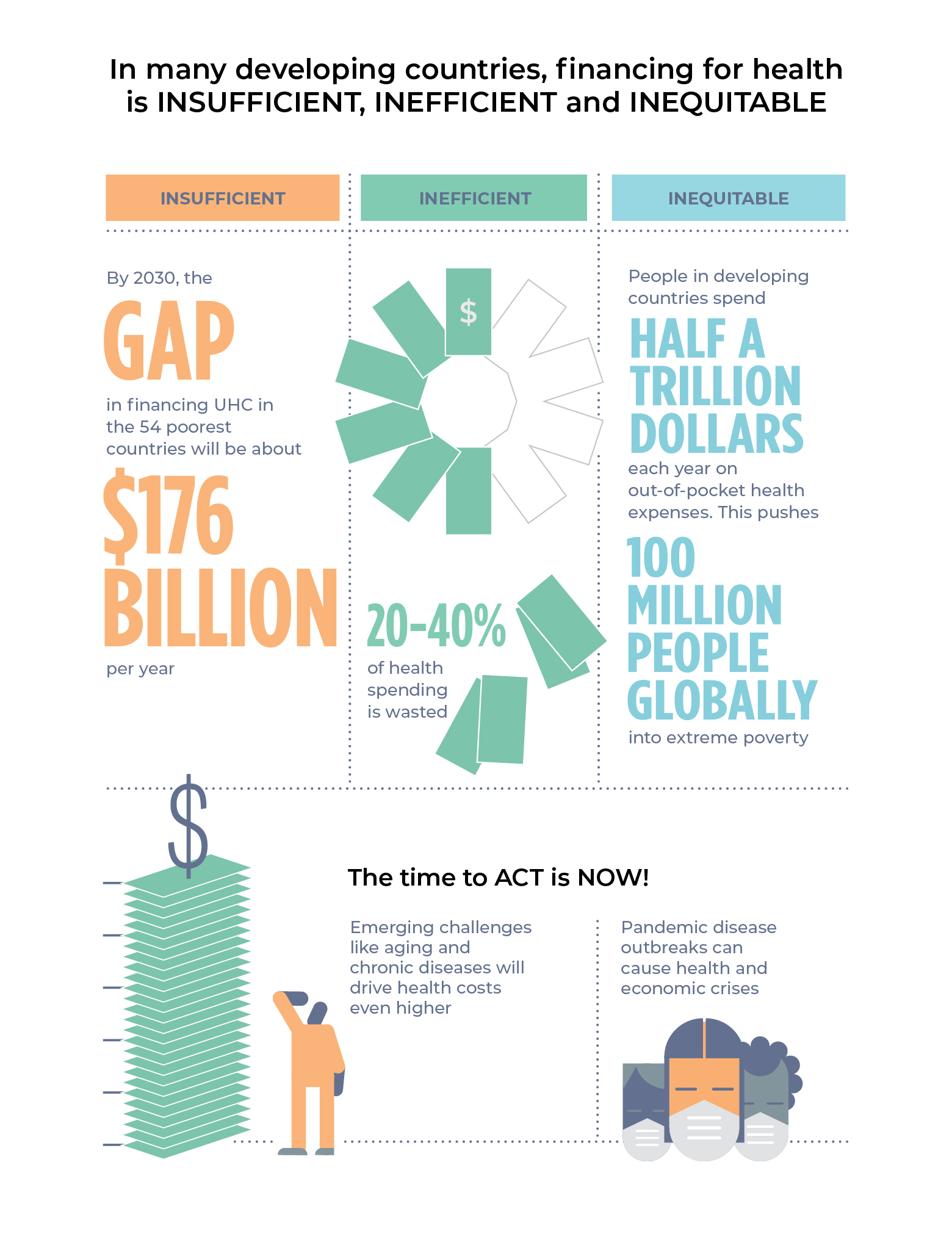 on track to meet Universal Health Coverage (UHC) targets to ensure access to quality, affordable health services to all. People in developing countries pay over half a trillion dollars annually out-of-pocket for health services, which is pushing about 100 million people into extreme poverty each year. The evidence is strong that progress towards UHC would spur not just better health but also inclusive and sustainable economic growth, yet this report estimates that in 2030 there will be a UHC financing gap of $176 billion in the 54 poorest countries. This threatens decades-long progress on health, endangers countries’ long-term economic prospects, and makes them more vulnerable to pandemic risks. This report, launched to inform the first-ever G20 Finance and Health Ministers session in Osaka, Japan in June 2019, lays out an action agenda for countries and development partners to bridge the UHC financing gap, and makes a strong case for a focus on innovation in health financing over the next decade.
Download Full report and Executive summary
 Netherlands for the World Bank
You must be logged in to post a comment.