
Tag Archives: Pandemic
Equal access to digital technologies: A key to resilient recovery

Register HERE
Meeting ID
937 3870 9546
Note: For security reasons, access to the session will be closed 30 minutes after starting.
2020 Annual Meetings
|
 decades of development outcomes.
Reversing the Inequality Pandemic: Speech by World Bank Group President David Malpass
World Bank Group President David Malpass: Speech at Frankfurt School of Finance and Management
 You can watch the replay of the event here
Introduction
Thank you, Jens. And thanks to Frankfurt School and the Bundesbank for hosting me virtually. I look forward to engaging with you and taking questions from students, who will be future business leaders in a post-COVID world. I’m here to set the stage ahead of the IMF and World Bank Group’s Annual Meetings, which will focus primarily on COVID and debt, and will also engage partners in urgent discussions on human capital, climate change, and digital development.
Pandemic Response
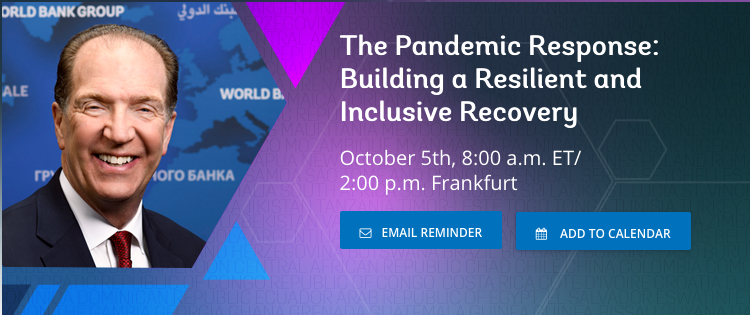
Ahead of the World Bank Group-IMF Annual Meetings, Frankfurt School of Finance and Management will host World Bank Group President David Malpass who will discuss the impact of the COVID-19 pandemic on the world’s poorest and most vulnerable people and the challenge of building a resilient and inclusive global recovery.
The event will be introduced by Germany’s Bundesbank President Dr. Jens Weidmann and include a conversation between President Malpass and Professor Nils Stieglitz, President and Managing Director of Frankfurt School of Finance and Management.
How AI can help developing countries rebuild after the pandemic
Technology has been a lifeline to developing countries during the COVID-19 crisis, helping to 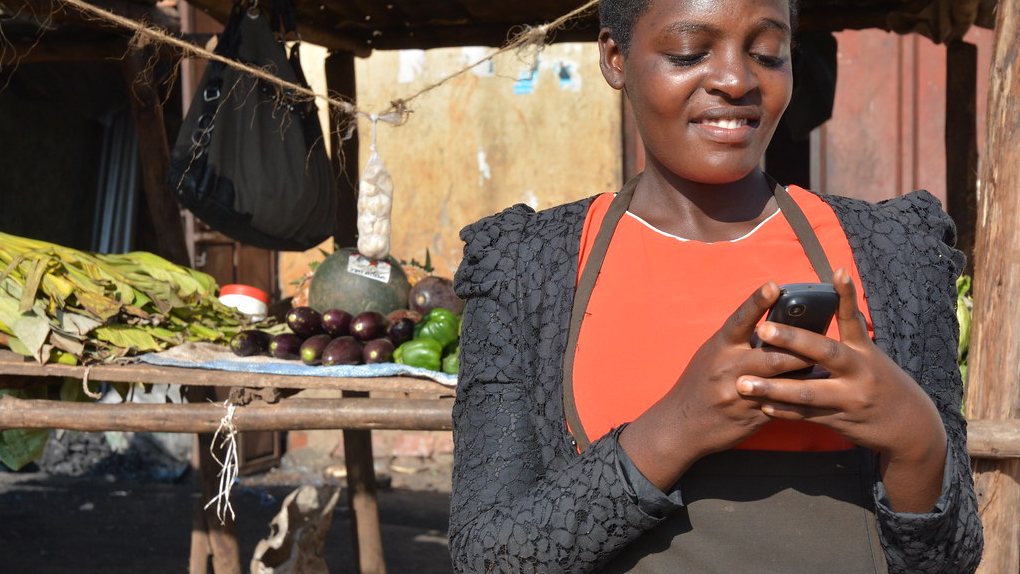 maintain essential services and keep companies in business. It has also offered a glimpse of a brighter future, one in which gains in income and employment are driven by technologies such as artificial intelligence.
Even before the pandemic, commercial uses for AI were expanding rapidly in emerging markets, in fields ranging from manufacturing and energy to education and financial services. The necessary lockdowns and travel restrictions imposed by countries have accelerated that trend. Companies like Clinicas de Azucar in Mexico are using AI to analyze data and improve health outcomes for thousands of at-risk diabetic patients. In India, 1mg uses AI to help customers compare prices for medical services from different labs.
Pandemic Threatens Human Capital Gains of the Past Decade, New Report Says
WASHINGTON, Sept. 16, 2020 – The COVID-19 pandemic threatens hard-won gains in 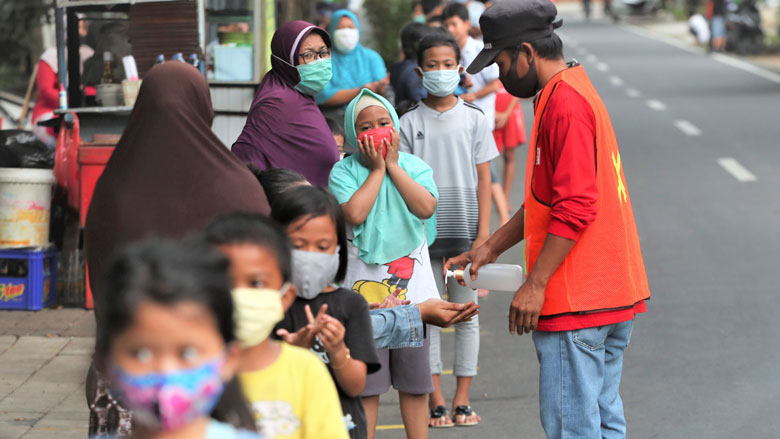 health and education over the past decade, especially in the poorest countries, a new World Bank Group analysis finds. Investments in human capital—the knowledge, skills, and health that people accumulate over their lives—are key to unlocking a child’s potential and to improving economic growth in every country. health and education over the past decade, especially in the poorest countries, a new World Bank Group analysis finds. Investments in human capital—the knowledge, skills, and health that people accumulate over their lives—are key to unlocking a child’s potential and to improving economic growth in every country.
The World Bank Group’s 2020 Human Capital Index includes health and education data for 174 countries – covering 98 percent of the world’s population – up to March 2020, providing a pre-pandemic baseline on the health and education of children. The analysis shows that pre-pandemic, most countries had made steady progress in building human capital of children, with the biggest strides made in low-income countries. Despite this progress, and even before the effects of the pandemic, a child born in a typical country could expect to achieve just 56 percent of their potential human capital, relative to a benchmark of complete education and full health. |
A lesson on the pandemic – the lesson we didn’t learn about inequality
School after this pandemic will be different. To a large extent this is due to many actors –  parents, teachers, mass media, the government, and others – who will have changed their views and perceptions about their role in the education process. This shift of mindsets will be critical for the future of the education system.
Parents now have a better understanding of the need to work jointly with schools to foster the education of their children. They now know that they can be, and actually are, a major figure in the education process of their children. And many parents who are now struggling with supporting they children to maintain some of their learning process at home will have a better understanding of just how demanding and challenging the teacher’s job is. Parents have a much greater appreciation for teachers and what they do. And parents now clearly recognize that education is a social experience – a lot of the magic of learning, of the development of ideas and creativity, come from the social interaction with teachers and peers. If someone ever thought that teachers could be replaced by artificial intelligence, it is now clear that is not the case.
Productivity growth threatened by COVID-19 disruptions
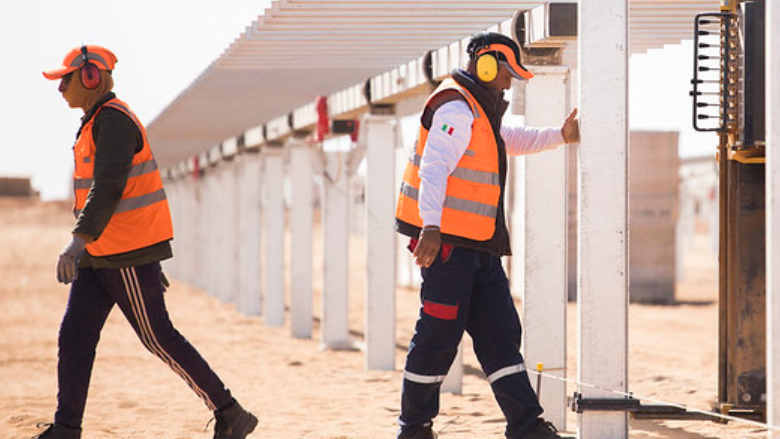
Productivity growth, a force that has contributed to lifting millions of people out of poverty in developing countries, will need substantial support from policymakers if it is to withstand the severe challenges posed by the COVID-19 pandemic’s economic shock. More in our latest study.
Investing in Africa’s people yields impact, strengthens efforts to beat pandemic

The pandemic is an important reminder of how precious and productive an investment human capital is. One year after the launch of the World Bank’s Africa Human Capital Plan, there has not only been a significant scale-up, but also a shift in World Bank support to African countries.
 Netherlands for the World Bank
You must be logged in to post a comment.