
WASHINGTON, March 7, 2022—The World Bank Board of Executive Directors today approved a supplemental budget support package for Ukraine, called Financing of Recovery from Economic Emergency in Ukraine – or FREE Ukraine – for $489 million. The package approved by the Board consists of a supplemental loan for $350 million and guarantees in the amount of $139 million and is also mobilizing grant financing of $134 million and parallel financing of $100 million, resulting in total mobilized support of $723 million. The fast-disbursing support will help the government provide critical services to Ukrainian people, including wages for hospital workers, pensions for the elderly, and social programs for the vulnerable.
Tag Archives: COVID-19
eC2: Support Develop Operational Guidelines for an agency specializing in Public Land Monetization
Deadline: 21-Mar-2022 at 11:59:59 PM (Eastern Time – Washington D.C.)

The consulting firm/company will have a proven track record of providing across-the-board advisory and/or operational support to a public land and building monetization organization in India and overseas. The consulting firm/company is expected to provide intellectual leadership to the technical report and its related activities.
An Accessible Future for Persons with Disabilities
120 kilometers south of Kigali, in a remote part of Southern Rwanda’s Huye District,  lies the G.S. Kabuga school.
Warm sunshine—with the occasional drizzle of rain—greets students as they trickle into class on a Monday morning. Led by their class prefect and teacher, the kids assume their seats inside a spacious classroom with two large blackboards on opposing flanks. One learner, a wheelchair user, rolls up alongside a bench and shuffles in alongside a classmate.
“Children with disabilities are just like other children,” remarks Brother Jovite Sindayigaya, headmaster at the school. “The country needs them and so does the world in general. I get happiness from seeing them succeed.”
G.S. Kabuga is one of 3,388 schools in Rwanda that have benefitted from reconstruction and refurbishment efforts, funded by the government of Rwanda and the World Bank, with technical assistance provided by the Bank’s Inclusive Education Initiative. In the span of just one year, 22,505 classrooms across all 30 districts of Rwanda were built or refurbished with some accessibility features for learners with disabilities.
Addressing fragility is critical for development
The COVID-19 pandemic and related shutdowns are challenging the effectiveness of civil and institutional structures around the world and adding to fragility and violence, resulting in interrelated crises for foreign policy, development, and economics.
Three ways to tackle gender data gaps – and 12 countries embracing the challenge
World Bank Strengthening Gender Statistics project is partnering with National Statistical Offices in twelve IDA-19 countries to support the production of gender data in the economic domain.
Continue reading
What You Need to Know About Oceans and Climate Change
Oceans play a critical role in regulating the climate, but how healthy are our oceans today and what kind of impact is climate change having? We sat down with Charlotte De Fontaubert, Global Lead for the Blue Economy at the World Bank, to learn about the state of our oceans and what the World Bank is doing to help keep them healthy and productive.
and what kind of impact is climate change having? We sat down with Charlotte De Fontaubert, Global Lead for the Blue Economy at the World Bank, to learn about the state of our oceans and what the World Bank is doing to help keep them healthy and productive.The Fragility Forum 2022 is committed to peace and development in the midst of new and intensifying crisis
Over the last two years the world has been on edge, with serious implications for the most fragile economies.
Fragility and conflict risks are also on the rise in middle-income countries. Our most recent economic forecast indicates that, by 2023, the output of fragile and conflict-affected countries will be 7.5 percent below pre-pandemic levels. This is well below prospects in emerging and developing countries at large. For the most vulnerable, this means food insecurity, extreme poverty, loss of human capital and fewer economic opportunities in addition to the threat of violence and forced displacement.
eC2: Analysis of energy efficient cold chains for Agriculture in Guatemala
Deadline:  28-Feb-2022 at 11:59:59 PM (Eastern Time – Washington D.C.)
The objective of the study is to provide an in-depth analysis and diagnostic to identify gaps (e.g. strategy gaps, types of investments needed and agro-logistics inclusion) and opportunities in cold-chain infrastructure on the agricultural sector in Guatemala, including investment, technology and spatial gaps, energy savings and GHG reduction potential, and refrigerants used in the cold-chain, identifying opportunities to fill these gaps within the recently approved Responding to COVID-19: Modern and Resilient Agri-Food Value Chains projects. The analysis will further assess opportunities for reducing food losses through adopting improved, efficient cooling technologies, as well as for investment in improved cooling technologies, also based on national and regional policies related to cold chain logistics.
Five threats to equitable and inclusive recovery from COVID-19: Evidence from East Asia and Pacific
Nearly two years into the COVID-19 pandemic, the World Bank’s High-Frequency Phone 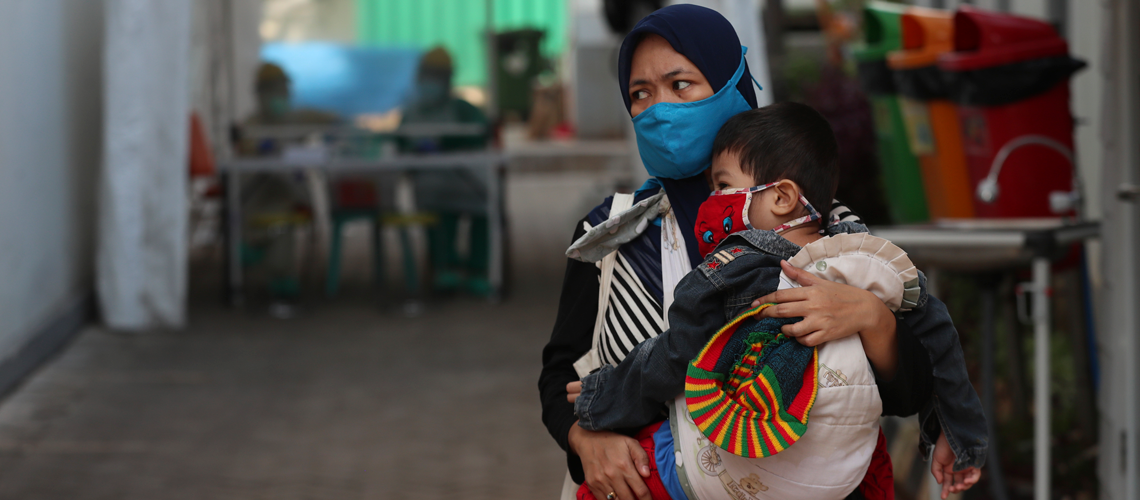 Surveys (HFPS) in the East Asia and Pacific (EAP) Region show that poorer households have been disproportionately affected and have been slower to recover. Findings from the HFPS reported in the recent EAP Economic Update and a new regional study show that inequality has likely been exacerbated in several dimensions.
 Netherlands for the World Bank
You must be logged in to post a comment.