
Statistics Netherlands (CBS) and World Bank Group have signed a Memorandum of Understanding with the desire to carry out activities  conducive to helping developing countries improve their statistical systems for collecting, processing and disseminating quality and timely data for evidence-based policymaking in order to achieve their national development goals as strive towards the Sustainable Developments Goals (SDGs).
Category Archives: WBG News & Reports
Ecofys: Connecting the dots on climate change
Last year, governments raised about US$26 billion charging for carbon emissions – a figure  taken from “Carbon Pricing Watch 2016” jointly prepared by the World Bank Group and Ecofys. Ecofys is proud to be able to support the World Bank Groups key ambition to bring down global emissions and drive investment into cleaner options.
The past four years Ecofys has assisted the World Bank in writing the annual report State and Trends of Carbon Pricing. The report is the authoritative reference point for carbon pricing information and provides data and insights of the work of the Carbon Pricing Leadership Coalition. Recognized by the international community, the State and Trends report provides insights used for the climate negotiations and, in turn, reports on their progress. The 2016 edition will focus on the alignment of carbon pricing with other climate policies. While a future outlook was released in May, the full 2016 report will be published later this year.
Save the date: World Bank procurement event in The Hague on November 2, 2016
Last ye ar the Netherlands Enterprise Agency organized an event on procurement focused on the international financial institutions e.g. World Bank Group and Inter-American Development Bank. On November 2nd in the Hague, a World Bank specific event will be organized in co-operation with the Netherlands’ Embassy in Washington, DC. The procurement event is geared to Dutch companies and organizations who have experience bidding for World Bank funded projects. Sessions will be organized to address specific aspects of and bottlenecks in the WBG procurement process. All sessions will be interactive, in small groups, and will address practical experiences in doing business with the World Bank. Please contact the Netherlands Enterprise Agency for more information: commerijn.plomp@rvo.nl.
Promoting partnership for a water-secure world
Article published on The Water Blog, Saturday 08/27/2016.
The global water community is gathering in Stockholm for World Water Week 2016. This year’s theme, “Water for Sustainable Growth,” comes at a critical time, as we are mobilizing to achieve the Sustainable Development Goals (SDGs), in which water plays an essential part.
China’s Flood Control Project: a Bigger Role for Farmers and a Better Alert System
After many years as a migrant worker in various cities, Chen Yin returned to Tuoxi village recently to pick up farm work again.
Save money using Vouchers!
The Netherlands Enterprise Agency (RVO) has introduced a new tool for small and medium sized enterprises (SME’s): business vouchers. Dutch SME’s can apply for a voucher, which they can use to purchase specific services from experienced consultants. It is a pilot project of the Dutch government, meant to complement the services the government already provides and to increase the competitiviness of Dutch SME’s when doing business with international organizations. The pilot runs until the end of 2016.
What is non-revenue water? How can we reduce it for better water service?
Blog Article: For more information on this initiative, contact Gerard Soppe (gsoppe@worldbank.org) or Jema Sy (jsy@worldbank.org).
with an economic value of over US$3 billion per year.
A World Bank study puts , half of which occurs in developing countries. Water utilities suffer from the huge financial costs of treating and pumping water only to see it leak back into the ground, and the lost revenues from water that could have otherwise been sold. If the water losses in developing countries could be halved, the saved water would be enough to supply around 90 million people.
How can water utilities provide reliable water to poor people in African cities?
Sustainable Development Goal (SDG) 6 targets“universal and equitabl e access to safe and affordable drinking water for all”. However, just accessing water is a daily struggle for many poor families
 . While Africa’s urban population is expected to triple by 2050, the proportion of people with improved water supply has barely grown since 1990, and the share of those with water piped to their premises has declined from 43 percent in 1990 to 33 percent in 2015. Poor families bear the brunt of these inadequacies through poor health, the long time required to collect water, and higher costs when purchasing from on-sellers’
The World Bank at World Water Week 2016
The global water community is gearing up for Stockholm World Water Week 2016. T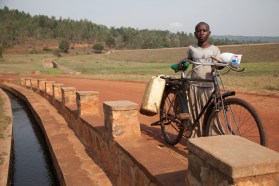 his year’s theme, “Water for Sustainable Growth,” comes at a critical time, as we are mobilizing to achieve the Sustainable Development Goals (SDGs), in which water plays an essential part.
Water touches nearly every aspect of development.  It drives economic growth, supports healthy ecosystems, and is fundamental for life. However, water can threaten health and prosperity as well as promote it. Water-related hazards, including floods, storms, and droughts, are already responsible for 9 out of 10 natural disasters, and climate change is expected to increase these risks. As water resources become increasingly strained, the risk of conflict and instability may also grow.
Water, Water (Not) Everywhere: the Imperative of Increasing Water Use Efficiency
Today, nearly 1.6 billion people live in countries with physical water scarcity – a figure that may double in just two decades.
As economies and populations grow, their demand for water also grows. Water is not only essential for human life, it is a vital factor for production – meaning that diminishing water supplies can translate into lower economic growth. A recent assessment, “High and Dry: Climate Change, Water and the Economy”, a report by the Water Global Practice of the World Bank, found that some regions could see their growth rates decline by as much as 6% of GDP by 2050 due to water-related losses in various sectors.


You must be logged in to post a comment.