Leveraging behavioral insights in the age of big data

­Access to an extremely large amount of data has enabled us to pursue research endeavors that just a couple of years ago seemed unimaginable. Examples of amazing big data applications in the field of economics are all over the place: using job-portals data to inform labor market policies; analyzing citizens’ reactions to public policies using Twitter; creating daily inflation data using billions of records from online retailers around the world; and even measuring economic growth from outer space!
The data revolution is open to anyone with the right tools, and big data can be useful to answer policy questions. Pairing big data with some of the traditional methods of data gathering such as household surveys can yield timely information and can help shape appropriate policy responses. For instance, traditional household surveys, from which unemployment estimates are calculated could carry outdated employment data by the time they become available. But big data can complement this effort in places where unemployment rates correlate with the frequency with which people use Google to search for jobs, as in the case of Brazil, that could be used to estimate real-time unemployment rates.

Monthly unemployment rate and google searches for “looking for a job” in Brazil, 2006-17

Continue reading

From Panic and Neglect to Investing in Health Security: Financing Pandemic Preparedness at a National Level

The IWG was set up following a series of reports in the aftermath of the Ebola crisis, all world_bank_west_africa_pandemicof which recommended the need to strengthen and scale up investments in global health security as an urgent priority. The IWG seeks to propose ways in which national governments and development partners can effectively and sustainably finance investments to strengthen country and regional preparedness capacities for health emergencies.

Report

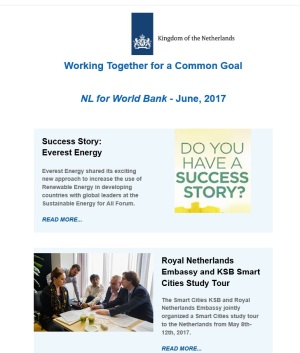
Newsletter June 2017: Working Together for a Common Goal

We are excited to bring you our SECOND edition of  2017 NL4WorldBank newsletter, Working Together for a Common Goal which was published June 1st. Working Together for a Common Goal

In this edition the success story highlights the work of Everest Energy, an Energy partner of the World Bank.
We are proud to bring you the details of The Smart Cities KSB and Royal Netherlands Embassy jointly organized Smart Cities study tour to the Netherlands. This event was a huge success and we look forward to organizing more like it.
Other important events that will be taking place soon are the Private Sector Webinar on “How to Complain”, The webinar will be held on Thursday June 8, 2017 and the Private Sector Liaison Officers (PSLO) joint mission focusing on the energy sector ,mark your calendar for October 23- 25, 2017.

Continue reading

Everest Energy at the SEforALL Forum in NYC

Accelerating Sustainable Energy development through smarter, faster financing. index

Everest Energy shared its exciting new approach to increase the use of Renewable Energy in developing countries with global leaders at the Sustainable Energy for All Forum. The theme of the Forum was “Going Further, Faster – Together” and it was structured as a marketplace of ideas to broker new partnerships, spur investment and drive action towards sustainable energy and realizing Sustainable Development Goal 7. With its new financing tools and its recently launched partnership in East Africa, Everest Energy has a role to play.

Continue reading

Disaster risk management a top priority on the international stage this week

How many school children can be endangered by the schools themselves? The answer was over 600,000 in metropolitan Lima alone.

In the region, fraught with frequent seismic activity, nearly two-thirds of schools were highly vulnerable to damage by earthquakes. Working with the Peruvian Ministry of Education (MINEDU), the World Bank and the Global Facility for Disaster Reduction and Recovery (GFDRR) conducted a risk assessment that ultimately helped make an estimated 2.5 million children safer and paved the way for a $3.1 billion national risk-reduction strategy.

Continue reading

World Bank Group Country Engagement

The World Bank Group’s Country Partnership Framework (scd_cdf_report-image_4CPF) aims to make our country-driven model more systematic, evidence-based, selective, and focused on the Bank’s twin goals of ending extreme poverty and increasing shared prosperity in a sustainable manner. The CPF replaces the Country Assistance Strategy (CAS). Used in conjunction with a Systematic Country Diagnostic (SCD),  the CPF guides the World Bank Group’s (WBG) support to a member country.

Continue reading

Webinar on “How to Complain?”

You are kindly invited to join us for a Private Sector Webinar on “How to Complain”, Theindex webinar will be held on Thursday June 8, 2017 from 08:00am – 10:00am Washington, DC Time.
Description

The 2016 Procurement Framework has enhanced the mechanism for handling of procurement-related complaints. The enhancements are aimed at providing fair, timely and meaningful relief to complainants while avoiding undue delays and disruptions to project implementation.

Register: Please email your interest to: Nancy Bikondo-Omosa (nbikondo@worldbank.org).

Deadline: 5pm, Monday June 5, 2017

Continue reading

Number of Carbon Pricing Initiatives Nearly Doubled over Past Five Years, says New Report

More Countries Expand Carbon Pricing Effortscarbon pricing

BARCELONA, May 23, 2017 – The number of carbon pricing initiatives implemented or scheduled has almost doubled over the past five years, according to Carbon Pricing Watch 2017, a new publication released at the Innovate4Climate Summit today.

Since 2016, eight new carbon pricing initiatives have been put in place – three at a national level and five at a subnational level.

Continue reading

A new role for development banks?

Earlier this month, development banks from around the world took stock of where they infrastructure2stand and where they see their efforts having the greatest impact at a meeting organized by the World Bank and Brazil’s development bank, BNDES.

As the world struggles to find funds to meet the Sustainable Development Goals, development banks can be instrumental in narrowing that gap. They can help to crowd-in the private sector and anchor private-public sector partnerships, particularly for infrastructure financing.

Continue reading

The Smart Cities KSB and the Royal Netherlands Embassy Smart Cities Study Tour to the Netherlands

A deep dive into the quadruple helix that makes the Netherlands ‘smart’ SC missie

The Smart Cities KSB and Royal Netherlands Embassy jointly organized a Smart Cities study tour to the Netherlands from May 8th-12th, 2017. City officials, officials from the national government, and urban planners from Bangladesh, Macedonia, Morocco, South Africa and South-Eastern Europe spent five days engaging with Dutch innovators and practitioners from the government and private sector on smart urban management, smart mobility, smart energy transition, PPP-structures, and citizen engagement, among other things.

Continue reading