Pulling the chain: business solutions for managing human fecal waste

­

The Water Blog

Private sector investment principles could make the fecal sludge management chain sustainable, says a new report released in time for FSM4

To understand why innovation in fecal sludge management matters, ask yourself this: In 15 years, when almost 5 billion people are using on-site sanitation, solutions like pit latrines and septic tanks, what will the world do with all the fecal waste? About half that many people use onsite sanitation today, and we already have a hard time keeping up.
Continue reading

Improving the Organizational Structure and Staff Conditions of Service for Lusaka Water and Sewerage Company, Zambia

Deadline: 24-Feb-2017 at 11:59:59 PM (Eastern Time – Washington D.C.)water

Lusaka Water and Sewerage Company (LWSC)is currently implementing a World Bank-assisted Lusaka Sanitation Project which aims to increase access to improved sanitation services and strengthening LWSC’s institutional capacity to deliver on its mandate. Within the context of the project, LWSC management has requested the Bank to support an urgent technical assistance (TA) activity aimed at reviewing LWSCs current organizational structure in order to inform important HR-related decisions that LWSC management and Board of Directors are considering as they embark on the process of transforming the utility. The objective of the TA is to review and advise on an improved and sustainable organizational structure and staff conditions of service for LWSC. The outputs from this activity will help inform critical decisions on maximizing staff productivity and performance, and reducing skyrocketing staff costs.

Continue reading

eC2:Technical Assistance to the Ministry of Water and Sanitation (Senegal) to improve sanitation services delivery in small towns

Deadline: 21-Feb-2017 at 11:59:59 PM (Eastern Time – Washington D.C.)

waste water treament

Pour être éligible, le candidat doit disposer de compétences avérées en matière détudes de définition de stratégie dassainissement dans les gros centres ruraux ou les petites villes, incluant lélaboration des schémas directeurs jusquà la réalisation des études techniques détaillées et la production des dossiers dappels doffres en vue de la réalisation des travaux. Les membres de léquipe de consultants choisie devront justifier chacun au moins de deux expériences concluantes en matière de projets similaires, particulièrement appliquées aux populations sénégalaises ou ouest-africaines. La gestion détudes sur des populations rurales de grande taille est aussi essentielle.

Continue reading

eC2:Water Utility Prefeasibility Study for Private and Public Debt Financing to Enhance the WSS Service Delivery in the Urban Area of Tegucigalpa

*Updated

Deadline: 15-Feb-2017 at 11:59:59 PM (Eastern Time – Washington D.C.)water

Design a business plan (BP) based on existing information on the SANAA, which will need to be validated to build an interactive financial model (FM) that will guide UMAPS in decision making with respect to the operation, maintenance and investments that will improve the quality of water and sanitation services as well as achieve financial and environmental sustainability.

Continue reading

Water, the economy, and development: New insights on a complex challenge

­

In the World Bank Water Practice, we often talk about how issues like flooding and drought_creative_commons.jpgdroughts threaten our mission to end poverty and boost shared prosperity. But how much do we actually know about how these floods and droughts – “water shocks” – impact farmers, firms, and communities? Perhaps adaptation in the economy has limited such impacts. Or maybe policies have led to economies being more vulnerable to such shocks.
Continue reading

eC2:Water Utility Prefeasibility Study for Private and Public Debt Financing to Enhance the WSS Service Delivery in the Urban Area of Tegucigalpa

Deadline: 08-Feb-2017 at 11:59:59 PM (Eastern Time – Washington D.C.)water

Design a business plan (BP) based on existing information on the SANAA, which will need to be validated to build an interactive financial model (FM) that will guide UMAPS in decision making with respect to the operation, maintenance and investments that will improve the quality of water and sanitation services as well as achieve financial and environmental sustainability.

Continue reading

Increasing Salinity in a Changing Climate Likely to Alter Sundarban’s Ecosystem

Story Highlightssundarbans_from_dr_danda
  • The salinity of river water and soil in Bangladesh’s low-lying southwest coastal region is increasing over time, and will aggravate further with sea-level rise in a changing climate.
  • The increase in salinity will reduce the Sunderbans’ key species Sundri, the forest’s highest-value timber species, and increase saline-tolerant species Gewa, Baen and Goran.
  • The progressive water salinization will change the availability of many freshwater fish species, thereby depriving the poor of their main source of protein, and adversely impacting the incomes of families. The poor populations that will lose freshwater fish species are about six times greater in number than those who will be gaining brackish fish species.


Continue reading

Testing water quality: When labs don’t work

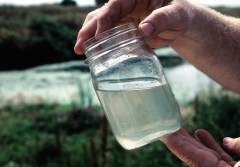
Drinking water utilities, water resource management agencies, and environmwater_quality_mason_jarental regulators across the world are required to establish laboratories to test water quality. Proper testing ensures that water is safe for its intended use, whether that be drinking, bathing, fishing, watering crops, or sustaining ecological health. Yet we routinely find poorly-functioning analytical labs. Failure to follow standardized procedures, maintain certification, and perform routine checks for quality assurance and quality control (QA/QC) compromises the reliability of lab results. As a result, the data are of limited use for managing water safety.

Continue reading

eC2:Urban Wastewater Treatment Directive: Opportunities of EU accession

Deadline: 31-Jan-2017 at 11:59:59 PM (Eastern Time – Washington D.C.)water

The objective of this study is to assess specific issues in Danube Basin region regarding: (i) implementation, (ii) outcomes; and (iii) sustainability (mostly from the point of view of affordability) of the UWWTD in the Danube Region. While the study will primarily base its assessment in the experience of current EU members countries within the Danube River Basin in the directive implementation, the work is expected to also benefit EU candidates and potential candidate countries from the region (meaning almost all other countries of the region). In this first stage, the study will not seek to answer all of those questions conclusively, but rather to provide sufficient elements needed to initiate an in depth discussion on achievement and appropriateness of UWWT directive implementation in DRB. In parallel, the study will also seek to document specific good practices that might show how to improve implementation efficiency

Continue reading