

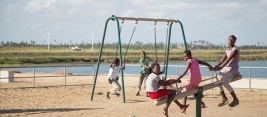
At a school in Malawi, students are enjoying play time at recess. Unfortunately,  sometimes recess lasts all day because the teacher doesn’t come to work.
In a classroom in Armenia, students are receiving grades for their ability to repeat memorized text, with textbooks dominating the learning process rather than teacher instruction and innovation, leaving graduates unprepared for a competitive work environment.
In Bangladesh, despite improving enrollment rates, girls are still not learning as much as boys, and dropout rates are high – with lost years in schooling being attributed to child marriage, household responsibilities and other factors.
 markets to invest in development projects. Through its arm for middle-income countries, the International Bank for Reconstruction and Development (IBRD), the World Bank Group funded public sector projects like roads, green energy, health or education systems; and through the International Finance Corporation (IFC), it provided capital to the private sector in developing countries to help businesses grow and provide jobs, taxes and other wider societal benefits.
 and ultimately of development benefits and livelihoods.
 technological advances to achieve long-lasting development solutions.
 quarter century—from 36 percent of the world population in 1990 to an estimated 8.6 percent in 2018—and that living standards for hundreds of millions of people have improved over that time.


 Netherlands for the World Bank
You must be logged in to post a comment.