
You are receiving this email because you signed up for our World Bank Live Updates. We want to let you know that we have a new event coming up. February 11, 2026 <a href="https://t.newsletterext.worldbank.org/r/?id=h2b08fbb1,eee1fdd,ef262e4&e=cDE9PGIgc3R5bGU9J2NvbG9yOg&s=moq4BV9sf59jrkGzm1tQd27yflhKkjicSn9DILXeFME#004370;font-size:16px;'>Making AI Work for All: You Ask, We Answer Making AI Work for All: You Ask, We Answer Location: Online 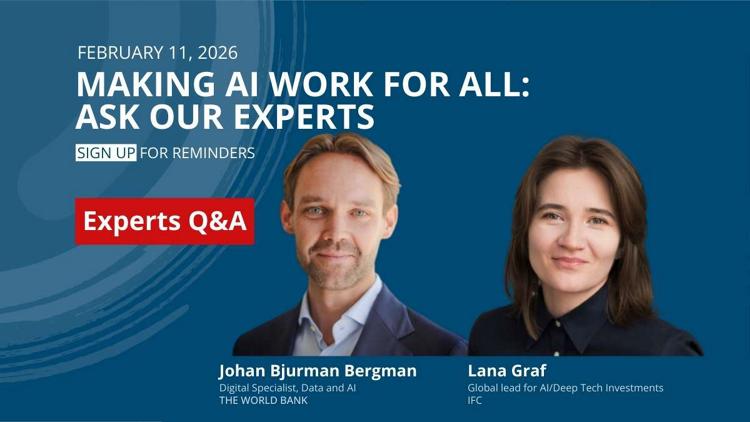 What is small AI, and how can it help developing countries tackle real-world challenges? In this live Q&A, two World Bank Group experts, Johan Bjurman Bergman and Lana Graf, will discuss how practical, affordable, and adaptable AI tools are improving health, agriculture, education, service delivery, and support for small businesses. What is small AI, and how can it help developing countries tackle real-world challenges? In this live Q&A, two World Bank Group experts, Johan Bjurman Bergman and Lana Graf, will discuss how practical, affordable, and adaptable AI tools are improving health, agriculture, education, service delivery, and support for small businesses.Submit your questions in advance to learn how governments are expanding access to AI foundations—skills, data, and computing infrastructure—and why partnerships with the private sector matter for scaling solutions. Sign up for an event reminder and join us live. Experts will answer questions in the chat during the session. World Bank Live Development Events Brought to You Live |
“Credit: World Bank Group. All rights reserved”
 940m people live without electricity,
  world’s poorest countries.
 Netherlands for the World Bank
You must be logged in to post a comment.