
Today, women have just three-quarters of the legal rights of men. In 1970, it was less  than half. The Women, Business and the Law 2020 report presented results from our recent effort to document how laws have changed since 1970. This exceptional dataset has already facilitated ground-breaking research that shows that a country’s performance on the Women, Business and the Law index is associated with more women in the labor force, a smaller wage gap between men and women, and greater investments in health and education. We hope that sharing the data and reform descriptions on our website will lead to more evidence that will inspire policymakers to change their laws so that more women can contribute to economic growth and development.
Tag Archives: Woman
eC2: IFC Research on Women & Ecommerce in Emerging Markets
Deadline: 29-Aug-2019 at 11:59:59 PM (Eastern Time – Washington D.C.) 
IFC seeks expressions of interest from firms to quantify, qualify and articulate the state of women in eCommerce, and the potential for eCommerce platforms to contribute to closing gender gaps through jobs, skills development and access to finance. This research aims to serve as a foundation of knowledge when building and growing gender-equitable eCommerce platforms in Africa and South East Asia.
Report: Women, Business and the Law 2019- A Decade of Reform
Women, Business and the Law measures global progress toward gender equality in the  law. Topic notes and related research provide further analysis of the data. To gain new insight into how women’s employment and entrepreneurship choices are affected by legal gender discrimination, this study examines ten years of Women, Business and the Law data through an index structured around economic decisions women make as they go through different stages of their working lives.
eC2: Women digital platform and positioning strategy
Deadline: 27-May-2019 at 11:59:59 PM (Eastern Time – Washington D.C.)
IFC is hiring a consulting firm that will help design and develop a digital platform for women customers; and support in the women positioning strategy for a financial institution headquartered in the Andean Region. Continue reading
Stand with us to help make land rights a reality for millions of women around the world
In March 2019, the World Bank and several other development organizations launched 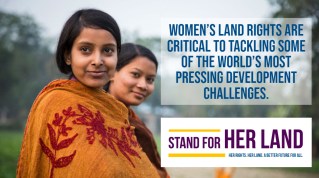 “Stand For Her Land,” a global advocacy campaign that aims to realize women’s equal access to land and properties worldwide. Let me share with you why this is important.
For more than 25 years, the World Bank supported over 50 countries in reforming land and property registration systems through modernizing laws and regulations, strengthening institutions, and issuing titles for all properties to lawful land owners. They often use land titles to access credit to improve their land and dwellings – and expand businesses or open new ones, generating jobs, boosting productivity, and increasing incomes. Furthermore, research has shown that secure land and property rights provide incentives for people to invest in agricultural land.
Trees and forests are key to fighting climate change and poverty. So are women
According to IUCN’s ‘Global Forest Watch’, from 2001 to 2017, 337 million hectares of  tropical tree cover was lost globally – an area the size of India.
So, we appear to be losing the battle, if not the war, against tropical deforestation, and missing a key opportunity to tackle climate change (if tropical deforestation were a country, it would rank 3rd in emissions) and reduce poverty. A key question, then, is what can forest sector investors, governments and other actors do differently to reverse these alarming trends?
eC2: Insights in the business case for non-financial services to Women-owned SMEs – FMO -IFC Research
Deadline: 17-Jan-2019 at 11:59:59 PM (Eastern Time – Washington D.C.)
Assignment Description
1. Gain insights into the banks business case for offering non-financial services (NFS) to SMEs broadly and in particular to women-SMEs and its impact on FI business growth and sustainability.
2. Understand how entrepreneurs usage of non-financial services offered by financial institutions (i) have an impact on the businesses as well as on family in the case of women entrepreneurs and (ii) how it translates into portfolio expansion and enhanced quality, business growth and profitability for the financial institution.
3. The study will include review of a broad set of banks and financial institutions that serve SMEs to capture practices that have been successful for SMEs in general which can be adapted and applied to benefit women SMEs/womens markets.
World leaders pledge US$1 billion to transform health and nutrition of world’s poorest women, children and adolescents
– Ten new investors—Burkina Faso, Côte d’Ivoire, Denmark, the European Commission,  Germany, Japan, Laerdal Global Health, the Netherlands, Qatar and an anonymous donor—have joined since the launch of the Global Financing Facility replenishment. They join existing funders the Bill & Melinda Gates Foundation, Canada, MSD for Mothers, Norway, and the United Kingdom to fund the GFF to improve the health and nutrition of women, children and adolescents.
– US$1 billion pledged to the GFF Trust Fund in Oslo today is expected to link to an additional US$7.5 billion in IDA/IBRD resources for women, children and adolescents’ health and nutrition.
– Burkina Faso reaffirmed its commitment to allocating at least 15% of its annual budget to improve health; Côte d’Ivoire committed to increasing its health budget 15% annually; and Nigeria recommitted to investing US$150 million per year from its budget to sustainably finance health and nutrition of women, children and adolescents.
– US$1 billion will help the GFF partnership on the pathway toward expanding to as many as 50 countries with the greatest needs, to transform how health and nutrition are financed. Alongside other global health initiatives, this can contribute to saving and improving millions of lives by 2030.
Women Wavemakers: Practical Strategies for Recruiting and Retaining Women in Coding Bootcamps
Coding bootcamps, a type of rapid tech skills training program, have recently emerged as a promising approach to equipping individuals with the skills needed to thrive in digital economies. Despite the potential of these programs, women often participate at lower rates than men.
The Women Wavemakers report draws on the experiences of 25 coding bootcamps and seven digital skills programs in 22 countries to provide a menu of options that providers and policymakers can test and refine, in three key areas:
Missed Opportunities: The High Cost of Not Educating Girls
Globally 89% of girls complete primary education, but only 77% complete lower  secondary education, which in most countries is 9 years of schooling. In low income countries, the numbers drop to below 2/3 for primary education, and only 1/3 for lower secondary school.
 Netherlands for the World Bank
You must be logged in to post a comment.