
Just over a decade out from the SDG deadline of 2030, many developing countries are not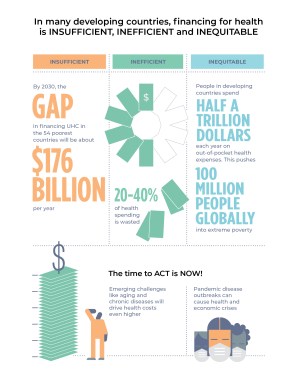 on track to meet Universal Health Coverage (UHC) targets to ensure access to quality, affordable health services to all. People in developing countries pay over half a trillion dollars annually out-of-pocket for health services, which is pushing about 100 million people into extreme poverty each year. The evidence is strong that progress towards UHC would spur not just better health but also inclusive and sustainable economic growth, yet this report estimates that in 2030 there will be a UHC financing gap of $176 billion in the 54 poorest countries. This threatens decades-long progress on health, endangers countries’ long-term economic prospects, and makes them more vulnerable to pandemic risks. This report, launched to inform the first-ever G20 Finance and Health Ministers session in Osaka, Japan in June 2019, lays out an action agenda for countries and development partners to bridge the UHC financing gap, and makes a strong case for a focus on innovation in health financing over the next decade.
Download Full report and Executive summary
 Sustainable Development Goals. To design and optimize projects for poverty reduction, we need to measure their impact on poverty. This is quite difficult because changes in the poverty rate might take some time, and it is usually hard to attribute the impact to a particular project, especially without conducting a randomized controlled trial (RCT). But even if we manage to overcome these challenges, we need to measure poverty before the start of the project – as a baseline and to understand whether the project adequately targets the poor – and at the end of the project to assess its impact. And that is also not easy.
 Caribbean (LAC) region is “on track to achieve universal access by 2030,” according to the
  sustainable investing in the capital markets. Today, the green bond model is being applied to bonds that are raising financing for all 17 Sustainable Development Goals.
 transformations: building human capacities (health, education, new job skills); decarbonising energy; promoting sustainable agriculture and biodiversity; building smarter cities; implementing the circular economy; and harnessing the digital revolution. As such, sustainable development and the 17 Sustainable Development Goals (SDGs) in particular pose a financing challenge. There are three distinct financing conundrums to solve: financing complex infrastructure, financing public services and amenities, and shifting investments from unsustainable to sustainable technologies. I discuss these in turn.
 a
a  In the context of strained public finances and limited borrowing capacity for developing countries, there is growing debate on the roles of public and private actors to deliver the trillions of dollars of infrastructure necessary to achieve the
  “The World Bank is one of the world’s largest producers of development data and research. But our responsibility does not stop with making these global public goods available; we need to make them understandable to a general audience.
  STORY HIGHLIGHTS
 Netherlands for the World Bank
You must be logged in to post a comment.