

Until recently, researchers studying AI’s labor market effects had to work with a fundamental limitation: Without actual usage data, we had to rely on theoretical measures of “exposure”— estimates of how susceptible different occupations might be to AI disruption. We discussed those studies in our earlier work on AI exposure in low- and middle-income countries. But a crucial question remained unanswered: Do the exposure predictions for these jobs match how people are using AI in practice?
The predictions largely got it right
Anthropic recently released anonymized usage data from a sample of conversations with Claude over one week in November 2025, categorized by task type using O*NET, a US classification system that links tasks to occupations. We mapped this data to occupations and countries to compare predicted exposure with actual adoption patterns.
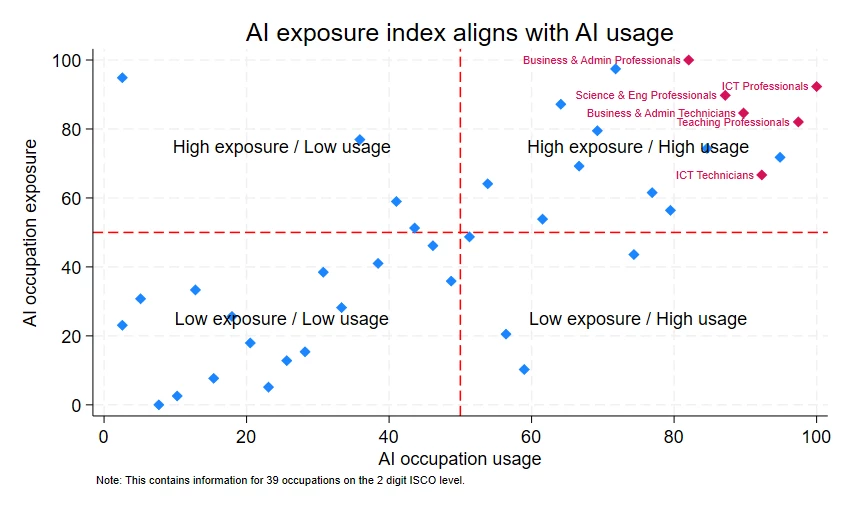
The central finding: Exposure indices prove to be remarkably accurate predictors of real-world AI adoption. Occupations with low predicted exposure generally showed low usage, while those with high exposure demonstrated high usage. Very few occupations fell into the mismatched categories of high exposure but low usage, or vice versa.
Digging deeper, we found that information and communications technology (ICT) professionals lead the pack in both AI exposure and usage. This makes intuitive sense as IT workers typically have better access to technology infrastructure and gain immediate productivity benefits from AI tools.
More surprising is the gap among managers. Management-level positions showed high AI exposure but relatively low usage. Several factors may be at play: Privacy concerns around sensitive business decisions, time constraints that limit experimentation, or organizational cultures where delegation to AI is not yet normalized. Understanding why managers—who often control AI adoption decisions—aren’t yet heavy users themselves could be crucial for predicting organizational AI diffusion patterns.
A stark global divide
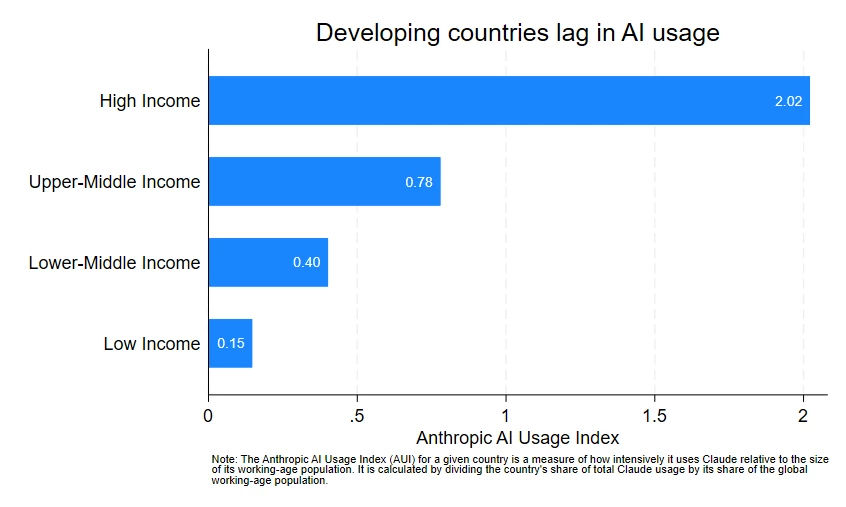
Additional data from the Anthropic AI Usage Index measures Claude’s usage intensity by country relative to the size of the working age population. A value above one means a country uses AI more than expected relative to its working-age population. An index value below one suggests AI is underutilized relative to expectations given the population size. Only high-income countries (HICs) have values above one, averaging 2.02, while all other country groups fall below one. On average, HICs report usage rates about four times higher than MICs, with only HICs exceeding the global per-capita benchmark.
The composition of usage also differs sharply. Anthropic’s data classifies usage of Claude by associated occupation. In HICs, Claude usage is spread across professions. In middle-income countries (MICs), it is heavily concentrated: ICT workers account for 48% of usage and teaching professionals for 24%. Together, these two groups account for nearly three-quarters of all AI usage in MICs, compared to more than half in HICs. This concentration likely reflects a combination of greater demand and greater access among these workers compared to others in MICs. The latter finding matches data showing that more than half of teachers in many MICs report they are already using AI. We omit low-income countries from this analysis due to insufficient observation.

Three key insights for policymakers
We see three conclusions from this brief analysis:
- First, exposure indices work. AI occupation exposure indices, such as the AI Occupational Exposure (AIOE) measure, correlate with AI usage. This means policymakers can use these indices to gauge which workers and industries may face the greatest jobs impacts.
- Second, adoption follows a predictable pattern. Generative AI tools are being adopted first by technologically savvy ICT professionals, then gradually spreading to other occupations. While the diffusion process is well underway in high-income countries and beginning in middle-income countries, it has barely started in low-income contexts.
- Third, the adoption divide demands deliberate action. The concentration of AI usage in high-income countries signals a risk of a new form of technological exclusion. Without deliberate interventions—investments in digital infrastructure, skills development, and enabling policy environments—low- and middle-income countries may find themselves further marginalized in an AI-driven global economy.
These findings carry profound implications for the World Bank Group’s mission and its jobs agenda. With more than a billion young people in developing countries set to enter working age over the next decade, understanding how AI reshapes labor markets is not an academic exercise but a development priority. The stark usage divide this analysis reveals, with four times lower AI adoption in middle-income countries than in high-income countries and barely starting in low-income countries, a new form of technological exclusion is emerging that could widen the gap between rich and poor nations precisely when the demographic stakes are highest. If AI-driven productivity gains remain concentrated in wealthy economies, developing countries could lose their comparative advantage in labor-intensive industries to automation and reshoring, undermining the export-led growth strategies that have historically lifted millions out of poverty.
“Credit: World Bank Group. All rights reserved”

 of
of  only to educate, but also to engage and inspire their audiences. Data is crucial for informing knowledge work and measuring the impact of sustainable development programs. The
  the equivalent of more than 200 percent of government revenues.
  Offices in twelve IDA-19 countries to support the production of gender data in the economic domain.
 living standards for the country’s people over the next two decades. A country in the Horn of Africa, Djibouti has a rocky, arid landscape that has driven the vast majority of people to cities. More than 35 percent of the country lives in poverty, and about 21 percent in extreme poverty, including nomadic Djiboutians and others who live in extreme rural poverty.
 increased to levels not seen in more than a decade, to 150 billion cubic meters (bcm), equivalent to the total annual gas consumption of Sub-Saharan Africa.
 Netherlands for the World Bank
You must be logged in to post a comment.