
It is increasingly apparent that the costs of COVID-19 will be borne disproportionately by poorer segments of society, especially in lower income countries. Women, children and displaced  populations have been hardest hit. This crisis – more so than other crises before – requires scalable solutions for the world’s poorest. For many countries, this presents unchartered territory.
Tag Archives: COVID-19
World Development Report 2021: Data for Better Lives
Data are everywhere. But what is the data revolution doing for the 700 million people who live 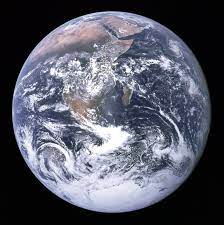 in extreme poverty? When data are turned into valuable information, they have the potential to improve lives, transform economies, and help end poverty. Now more than ever, the world is facing new demands for data as our principal weapon in the war against COVID-19. The latest edition of the World Development Report from the World Bank provides a blueprint on how to harness the power of data for development, to ensure no one is left behind.
https://wdr2021.worldbank.org/
https://wdr2021.worldbank.org/the-report/#download
Tackling the COVID-19 Pandemic of Inequality to Build a Green, Inclusive, & Resilient Recovery
Join World Bank Group President David Malpass, ahead of the Spring Meetings, at the London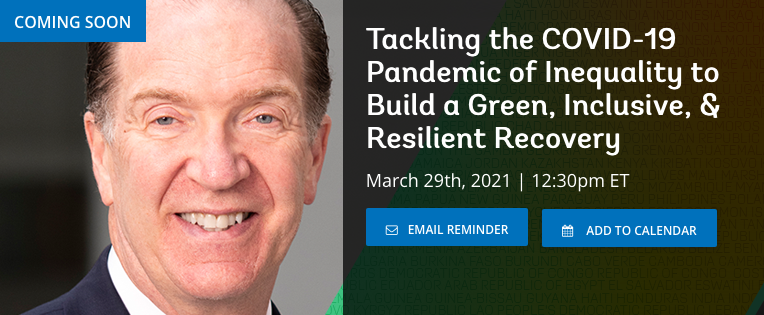 School of Economics as he discusses what is needed to build a green, inclusive, and resilient recovery from the pandemic. The crisis has worsened inequality and disproportionately impacted the poorest and most vulnerable, particularly women and children.
In his conversation with Minouche Shafik, Director of the London School of Economics and Political Science, President Malpass will share his thoughts on accelerating a recovery that tackles growing inequalities and improves livelihoods.
Join us for the live conversation on March 29.
Be sure to sign up for an email reminder!
See the list of Speakers
Assessing Country Readiness for COVID-19 Vaccines – First Insights from the Assessment Rollout
The global COVID-19 vaccination campaign will be the largest in history. The delivery of

COVID-19 vaccines presents challenges unprecedented in scale, speed and specificities, especially in low- and middleincome countries. In November 2020, anticipating the availability of safe and effective vaccines for COVID-19, the World Bank together with WHO, UNICEF, the Global Fund, and Gavi rolled out readiness assessments in more than 100 low and middle-income countries.
One Year Into The COVID-19 Pandemic, Six Stories That Inspire Hope
March 11 marks one year since COVID-19 was officially declared a pandemic. While the past year has been tremendously challenging, there have been remarkable stories of human resilience, ingenuity, and creativity. On this grim anniversary, we wanted to bring you stories from around the world that inspire. The following six stories are not billion-dollar projects, but the tales of everyday entrepreneurship and innovation happening on a small scale with a big impact. The World Bank Group is continuing to support the poorest countries as they look to a build a sustainable, resilient, and inclusive recovery.
1. Lao PDR: Unlocking the Full Potential of Small- and Medium-Sized Enterprise
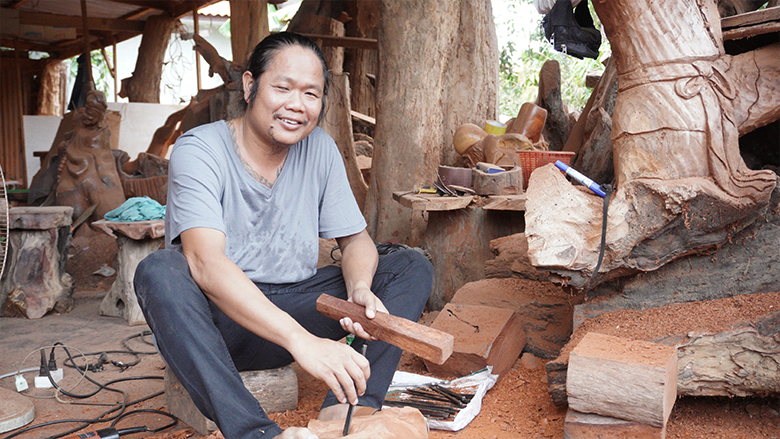
Vorachith Keoxayavong
Building back better from the crisis: What will it take for the poorest countries?
It is a catchy acronym. An alliterative call to action. It rolls off the tongues of world leaders like  UK Prime Minister Boris Johnson and US President Joe Biden. Building Back Better—or BBB—is the seeming light at the end of the COVID-19 tunnel. But what does BBB really mean in the world’s poorest countries? And how can these countries—which are supported by the World Bank’s International Development Association (IDA)—secure the resources they need to make it happen?
Empowering the Poorest Countries Towards a Resilient Recovery
Economic inclusion programs: A springboard out of extreme poverty
As the world grapples with the pandemic, the new State of Economic Inclusion
report points to paths out of poverty for the poorest and most vulnerable.
The World Bank estimates that the economic fallout from the pandemic may add as many as 150 million extreme poor by 2021. Women, children, displaced populations, and people with disabilities have been particularly hard hit.
Better Farming on Their Own Land: How Rural Communities in Cambodia Overcome COVID-19 Restrictions and Sustain Incomes
Story highlights: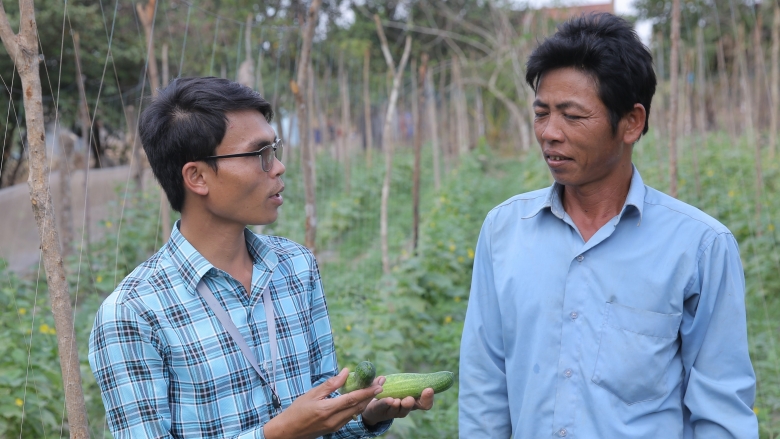
- In Cambodia, the Land Allocation for Social and Economic Development (LASED) projects secured about 16,000 hectares of land for landless and small landholder families across five provinces.
- Over 5,000 households have received direct benefits, including land titles.
- The projects will phase out by ensuring the sustainability of achievements and improving family incomes.
After the pandemic, put women first
From education to entrepreneurship, global recovery efforts need to pay
particular attention to the needs of women and girls.
When the 2008 recession hit, few asked how stimulus measures would affect women compared with men.
 Netherlands for the World Bank
You must be logged in to post a comment.