Netherlands for the World Bank

Your guide to the World Bank Group

Netherlands for the World Bank

Countdown to 2030: A race against time to end extreme poverty

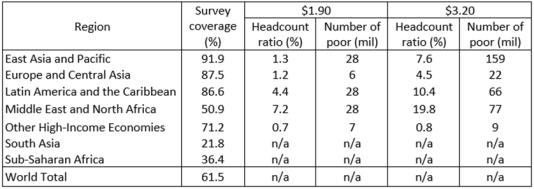
Imagine you are in a race, running at a steady pace during the first two-thirds. However, center-gravity-extreme-poverty-povcal-world-bankyou notice that your pace is slowing, and you realize that unless you make changes you are not only not going to win, but you risk not even completing the race.

I find this analogy to work well while narrating the story about the reduction in global extreme poverty to my family and friends. As we move into 2020, we only have a decade to make extreme poverty history.   Even though this is when we should be ratcheting up the pace, it has been slowing for the last few years, so that the world not only risks missing out on its extreme poverty reduction goals, but in some cases, we are seeing a reversal in the gains achieved.

Continue reading

eC2: A landscape analysis and pre-feasibility study of Urban Nature Based Solutions to reduce flood risk and strengthen resilience in the City of Kigali, Rwanda

Deadline: 29-Jan-2020 at 11:59:59 PM (Eastern Time – Washington D.C.)blog-in-benin-can-resilient-investment-solutions-save-a-battered-coast-780x439

The World Bank is providing Technical Assistance (TA) to the Government of Rwanda under the Rwanda Urban Development Project II (RUDP II), to identify suitable typologies and sites for Nature-Based Solutions (NBS) to reduce flood risk reduction and strengthen resilience in the City of Kigali. The overall objective of the TA is to mitigate the impact of flooding in precarious urban neighborhoods and to create multiple benefits for livelihoods in Kigali through targeted green interventions in urban planning and flood risk management. This TA helps to identify the potential for city-wide NBS investments, and to support dialogue with the Government of Rwanda for specific works to be financed under RUDP II.

Continue reading

Data Collection in Fragile States

Highlights Data-collection-fragile-settings1.jpg

  • Decision makers in fragile countries need quality data; obtaining such data is challenging.
  • This book presents innovations, methodological as well as in data collection, to meet this challenge. The innovations presented in this book are relevant beyond fragile situations.
  • With effort, quality data can be produced for many fragile situations, effectively eliminating the notion that data cannot be collected in certain difficult circumstances.

Continue reading

Does the impact of refugees on host communities pass down through generations?

Following decades of violent conflicts in Burundi, Rwanda, South Sudan and the untitledDemocratic Republic of Congo (DRC), Tanzania became home to thousands of refugees seeking shelter.  By the end of 1994, Tanzania— known for its hospitality and open-door policy— was hosting close to 1.3 million refugees in its northwestern region , making it one of the top four refugee-receiving countries in Sub Saharan Africa. The majority of these refugees settled in 13 main camps in the northwestern districts of Karagwe, Ngara, Kasulu, Kigoma and Kibondo.  In some of these districts, refugees outnumbered Tanzanians five to one— making it perhaps the most pronounced forced displacement crisis. By the end of May 1994, the Benaco refugee camp in Ngara district had become the largest in the world.

World Bank Blogs

Continue reading

eC2: Gender-disaggregated Impacts of Street Lighting in Brazil

Deadline: 30-Jan-2020 at 11:59:59 PM (Eastern Time – Washington D.C.) Solar-street-lights-in-Guinea1

The objective of this activity is to carry out a qualitative baseline assessment of the effects of street lighting (or the lack of it) on mens and womens perceptions of safety and on mobility, economic activity, and educational and professional opportunities. The analysis will also include a comprehensive qualitative assessment of the current level of street lighting (pole presence, energy source, technology, brightness, availability, reliability, etc.), and a review of the literature on the impacts of street lighting on crime and violence.

Continue reading

eC2: Regional Program for Digital Innovation to Support Public Transport and Sector Growth

Deadline: 27-Jan-2020 at 11:59:59 PM (Eastern Time – Washington D.C.) general-transport-mosaic-main

The project objective is to apply best global practice and develop shared knowledge and tools to understand, regulate and improve paratransit transportation in developing countries by using new digital technologies through a regional programmatic approach for countries in Southern Africa. This will require a deeper understanding of the informal paratransit operations and business efficiency (or inefficiency) and contribute toward moving the informal sector toward formalization in the SSA region and globally.
Specific objectives
This project intends to address the following specific objectives:
(i) understand the quality and efficiency of paratransit operations and users mobility patterns, (ii) share such information with paratransit operators and engage them in the discussion of potential operations and business improvements, and (iii) contribute to the development of regulation and policies that will yield service improvements in the informal transit sector.

Continue reading

eC2: Evaluation of the 2030 Water Resources Group Model & Lessons Learned for Achieving the SDGs

Deadline: 13-Feb-2020 at 11:59:59 PM (Eastern Time – Washington D.C.) index

Launched in 2008, the 2030 Water Resources Group (2030 WRG) (http://www.2030wrg.org) aims to help countries facilitate collective action among government, the private sector, and civil society to improve water resources management. 2030 WRG does so by: (a) creating the wider political economy conditions and momentum for change in water sector reform; (b) facilitating collaboration and awareness building within the water resources community, including the private sector; and, (c) improving the design and implementation of a comprehensive and innovative set of policies, programs and projects in selected countries or regions in order to increase their water security.

Continue reading

January 2020 Global Economic Prospects: Slow growth, policy challenges

STORY HIGHLIGHTSGEP_FS.jpg

  • The world economy is poised for a modest rebound this year, but outlook is fragile.
  • Emerging, developing economy growth to accelerate in 2020 as some emerging economies recover from periods of stress.
  • Rise in debt, slowdown in productivity pose challenges for policymakers.

eC2: Public Expenditure Reviews of the Water Sector in select countries in Africa (Kenya, Mozambique, Nigeria and Sierra Leone)

Deadline: 23-Jan-2020 at 11:59:59 PM (Eastern Time – Washington D.C.) water

In each country, the main objectives of the planned PER are:
1. To identify strategic programs and activities in the water sector, consistent with its other objectives particularly those related to macroeconomic stability and public financial management
2. To make assessment of the funding gaps and efficiency gaps (both allocative efficiency and technical efficiency) in the water sector and develop appropriate polices for improving efficiency and effective channelization of financial resources to reach agreed sector goals.
3. To support the design and delivery of effective water services.

Continue reading