
February 17, 2015 — IFC and the World Bank held a series of policy meetings last week with the Dutch where they agreed on strengthening their partnership by 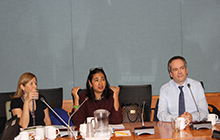 engaging in strategic priorities, finding new ways of working together, and exploring the implications of our partnership in light of the recent organizational changes within the World Bank Group.
The meetings, which followed high-level strategic consultations held in September 2013, explored further engagement in four key mutual strategic priorities: agriculture and food security; fragility, conflict and violence; water; and sexual and reproductive health and rights.
Category Archives: WBG News & Reports
The newly launched WBG Analyst Program
The newly launched WBG Analyst Program is an early starting point for an exciting career in the World Bank Group (WBG).
The live Q&A will start here on February 24th at 10:00am ET.

On February 24th, WBG representatives from Human Resources as well as other junior staff currently working at the WBG will take your questions in this newly launched Program. Come and join us in this live chat and learn more about this exciting new employment opportunity.
WB E-institute course : Frontiers in Development Policy
Dates: February 16, 2015 – March 13, 2014
Application Ends On : February 12, 2015
The world economy is undergoing a major transformation.The economic crises in Western economies, persistent poverty despite impressive GDP growth in a number of developing countries, and the emerging prominence of Brazil, China, and India hint at changing global dynamics.
Policymakers and development practitioners are facing an increasingly complex array of economic, social, and political challenges.They need a broad-based understanding of the functioning and complexities of the economy as well as an awareness of the latest thinking and approaches to development policy.
The Frontiers in Development Policy course helps address this need. It is designed for future leaders, policymakers, and change agents who are trying to meet the development challenges facing their countries. This practical policy course will distill and disseminate “what we know and don’t know” and will outline the “how to” of reform.
Target Audience:
Policy makers, academics, representatives of donor agencies and civil society organization, students of development economics.
Interested in learning more about development policy click here.
World Bank CFO Badré in the Netherlands
Last week, the World Bank’s Chief Financial Officer (CFO) Bertrand Badré was in the Netherlands for a roadshow covering banks and institutional investors. Accompanied by Frank Heemskerk, the Netherlands Executive Director, he visited potential creditors in the Netherlands. Part of the mission was to look for the financial firepower of Dutch pension funds that can possibly be leveraged by the World Bank Group.
‘We present to ABP and PGGM what we do’, Badré says. ‘Banking is not about making money, but about dealing with future risks. Infrastructure, for instance, is an investment category for institutional investors. We are well-placed to finance infrastructure in developing countries and can leverage investment from institutional investors. Banks are cautious. So we have to turn to pension funds, but also the BlackRocks and AXAs of this world. They don’t come to us, so we go to them.’
Boosting Solar Energy Capacity in Africa
Press release published on the World Bank website.
The IFC prides its self on funding innovation, this makes for interesting opportunities for Dutch companies developing innovative products who are looking for a strong partner.
“We take innovative approaches to our investments, supporting large, potentially transformative projects. We also help developing countries expand the use of cutting-edge technologies, such as concentrated solar power”-
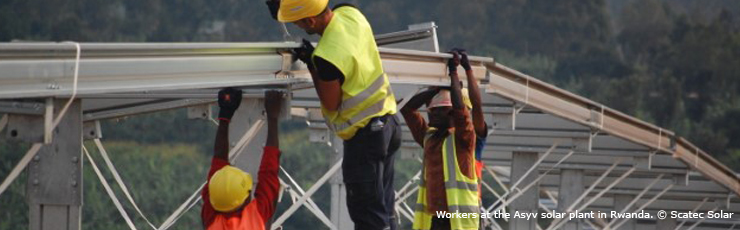
Sub-Saharan Africa is rich in energy resources but its potential remains mostly untapped. Despite the abundance of sunlight, solar projects have been developed slowly and often inefficiently.
Weak competition and high transaction costs are some of the obstacles that hamper the progress of the technology.
PSLO Follow-up Mission to Ghana & Senegal
Mark your calendars: May 31 – June 05, 2015 – Ghana & Senegal
The PSLO Network invites you to mark your  calendars for a follow-up PSLO Mission to Senegal and Ghana, organized by PSLOs for Belgium Johan Malin and Alexander Herring. The Mission will include meetings with World Bank and IFC representatives, Government Implementing Agencies, and Business-to-Business meetings with local companies.
IFC Global Private Health Conference 2015

“In its sixth year, the IFC Global Private Health Conference will provide a unique environment for leaders in the health industry from developed and emerging markets to exchange ideas, knowledge and best practices. The conference is a great opportunity to build new relationships and strengthen existing ones.”
More information can be found here.
When
Tuesday, May 12, 2015 9:00 AM – Wednesday, May 13, 2015 3:00 PM
Central Europe Time
Where
Marriott Prague
V Celnici 8, Praha 1 110 00 Czech Republic
Registration Deadline
Friday, May 8, 2015
WB Job opening: Senior Agriculture Economist – Dakar, Senegal
Job Title: Senior Agriculture Economist
Job Family: Agriculture & Rural Development
Job Type: Professional & Technical
Grade: GG
Location: Dakar, Senegal
Recruitment Type: International Hire
Language Requirement: English [Essential]; French [Essential]
Closing Date: 20-Jan-2015
GFADR seeks a Senior Agriculture Economist to support its strategic, advisory, and operational work in Senegal and where needed elsewhere. The Bank has a very active engagement on agriculture in Senegal, consisting of a significant portfolio of projects covering among other agricultural research, food security, agribusiness and value-chain development. There is a very active policy dialogue and close coordination with other development partners. Agriculture also figures highly in Senegal’s country partnership strategy.
Info at http://bit.ly/1BZUm1S
Global Economic Prospects
The World Bank Group published its Global Ec onomic Prospects (GEP) report yesterday, January 13, 2015.
After growing by an estimated 2.6 percent in 2014, the global economy is projected to expand by 3 percent this year, 3.3 percent in 2016 and 3.2 percent in 2017, predicts the Bank’s twice-yearly flagship. Developing countries grew by 4.4 percent in 2014 and are expected to edge up to 4.8 percent in 2015, strengthening to 5.3 and 5.4 percent in 2016 and 2017, respectively.
“In this uncertain economic environment, developing countries need to judiciously deploy their resources to support social programs with a laser-like focus on the poor and undertake structural reforms that invest in people,” said World Bank Group President Jim Yong Kim. “It’s also critical for countries to remove any unnecessary roadblocks for private sector investment. The private sector is by far the greatest source of jobs and that can lift hundreds of millions of people out of poverty.”
Read the World Bank press release here.
Ebola Hampering Household Economies across Liberia and Sierra Leone
Press release published on the World Bank website.
Latest surveys point to declines in employment, food insecurity, and long-term welfare concerns
WASHINGTON, January 12, 2014—The socio-economic impacts of Ebola in Liberia and Sierra Leone are far-reaching and persistent, according to two new World Bank Group reports. Both countries continue to experience job losses, despite their differing health outlooks. These impacts have not been limited to the areas where infections have been the highest, which points to economy-wide slowdowns. As a result, many households have been forced to take short-term actions to cope, which can have substantial long-term effects on welfare.


You must be logged in to post a comment.