
Data plays a crucial role in the 2030 agenda set out by the Sustainable Development  Goals (SDGs). It helps us to focus policies and make better decisions. It is needed to set targets, measure progress towards those targets and to hold governments accountable to their commitments under the SDGs.
Data is also essential for governments to fulfill their pledge to leave no one behind in the SDGs; that the goals should be met for all segments of society and that those furthest behind should be reached first. Despite significant progress over the last few years, we are still far away from being able to systematically identify those at risk of being left behind or to monitor their progress towards the 2030 commitments.
 ial products that households and firms use, questions about how these services are affecting consumers, providers, and the economy as a whole have become central. A new
 to announce that a
 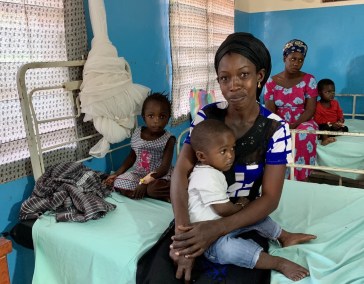 forced to ask friends and family for money. It was out of desperation after the birth of her fifth child, a little boy with a life-threatening condition that needed specialist treatment in the capital. Dieynaba was forced to leave her job teaching French and hurriedly relocate to Dakar, where she was able to find the health services he needed.
 leaders and laggards. Through institutional reform that leverages the advantages of digitalization, the Mashreq can become a vital hub in international data networks. Furthermore, digital transformation can assuage pressing challenges. It can deliver higher transparency, accelerate lackluster productivity and increase economic opportunities for all, especially the youth of this region. A new report,
 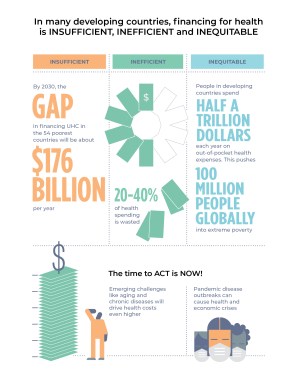 on track to meet Universal Health Coverage (UHC) targets to ensure access to quality, affordable health services to all. People in developing countries pay over half a trillion dollars annually out-of-pocket for health services, which is pushing about 100 million people into extreme poverty each year. The evidence is strong that progress towards UHC would spur not just better health but also inclusive and sustainable economic growth, yet this report estimates that in 2030 there will be a UHC financing gap of $176 billion in the 54 poorest countries. This threatens decades-long progress on health, endangers countries’ long-term economic prospects, and makes them more vulnerable to pandemic risks. This report, launched to inform the first-ever G20 Finance and Health Ministers session in Osaka, Japan in June 2019, lays out an action agenda for countries and development partners to bridge the UHC financing gap, and makes a strong case for a focus on innovation in health financing over the next decade.
 and tourist, to Uzbekistan, then still a Soviet republic. In Karakalpakstan, the autonomous republic in current-day Uzbekistan, the Aral Sea has all but disappeared. Where fishing communities once thrived, all that remains is a scarred, desert landscape. Rusted ships are perched precariously on piles of sand and salt, along with a potent, unhealthy mix of toxic pollutants from industrial agriculture.
 Sustainable Development Goals. To design and optimize projects for poverty reduction, we need to measure their impact on poverty. This is quite difficult because changes in the poverty rate might take some time, and it is usually hard to attribute the impact to a particular project, especially without conducting a randomized controlled trial (RCT). But even if we manage to overcome these challenges, we need to measure poverty before the start of the project – as a baseline and to understand whether the project adequately targets the poor – and at the end of the project to assess its impact. And that is also not easy.
 Netherlands for the World Bank
You must be logged in to post a comment.