
There are uncertainties and misconceptions about the impact of digital technologies on the future of work. Will robots replace humans in the work place? Will digital technologies create a new “digital divide” and widen inequalities between the higher-educated connected and lower-educated unconnected people? Will new opportunities open up for African countries to create jobs, improve incomes, reduce poverty and climb up the development ladder?
Yearly Archives: 2019
eC2: DRONE TECHNOLOGY FOR MONITORING INDEPENDENT PALM OIL SMALLHOLDERS PRODUCTION
Deadline: 31-Jul-2019 at 11:59:59 PM (Eastern Time – Washington D.C.) 
The overall goal of this project is to establish new method on monitoring independent palm oil smallholder. The selected vendor is expected to recommend a method for smallholder monitoring using drone image advice and data service for smallholders, including develop an effective data distribution to smallholder farmers, cost per farmers, and payment collection system from smallholder farmers.
Specifically, the project will conduct aerial mapping of a minimum 15,000 hectares of smallholder farmland (each with approximately one to three hectares of land) and distribute image data to a minimum 1000 of independent smallholder farmers.
This will include:
– aerial mapping of a minimum 15,000 hectares of smallholder farmland,
– image analysis and interpretation of the image captured by the aerial mapping
– Provide report and recommendation for scale up the use of drone for smallholder monitoring, cost per farmer, effective data distribution and payment collection system from smallholders.
IMF Reports World Economic Outlook, July 2019
 till Sluggish Global Growth
New Findex notes showcase digital financial inclusion in Sub-Saharan Africa
We’re thrilled to release five new data notes in collaboration with the International 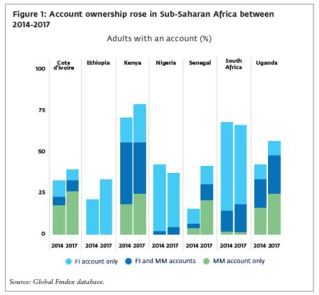 Finance Corporation and Mastercard Foundation Partnership for Financial Inclusion outlining Sub-Saharan Africa’s successes and challenges in building digital financial inclusion. The notes—all of which are available for download at our homepage—draw on tens of thousands of surveys to explore how adults in the region use accounts, digital payments, and savings to manage their financial lives.
Sub-Saharan Africa leads one of the most exciting development innovations of our time—the rise of mobile money. Our first note explains how this technology can expand the use of financial services and describes how it has spread over time.
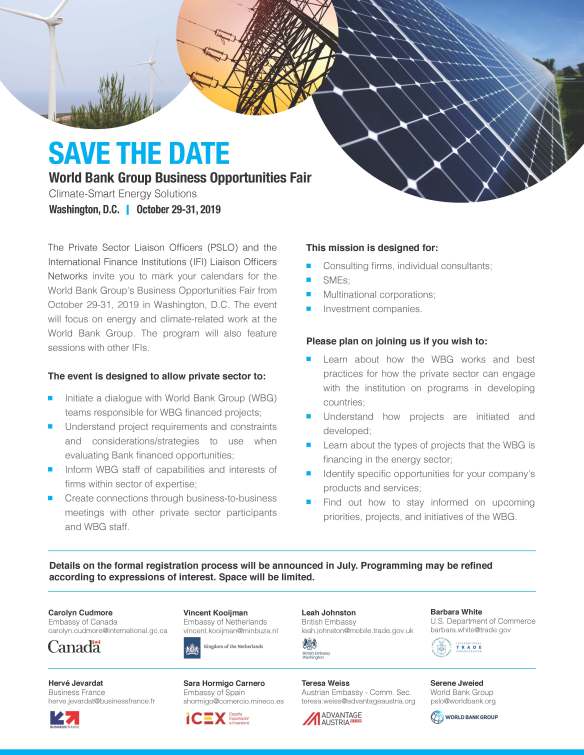
Save the Date:Climate-Smart Energy Solutions Business Opportunities Fair
Image
eC2: Eastern Caribbean Disaster Preparedness and Response Capacity Support and Technical Assistance Program
Deadline: 05-Aug-2019 at 11:59:59 PM (Eastern Time – Washington D.C.) 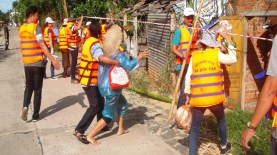
Across the eastern Caribbean sub-region many disaster agencies are under capacitated and institutionally weak due to limitations in human and financial resources. The World Bank is looking for qualified consulting firms to support 5 countries in the Eastern Caribbean and the Caribbean Disaster and Emergency Management Agency (CDEMA) in undertaking institutional assessments and strategic investment planning supporting the national and regional architecture for emergency preparedness and response. Work will be done in coordination with beneficiary Governments and CDEMA. The consulting services include (i) assessment of institutional arrangements in place and recommendations for institutional restructuring and organizational change; (ii) support for strategic planning and development of an investment roadmap based on each country’s hazard risk, organizational capacity and resources; and (iii) stakeholder engagement activities.
Continue reading
Making a better poverty map
The digital economy is transforming how data is collected, processed and used for  evidence-based decisions to monitor and achieve the Sustainable Development Goals. Promising new methods that combine traditional household survey data with non-traditional data sources (such as mobile phone data, satellite data and text data) are creating opportunities to map poverty at a higher resolution and scale. Nonetheless, significant technical, practical and ethical challenges still hamper the operationalization of these methods.
“The careful combination of ground truth surveys with an abundance of big data increases—not decreases—the value of surveys.”
eC2: Agricultural Technologies and Supply Chain Innovations (AgTech) Project. Use Case 2: Digitally Enhanced Agricultural Extension Service Delivery
Deadline: 29-Jul-2019 at 11:59:59 PM (Eastern Time – Washington D.C.)
IFC is seeking to introduce IT based solutions that help its agribusiness clients to increase the number of farmers they reach cost-effectively with consistent extension messages. IFC intends to contract a Consulting Firm who will use communication technologies to deliver standard and localized extension messages to Smallholder Farmers (SHFs) and agents participating in the AgTech project. This approach primarily entails the use of digital tools to deliver extension trainings and to receive feedback from trainees, thereby improving service and the quality of information delivered to SHFs. The required digital solution would be the use of videos integrating other communication channels, such as radio, mobile applications, SMS, and interactive voice response for the delivery of localized and consistent extension messages to SHFs/ agents.
Continue reading
Understanding the “new rurality” in Latin America and what it means to the water and sanitation sector
Despite the urbanization trends seen in Latin American and Caribbean (LAC), it seems 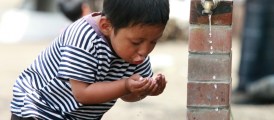 that the rural population in LAC is decreasing in relative terms. In 2001, official figures indicated that 125 million people in LAC resided in rural areas representing 24% of the total LAC population. In 2013, this value decreased to 21% (130 million out of a total population of 609 million inhabitants), and it is estimated that by 2030, the rural population will decrease to represent 16.5% of the total (CEPAL, 2014).
New country classifications by income level: 2019-2020
Updated country income classifications for the World Bank’s 2020 fiscal year are available 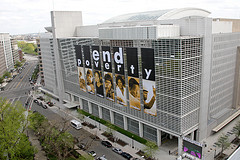 here.
here.
The World Bank classifies the world’s economies into four income groups — high, upper-middle, lower-middle, and low. We base this assignment on Gross National Income (GNI) per capita (current US$) calculated using the Atlas method. The classification is updated each year on July 1st.
 Netherlands for the World Bank
You must be logged in to post a comment.