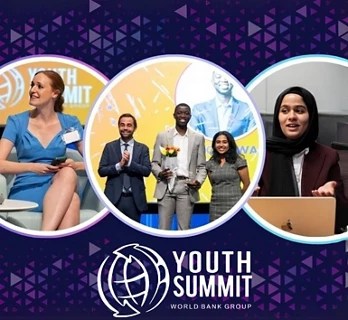
Calling all young innovators and changemakers! Join the World Bank Group Youth Summit 2025 Pitch Competition Launch on January 16th, 2025 (time to be confirmed). Discover how to pitch your creative solutions addressing climate action, digital transformation, and creative industries. We will spotlight the inspiring work of young entrepreneurs and past competition winners tackling global challenges.
For full competition rules and timeline, visit our website.
More details on the session and speakers coming soon.
WASHINGTON, D.C., January 7, 2025 – The World Bank (International Bank for Reconstruction and Development, IBRD, Aaa/AAA) today priced a 7-year benchmark bond that matures in January 2032. The Sustainable Development Bond raised USD 6 billion from investors seeking a high-quality liquid investment that supports the World Bank’s work to end extreme poverty and boost prosperity on a livable planet.
Accountability is a basic principle of good governance. But in a rapidly evolving world, how can public institutions ensure their checks and balances remain strong and responsive to change?
The scale of the global health challenge is staggering. Global megatrends—such as decreasing investments in health systems, climate change, and aging populations—are making it harder to access quality, affordable health care. Over half of the world’s population lack access to essential health services, and nearly 2 billion people face financial hardship due to the high costs of health care. Without access to essential health services, millions remain trapped in cycles of poverty. This lack of opportunity stifles human potential and economic growth. Good health means improved quality of life, increased access to education and employment, and greater resilience in the face of future crises.
Can you imagine a job where you can decide where to work, when to work, and which projects to work on? According to our recent data analysis, this is exactly how 243 million youth around the world are challenging the traditional career path, particularly in developing countries where they seek higher pay and jobs that are not easily available close to home.
As explored in the recent World Bank report Working without Borders, many young workers are using digital platforms to access jobs from all over the globe and embracing online gig work rather than pursuing informal, low-quality, local jobs. They are performing task-based jobs facilitated through online gig platforms, continually upgrading their skills, and trying to stay ahead of the competition and evolving technology.
In addition to flexibility, online gig work also presents the opportunity to earn higher pay compared to traditional employment. This income potential, coupled with the ability to be one’s own boss and access job opportunities in areas where local demand for labor may be low, makes online gig work an attractive proposition for many. It also enables people to cover income gaps and achieve greater financial stability, especially during shock or transition.
Figure 1: Motivations for Youth Participation in Online Gig Work
Source: Global Online Gig Workers Survey (2022)
Where do online gig workers live, and how does internet access affect this trend?
Contrary to a commonly held assumptions, our research revealed that a significant number of online gig workers hail from smaller towns rather than major metropolitan areas. This presents a valuable opportunity for youth living in smaller cities, where there may be few local employment opportunities.
Online gig workers may not need to move to big cities to find work, but they need access to the internet, a reliable connection, and digital devices. In countries with higher internet coverage, the percentage of online gig workers from smaller cities is notably higher, highlighting the importance of expanding internet access to address spatial inequalities in labor markets.
So, is expanding internet access enough? The answer is NO. Our survey found variations across countries with similar levels of internet coverage, suggesting there are barriers to online gig work beyond internet access. For example, in the Middle East and Northern Africa, the share of youth performing online gig work in smaller cities is lower despite higher internet coverage, highlighting untapped potential opportunities.
Figure 2: Internet coverage and the share of young online gig workers in smaller cities
Source: Global Online Gig Workers Survey
Source: Global Online Gig Workers Survey
What are the benefits of online gigs for different workers?
Online gig work offers better pay and opportunities for young people regardless of their education attainment. For example, in Pakistan’s Khyber Pakhtunkhwa region, online gig workers earn more than informal sector workers, even after adjusting for education, age, marital status, and working hours. Our research, however, suggests that in general workers with a college education have a greater chance of accessing higher-paying gigs.
Young gig workers aim to improve their skills, while also earning an income. While technical and digital skills are important, youth also highlight the importance of learning communication and time management skills to be successful as gig workers.
How can we help address potential challenges of online gig work?
While online gig work holds immense potential, most online gig workers – like other informal jobs in developing countries – do not have adequate social protection. While most young gig workers lack access to health insurance or old age benefits, they aspire for more than just traditional social security benefits; they are keen to develop their skills and want financial support for work-related needs such as computers and devices, highlighting the need for targeted social protection programs.
The Inter-American Development Bank (IDB) approved a US$25 million program to improve Suriname´s air transportation sector, increasing its safety and connectivity.
The program approved by the IDB’s Board of Executive Directors will support actions to improve compliance with international civil aviation safety and security standards and increase the quality and resilience of air transport infrastructure.
Financial Squeeze on Poorest Economies Tightened as Private Creditors Retreated
WASHINGTON, Dec. 3, 2024—Developing countries spent a record $1.4 trillion to service their foreign debt as their interest costs climbed to a 20-year high in 2023, the World Bank’s latest International Debt Report shows. Interest payments surged by nearly a third to $406 billion, squeezing the budgets of many countries in critical areas such as health, education, and the environment.
The Inter-American Development Bank (IDB) completed its second risk-transfer transaction with private insurance companies, leveraging credit insurance protection to diversify its portfolio and unlock capital for additional lending.
This transaction provides $300 million in credit insurance coverage across two sovereign exposures on the IDB’s balance sheet. By releasing capital with a lending multiplier of up to four times, the deal expands the Bank’s ability to increase development financing, supporting critical projects and improving lives in Latin America and the Caribbean. The coverage is distributed among seven insurance companies in the United States and Europe, including four new counterparties participating in this initiative.
As a pioneer in credit-substitution transactions and guarantees, the IDB continues to lead innovative collaborations with Multilateral Development Banks (MDBs), governments, and the private sector. This effort reinforces the IDB’s strategy to maximize lending capacity and aligns with the recommendations of the G20-sponsored MDB Capital Adequacy Framework Review.
USAID announced a new $50 million round of funding for the USAID’s EDGE Fund. The EDGE Fund enables USAID Missions worldwide to leverage private sector expertise, networks and supply chains to drive sustainable and scalable solutions to global challenges.
Recognizing that the needs faced by communities around the globe are simply too large for governments and donors to tackle alone, USAID engages a wide range of partners in its work, most notably the private sector. The EDGE Fund supports the most catalytic types of private sector partnerships in which there is significant alignment between the commercial interests of our private sector partners, the development objectives of the Agency, and development needs of local populations, ensuring continued private sector investment into targeted communities well into the future.
Through prior rounds of EDGE funding, USAID is investing $100 million and is leveraging over $280 million from the private sector to implement solutions that could unlock upwards of $2 billion in mobilized investments for sustainable development. Through collaborations with over 80 private sector partners, the EDGE Fund is advancing market-led solutions that address conflict, displacement, and food insecurity; accelerate inclusive economic growth; tackle the climate crisis; and combat political repression and corruption.
This new $50 million third round of funding, brings total USAID investment through the EDGE Fund to $150 million.
Prospective partners can submit Expressions of Interest on the EDGE Fund page.
ABIDJAN, December 5, 2024 – With support from the World Bank Group, Côte d’Ivoire will complete a debt-for-development swap, a transaction designed to improve the country’s debt profile and generate significant fiscal savings. The money saved by replacing expensive debt with cheaper financing will be used to improve education across the country. This will be the first debt-for-development swap of its kind supported by the World Bank Group.

 can public institutions ensure their checks and balances remain strong and responsive to change?
  decreasing investments in health systems, climate change, and aging populations—are making it harder to access quality, affordable health care.

 Netherlands for the World Bank
You must be logged in to post a comment.