
Tag Archives: Energy
Powering Prosperity: Unlocking East Asia’s Renewable Energy for Growth and Competitiveness
With vast, untapped renewable resources, East Asia can accelerate its clean energy transition—boosting competitiveness, creating millions of jobs, and strengthening energy security. A new World Bank report charts how.
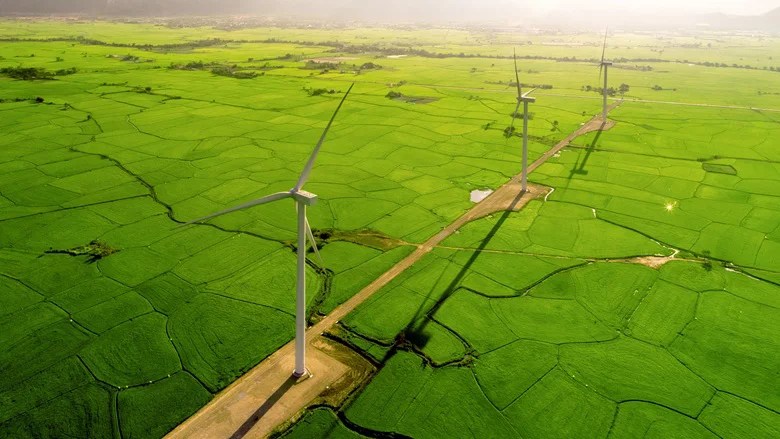
East Asia’s industrial rise has been powered by coal in recent decades – delivering rapid growth – but also making the region a major contributor to global greenhouse gas emissions. Today, the economics and the imperatives have shifted. A new World Bank Group report, Green Horizon: East Asia’s Sustainable Energy Future, finds that the region’s enormous, but largely untapped, renewable energy potential can fuel the next wave of growth, secure affordable energy, and enhance competitiveness.
Continue readingWorld Bank Scales Up Support to Cabo Verde’s Energy Transition and Universal Access
WASHINGTON, January 8, 2026 – The World Bank today approved a $13.30 million concessional financing through the International Development Association (IDA) for Cabo Verde’s renewable Energy and Improved Utility Performance Project (REIUP). The operation is co-financed by a $1.2 million concessional loan and $0.41 million grant from the Canada Clean Energy and Forest Climate Facility (CCEFCF), as well as a $0.4 million reimbursable grant from the Global Infrastructure Facility (GIF).
The financing will support Cabo Verde to accelerate its clean energy transition and achieve universal access to electricity.
Cabo Verde has made significant progress in energy access, achieving 98% coverage and bringing reliable electricity to nearly the entire population. The country has also advanced its energy transition efforts, aiming for 100% renewable electricity by 2040, supported by ongoing sector reforms. Meeting the country’s targets will require further investment in clean power, improved grid stability, and continued reforms following the demerger of the vertically integrated utility ELECTRA. The approved financing supports these national priorities and is expected to leverage substantial private capital for large-scale renewable energy deployment.
“The scaling up of REIUP reinforces Cabo Verde’s ambition to become a leader in achieving universal access to electricity in Africa. By mobilizing private capital to accelerate the energy transition and strengthening the sector’s institutional foundations, the project will help ensure a sustainable, financially viable, and climate-resilient energy sector”, said Kwawu Mensan Gaba, World Bank Energy Global Practice Manager for Western and Central Africa.
The operation will:
- Increase renewable energy generation capacity by supporting the development of 68 MW of new solar PV and wind generation and 12 MWh of battery storage, through a combination of public investments on smaller islands and private sector participation.
- Enable the operationalization of a newly established, Government-backed Risk Mitigation Facility, expected to mobilize US$108 million in private capital.
- Advance Cabo Verde’s efforts to achieve universal access to electricity through 1,800 additional household connections and last mile electrification.
- Strengthen and consolidate ongoing energy sector reforms and institutional capacity, particularly for newly created entities resulting from the separation of water and power utilities, to improve financial performance, operational efficiency, and reduce commercial losses.
“With this new operation, we are investing in a cleaner, more affordable energy future for Cabo Verde—one that reduces dependence on imported fossil fuels, shields the economy from the volatility of global price shocks, and strengthens competitiveness. At the same time, it will drive job creation in the energy transition, with a strong focus on closing the gender gap in the sector.” saidIndira Campos, World Bank Group Resident Representative for Cabo Verde.
REIUP aligns with Cabo Verde’s Master Plan for the Power Sector and complements all other development partners’ efforts in the sector.
PRESS RELEASE NO: 2026/044/AFW
Contacts
In Cabo Verde:Marco António Medina Silva,
+238 9511616
“Credit: World Bank Group. All rights reserved”
Publication: Keys to Energy-Efficient Shipping
Abstract
This report quantifies the extent to which energy efficiency measures can reduce greenhouse gas (GHG) emissions and fuel costs in global shipping. Drawing on a fleet-wide analysis across key vessel segments (bulk carriers, container ships, and tankers), it assesses the untapped potential of technical and operational efficiency measures through to 2050. Findings show that maximizing energy efficiency can cut global shipping’s GHG emissions by up to about 40% by 2030, exceeding current IMO interim targets, while simultaneously lowering the costs of the energy transition. Roughly half of these potential GHG savings by 2030 pay for themselves, offering savings of up to $220 billion annually in total costs as green fuel supply chains develop, and helping to build resiliency against fuel price volatility and rerouting shocks. The report highlights the role of short-term operational measures (such as forms of port call and speed optimization) and medium-term technical innovations (for example, wind-assisted propulsion) in achieving substantial efficiency gains. It identifies persistent economic, behavioral, and organizational barriers to uptake and illustrates them through deep dives on port call optimization and wind-assisted propulsion, showcasing innovative industry initiatives being applied to overcome these barriers. Finally, the report offers targeted recommendations for policymakers, industry, ports, and financiers to accelerate the adoption of energy efficiency solutions at scale.
“Credit: World Bank Group. All rights reserved”
Türkiye’s Energy-Efficient Buildings Bring Savings, Security, Better Lives
Story Highlights

- With a growing economy and rising energy demand, Türkiye has been taking bold steps to enhance energy efficiency and reduce reliance on imports.
- Energy efficiency measures in buildings—such as better insulation, efficient heating and cooling technologies, and LED lighting, combined with solar panels to generate clean energy—are being implemented in public hospitals, schools, and government offices.
- With World Bank support, Türkiye is aiming to reduce energy consumption in public buildings as part of efforts to achieve energy security and cut harmful emissions.
Power More With Less: Scaling Up Energy Efficiency for Growth and Energy Security
Energy efficiency is a transformative, low-cost solution that can fast-track access to affordable and secure energy and boost economic growth. Amid soaring power demand, driven in part by air conditioners, heavy industry, and, increasingly, data centers needed to power artificial intelligence, energy efficiency can help countries avoid overspending on new energy infrastructure, importing fuels, and taking on more debt for their energy sectors.

2025 Global Gas Flaring Tracker Report
Highlights
- In 2024, flaring surged by 3 billion cubic meters (bcm) to 151bcm, the highest level since 2007. The top nine flaring countries continue to account for three-quarters of all flaring, but less than half of global oil production.
- More than half a billion people still lack reliable access to electricity. The associated gas wastefully burned each year is equivalent to Africa’s total annual gas consumption.
- 389 million tonnes of carbon dioxide equivalent (MMtCO2e) emissions, including 46 MMtCO2e in the form of unburnt methane, were released by flares in 2024.
The latest Global Gas Flaring Tracker, an independent report of gas flaring worldwide, reveals that global gas flaring volumes rose to 151 bcm in 2024 from 148 bcm in 2023. This is the highest level since 2007. Flaring Intensity, the amount of flaring per barrel of oil produced, has remained largely unchanged in the last fifteen years.
The top nine flaring countries continue to account for three-quarters of all flaring, but less than half of global oil production. If captured and used, the gas flared could have helped provide energy for some of the world’s most energy-deprived people.
The increase in gas flaring in 2024 highlights the need for oil producers to rapidly accelerate efforts to end routine flaring and minimize pollution from oil and gas operations. The World Bank’s Global Flaring and Methane Reduction (GFMR) Partnership estimates that in 2024 flaring released 389 million tonnes of CO2e, with a significant portion in the form of unburnt methane.
The report highlights that countries committed to the Zero Routine Flaring by 2030 (ZRF) initiative performed significantly better than countries that have not made the commitment. However, while some countries have made progress reducing flaring, the overall increase in 2024 underscored the need for governments and operators to prioritize flaring reduction projects.
The report calls on governments and operators to act now to end routine gas flaring and reduce methane emissions from oil and gas production.
The World Bank’s annual Global Gas Flaring Tracker is a tool for monitoring and understanding the state of flaring worldwide and the progress made towards achieving Zero Routine Flaring by 2030. GFMR, together with the Payne Institute at the Colorado School of Mines, has developed global gas flaring estimates based upon observations from a satellite launched in 2012 and operated by the U.S. National Oceanic and Atmospheric Administration. The advanced sensors of this satellite detect the heat emitted by gas flares as infrared emissions.
About GFMR
GFMR is a multi-donor trust fund supported by governments, companies, and multilateral organizations committed to ending routine gas flaring and reducing methane emissions from the oil and gas sector. GFMR provides catalytic grant funding, technical assistance, policy and regulatory reform advisory services, capacity building and institutional strengthening for methane and flaring reduction projects. For example, GFMR mobilized $11 million to detect and repair methane leaks in Uzbekistan’s gas distribution network. The project has already eliminated 9,000 tones of methane emissions per year, with further reductions of 100 thousand tonnes of methane emissions expected each year.
Tracking SDG 7 – The Energy Progress Report 2025
Highlights

- In 2023, the number of new electricity connections outpaced population growth, increasing global access to electricity to 92%. While this means 19 million fewer people are without electricity compared to the previous year, 666 million people are still without power. In addition, this rate of growth is not fast enough to ensure universal access to electricity by 2030.
- 85% of the world’s population without electricity lives in Sub-Saharan Africa, up from 50% in 2010. In 2023, 35 million people in this region got electricity, but due to population growth, the number of people without electricity only decreased by 5 million, from 570 million in 2022 to 565 million in 2023.
- Most people without electricity live in remote areas, places facing conflict or violence, and low-income regions, making it hard to expand the electricity grid. However, new technologies and business models for decentralized renewable energy (DRE) – such as solar home systems and solar mini grids- offer flexible solutions for these areas. These solutions are expected to help over 561 million people worldwide in 2023, and they provided 55% of new electricity connections in Sub-Saharan Africa from 2020 to 2022.
World Bank Group, IAEA Formalize Partnership to Collaborate on Nuclear Energy for Development
PARIS, June 26, 2025—The World Bank Group and the International Atomic Energy Agency (IAEA) sealed an agreement today to work together to support the safe, secure and responsible use of nuclear energy in developing countries. The partnership agreement, signed by World Bank Group President Ajay Banga and IAEA Director General Rafael Mariano Grossi, formalizes multiple engagements between the two institutions over the last year, and marks the World Bank Group’s first concrete step to reengage with nuclear power in decades.
Continue readingPower More With Less: Scaling Up Energy Efficiency for Growth and Energy Security
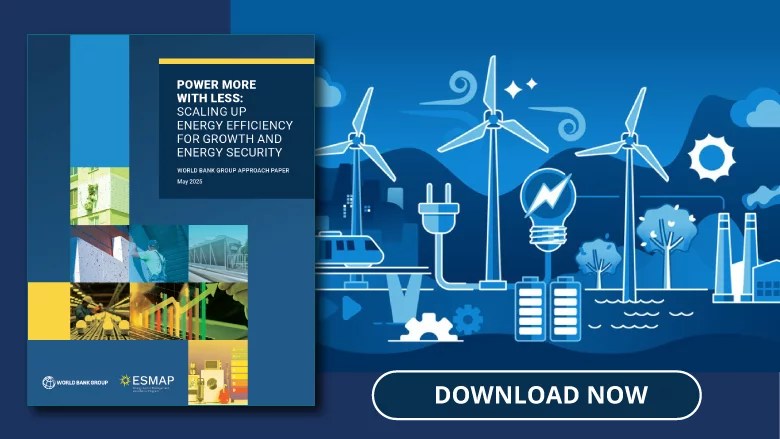
Energy efficiency is a transformative, low-cost solution that can fast-track access to affordable and secure energy and boost economic growth. Amid soaring power demand, driven in part by air conditioners, heavy industry, and, increasingly, data centers needed to power artificial intelligence, energy efficiency can help countries avoid overspending on new energy infrastructure, importing fuels, and taking on more debt for their energy sectors.
Continue reading Netherlands for the World Bank
You must be logged in to post a comment.