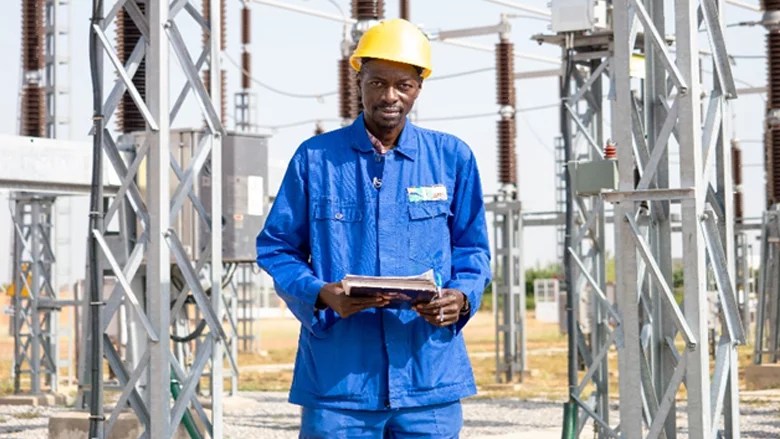
The construction of a 1,303 km 225 Kilovolt (kV) transmission line connecting the electricity grids of Côte d’Ivoire, Guinea, Liberia, and Sierra Leone (CLSG) has facilitated cross-border electricity trade and delivered affordable, renewable, and abundant electricity to approximately 2.8 million people across Guinea, Liberia, and Sierra Leone. This initiative has also contributed to a reduction in greenhouse gas emissions, amounting to about 13.8 million tons of CO2.
A newly built 228 km 225 kV transmission line connecting Kayes in Mali and Tambacounda in Senegal has significantly improved electricity supply and access for 404,000 people in Mali, Mauritania, and Senegal.
The Gambia River Development Organization (OMVG) Interconnection has helped improve access to clean, lower-cost, and more reliable electricity service for more than 2.5 million households and businesses, equivalent to 15 million beneficiaries in Guinea, Guinea-Bissau, Senegal and The Gambia.
The construction of a 913 km 330/225 kV transmission line connecting Benin, Burkina Faso, Niger, and Nigeria under the North Core Interconnection project is expected to successfully deliver 600 MW of affordable, renewable, and abundant electricity to Niger, Burkina Faso, Benin, and Togo, and provide rural electrification to approximately 1.2 million people across Niger and Burkina Faso.
Two years ago, Türkiye was shaken by a series of devastating earthquakes, which claimed over 50,000 lives and caused direct damages exceeding $34 billion and associated reconstruction costs estimated at $ 81.5 billion. Entire neighborhoods were reduced to rubble, with thousands of homes, schools, hospitals, and transportation networks destroyed. More than 1.5 million people were displaced, and millions face an uncertain future in the wake of the immense loss and disruption.
Small businesses can play an impactful role in fragile and conflict affected situations (FCS). They can create jobs and directly provide necessity goods and services such as food, water, health, education, and transportation. They can also contribute to the resilience of local populations during periods of conflict.
However, small businesses operating in FCS countries endure numerous setbacks to their activity, from frequent electricity cuts to bribery to armed attacks. Surviving and growing in these situations is difficult. Navigating daily challenges without access to affordable credit is almost impossible.
Figure 1. Access and use of financial services by SMEs
Image
Source: Author’s elaboration on WBES data
What drives SME financial exclusion in FCS countries vis-à-vis non-FCS countries? In a recent paper we examine this question, focusing in particular on the role of economic fundamentals and institutional factors. Economic fundamentals matter for SME financial inclusion. Higher incomes and better physical infrastructure increase savings and the pool of funds in the economy and improve access to finance while macroeconomic and financial stability can positively affect credit and other financial services to SMEs.
Institutions—the rules of the game in a society—matter too. Institutions influence the development of entrepreneurship and can support SME financial inclusion by improving the information environment and strengthening contract enforcement, as well as supporting equal treatment of firms in access to financial services.
On both counts, FCS countries generally lag behind non-FCS countries, especially, as would be expected, in terms of institutional development (figure 2). But what do we find in the data?
Figure 4. Macroeconomic, financial sector, institutional and business environment features
Image
Source: Author’s elaboration on WDI, GFD, WGI, WDI, Heritage Foundation
The results of our analysis show that output growth has a negative impact on SME financial inclusion in FCS countries, probably reflecting demand for countercyclical finance — typically backed by the government — by financially constrained SMEs that otherwise tend to resort to internal funds to finance their operations and investment.
On the other hand, price stability, a key sign of macroeconomic stability, is associated with higher SME financial inclusion in FCS countries. Moreover, access and usage of financial services by SMEs in FCS countries tends to increase with economic development, for example, income levels.
Other economic fundamentals also play a role in SME financial inclusion in FCS countries. Economies with large informal sectors tend to face tighter constraints on SME financial inclusion. Similarly, the lack of economic diversification also has a significant impact. Financial sector characteristics also affect SME access and usage of finance. The quantity of financial intermediation, such as deeper credit markets, helps enhance SME financial inclusion, and this is particularly important in FCS contexts.
The quality of financial intermediation is equally important because government and state-owned enterprise financing can crowd out credit to the private sector, including SMEs. In our sample of FCS countries, available credit tends to go proportionally more to the public sector than the private sector compared to non-FCS countries. Our analysis suggests that a significant role is played by crowding out effects in FCS countries. A lack of competition among banks reduces SME financial inclusion in FCS countries. Reducing banking market concentration is found to have a positive impact on SME access and usage of formal financial services in FCS countries. Finally, banking sector soundness, as measured by the quality of lending (NPL ratio), significantly and strongly supports SME financial inclusion.
Turning to institutional factors, strong governance and stable institutions exert a significant influence on SME access and usage of formal financial services in FCS countries. Voice and accountability, political stability, government effectiveness, and control of corruption are all positively correlated with SME financial inclusion. The importance of government effectiveness and control of corruption is particularly strong for FCS countries.
Credit information is also a key factor for SME financial inclusion. Rules affecting the scope, accessibility, and quality of credit information available through public or private credit registries can greatly facilitate banking relationships, and they are especially important for FCS countries.
Constraints to the quality of contract enforcement, property rights, and the effectiveness of courts, as well as to the ability of the authorities to formulate and implement policies and regulations that permit and promote private sector development, are negatively correlated with SME access and usage of formal financial services. Their impact is significantly stronger for FCS countries, suggesting that improvements in the overall business environment can have relatively sizable effects on SME financial inclusion in those countries.
In this month’s edition of IFC Insights, we focus on the power of connections. While the proliferation of new technologies has increased the ease and possibilities of connectivity across the globe, the access to and uptake of these tools has not always been evenly spread.
Our upcoming Spring Meetings will focus on Reshaping Development for a New Era – this is an excellent opportunity to take stock of progress being made to tackle the many challenges facing global development, including climate change.
Deadline: 10-Aug-2022 at 11:59:59 PM (Eastern Time – Washington D.C.)
The objective of this assignment is to review and assess country level energy demand and supply resources for the period of 2022-2060, develop/update regional power system optimization model, examine potential and benefits of electricity trade among Central Asian countries, and identify interconnection upgrades and potential new cross-border transmission projects that would support decarbonization in the region through scaling up of regional electricity trade in Central Asia. The assessment has to be carried out through comparison of the nationally optimized plan and the regionally optimized plan on each countrys generation development, including considering the latest commitments to carbon neutrality/NDCs, as , as well as World Bank Country Climate and Development Reports (CCDR) where applicable, nature of energy security considerations vs integration of regional options.
Deadline: 08-Aug-2022 at 11:59:59 PM (Eastern Time – Washington D.C.)
IFC is seeking a firm to support an advisory project in the Rwenzori region of Uganda that will complement an IFC investment transaction. The advisory project will support smallholder farmers to improve coffee production and productivity through the sustained adoption and application of good agronomic practices and enable the Client and its partners to improve the sourcing capacity of high-quality coffee. IFC is therefore seeking a vendor firm to deliver a gender capacity building program [Training of Trainers] to a team of agronomists/field in each of the origin using a transformative change methodology. The training on the gender transformative approach will be delivered by a vendor firm and will target: up to 23 trainees in Uganda up to 7 trainees in Zimbabwe
Deadline: 04-Aug-2022 at 11:59:59 PM (Eastern Time – Washington D.C.)
The World Bank is providing technical assistance to Cambodias Ministry of Land Management, Urban Planning and Construction (MLMUPC) and Phnom Penh Capital Authority (PPCA) to conduct the Phnom Penh Capital City Diagnostic aimed at updating the Phnom Penh Green City Strategic Plan (the Strategic Plan). The Strategic Plan will identify opportunities for low-carbon and resilient development under climate change. The project is funded by the City Climate Finance Gap Fund, which aims to help cities in low- and middle-income countries transition towards low-carbon and climate-resilient pathways in line with the goals of the Paris Agreement.



 proliferation of new technologies has increased the ease and possibilities of connectivity across the globe, the access to and uptake of these tools has not always been evenly spread.
  an excellent opportunity to take stock of progress being made to tackle the many challenges facing global development, including climate change.
 08-Aug-2022 at 11:59:59 PM (Eastern Time – Washington D.C.)


You must be logged in to post a comment.