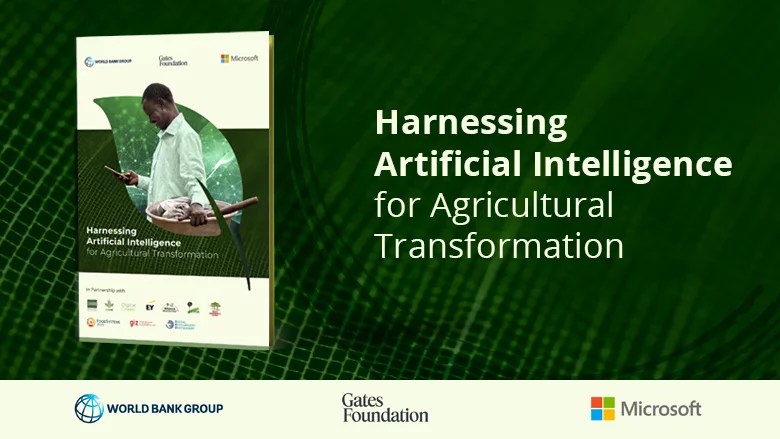
Harnessing Artificial Intelligence for Agricultural Transformation

Download report here

This report presents a comprehensive analysis of how AI can be responsibly deployed across agrifood systems, especially in low- and middle-income countries. It provides a roadmap of applications, requirements, and investment priorities focusing on ethical, inclusive, and scalable use.

Continue reading

From open data to AI-ready data: Building the foundations for responsible AI in development

The production and use of development data have undergone significant transformation over the past two decades. The shift from paper-based records to digital formats has made data more accessible and easier to share. The open data movement has dramatically increased the availability of government and institutional datasets, which in turn catalyzed greater opportunities for analysis, transparency, and innovation. And major advances in big data and data science have further expanded both the volume and diversity of information guiding development policy.

Amid rapid advances in artificial intelligence (AI), development data has now reached another pivotal juncture: the evolution to AI-ready development data—data that is readily discoverable, comprehensible, accessible, and usable by both humans and AI applications.

Continue reading

Is Artificial Intelligence the future of farming? Exploring opportunities and challenges in Sub-Saharan Africa

Across Sub-Saharan Africa, a quiet revolution is underway. Smallholder farmers are increasingly leveraging Artificial Intelligence (AI), once a futuristic concept, to transform agriculture. AI now plays a crucial role in addressing the region’s most pressing challenges: food insecurity, environmental degradation, and economic inequality. 

Continue reading

AI’s impact on jobs may be smaller in developing countries

Artificial intelligence is transforming the global workforce, but its impact may not affect all regions equally. Much of the conversation about AI and jobs focuses on high-income countries—where the technology threatens to reshape entire industries. But what will AI mean for workers in developing nations, who constitute 80 percent of the global workforce?

To better understand AI’s labor market impact in the developing world, in a recent paper we analyzed data from 25 countries, covering a population of 3.5 billion people. For workers in those countries, we assessed the level of AI exposure, which captures to what extent their jobs could be performed using AI. Our findings suggest that AI’s effects on jobs will be more gradual in the Global South, particularly in low-income countries.

Continue reading

International Day of Education 2025: Digital solutions for equitable education systems

The 2025 International Day of Education inspires reflectionson the power of education to equip individuals and communities navigate, understand and influence technological advancement. This year the focus is “AI and Education: Preserving Agency in a World of Automation.”

Continue reading

Educating for the present and the future: using Artificial Intelligence (AI) to address the learning crisis

Can Artificial Intelligence (IA) help address massive education gaps? The answer is a cautious EducacionTecnolog-aLAC 1140x500and optimistic yes. 1.8 billion students in the world should receive a good education. However, half of them do not achieve basic reading and numeracy skills needed for life.

Continue reading

Tipping the scales: AI’s dual impact on developing nations

Artificial Intelligence (AI) is transforming our world, and its potential to reshape development, especially in emerging markets and developing economies, is nothing short of revolutionary. But this isn’t just about getting AI to help with scheduling or recipe recommendations, it’s about real change, real challenges, and monumental opportunities.

Continue reading

Competition and the rise of the machines: Should the AI industry be regulated?

A multinational conglomerate uses artificial intelligence (AI) algorithms to gather untitled.pngintelligence about the news you peruse, social media activity, and shopping preferences. They choose the ads you passively consume on your newsfeed and throughout your social media accounts, your internet searches, and even the music you hear, creating an incrementally increasingly customized version of reality specifically for you. Your days are subtly influenced by marketers, behavioral scientists, and mathematicians armed with cloud supercomputers. All of this is done in the name of maximizing profit to influence what you’re thinking, buying, and whom you will be electing…

Continue reading

Artificial intelligence for smart cities: Insights from Ho Chi Minh City’s spatial development

1_Dptq_roODJNwjcXuW7mijQIt’s amazing to see what technology can do these days! Satellites provide daily images of almost every location on earth, and computers can be trained to process massive amounts of data generated from them to produce insightful analysis/information. This is just one of the demonstrations of artificial intelligence (AI). AI can go beyond just reading images captured from space, it can help improve lives overall.

Continue reading