
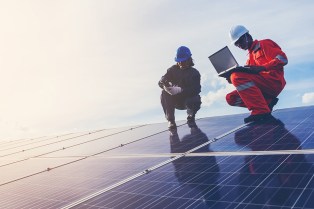
 There are many drivers of climate change, but few would disagree that energy infrastructure built according to “business-as-usual” standards is a major one. Meeting the lofty goals set at the 2015 Paris Climate Accords requires powering our homes, businesses, and government agencies with a cleaner mix of energy that includes more renewable sources. It also requires promoting standards that encourage energy efficiency—for example, for appliances or building codes—as a low-cost and high-impact way to reduce greenhouse gas (GHG) emissions.
Category Archives: WBG News & Reports
#AfricaCAN: A Lesotho farmer can now grow vegetables all year long
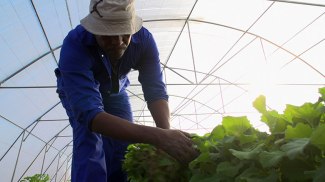 I met Thabo Lefatle on a cold winter day in Lesotho. We – a team from the World Bank Communications Department – had driven an hour and a half south of the capital Maseru to get to his farm. As we traveled through different parts of the small mountainous kingdom, we met several farmers to find out exactly how the Smallholder Agriculture Development Project (SADP) impacted their lives.
Indian agriculture at a crossroads: Smart solutions towards doubling farmers’ incomes
 A few weeks ago, I felt a sense of déjà vu. I was at a roundtable on agriculture in Delhi, in the same conference hall where, ten years ago, I participated in the consultations on the Bank’s World Development Report 2008 on Agriculture for Development.
This time we were discussing how India can build a stronger agriculture sector without further harm to the environment or depletion of its natural resources. The high-level dialogue was attended by senior representatives from India’s Niti Aayog, Ministry of Agriculture and Farmers’ Welfare, leaders of farmers’ associations from Punjab and Haryana, as well as by researchers, academics and donors. We focused on the ‘agriculture-water-energy’ nexus, achieving India’s second green revolution, making agriculture more climate resilient, as well as options to stop the burning of crop residue that is worsening air quality in much of northern India. It was heartening to see the torch bearers of India’s drive towards food security unhesitatingly debate a host of complex and sensitive issues.
Getting to zero traffic fatalities: What will it take?
 We must stop deaths on the roads. No one would argue with that, of course. But for us who live in Peru and many other developing countries, the importance of making road safety a global development priority really hits home—especially after a string of dramatic crashes that have made headlines across the country.
Last February, a bus fell to the bottom of a 200-metre ravine and left 45 dead in Arequipa, including several children. A month before, the country witnessed its deadliest traffic crash on record when a bus plunged down a cliff in Pasamayo, just north of Lima, killing some 52 people.
A Strong Foundation for Greater Impact
 Despite expectations that growth will be robust in the near term, developing countries face challenges to keep up the pace of progress and ensure inclusive, sustainable growth amid structural changes to the global economy. The World Bank Group is uniquely placed to address global challenges and help countries achieve their goals in today’s increasingly complex development landscape.
World Bicycle Day: Meet the man who made it happen
 Three years ago, Professor Leszek Sibilski embarked on an academic project to explore the role of bicycles in development. Little did he know then that his project would evolve into a massive advocacy effort, backed by the Sustainable Mobility for All initiative, to have the United Nations designate a day to celebrate and promote bicycle use around the world. He succeeded. On April 12th 2018, all 193 UN member states adopted General Assembly Resolution A/Res/72/272, which declared June 3 as World Bicycle Day. The resolution was sponsored by Turkmenistan and co-sponsored by some 56 countries.
For Better Returns than the U.S. Stock Market, Invest in Education
We all know that education is a sound investment, but just how solid is it? We set to find out, with a comprehensive review that covered trends and patterns from a database of 1,120 estimates in 139 countries spanning nearly seven decades.
The result—a 9 percent average individual return for one extra year of schooling globally, or in other words, 9 percent increase in hourly earnings—is staggering, especially when compared to other investment options available. One such investment many people choose to invest in are United State stocks and bonds. However, when we learned that investors over a five-decade period from the mid-1960s collected only a mere 2.4 percent return, investing in education looks even more solid.
Q1 2018 update of World Development Indicators available
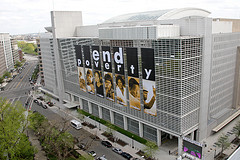 The World Development Indicators database has been updated. This is a regular quarterly update to 1,600 indicators and includes both new indicators and updates to existing indicators.
This release features updates for national accounts, balance of payments, demography, health, labor market, poverty and shared prosperity, remittances, and tourism series. New estimates are also available for electricity-related indicators from the Global Tracking Framework, adjusted net savings, law and regulation towards gender equality from Women, Business and the Law, ownership of financial accounts from the Global Findex, mobile and internet, and education series.
Pitfalls of Patient Satisfaction Surveys and How to Avoid Them
![medical-appointment-doctor-healthcare-clinic-health-hospital-medicine[7]](https://nl4worldbank.org/wp-content/uploads/2015/09/medical-appointment-doctor-healthcare-clinic-health-hospital-medicine7.jpg?w=247&h=165) A child has a fever. Her father rushes to his community’s clinic, his daughter in his arms. He waits. A nurse asks him questions and examines his child. She gives him advice and perhaps a prescription to get filled at a pharmacy. He leaves.
A child has a fever. Her father rushes to his community’s clinic, his daughter in his arms. He waits. A nurse asks him questions and examines his child. She gives him advice and perhaps a prescription to get filled at a pharmacy. He leaves.
How do we measure the quality of care that this father and his daughter received? There are many ingredients: Was the clinic open? Was a nurse present? Was the patient attended to swiftly? Did the nurse know what she was talking about? Did she have access to needed equipment and supplies?
Spring Meetings 2018: World Bank Group Events Recap
 It’s Spring Meetings time and we’re on the ground to give you an inside look at the events here in Washington, DC!
On this page, you will find a daily recap of the World Bank Group events, including highlights from high-level panel discussions, Facebook live interviews, roundtables, hangouts and more!
Lock in, don’t look away, amp up your Spring Meetings experience and share this page!
 Netherlands for the World Bank
You must be logged in to post a comment.