
Today, women have just three-quarters of the legal rights of men. In 1970, it was less  than half. The Women, Business and the Law 2020 report presented results from our recent effort to document how laws have changed since 1970. This exceptional dataset has already facilitated ground-breaking research that shows that a country’s performance on the Women, Business and the Law index is associated with more women in the labor force, a smaller wage gap between men and women, and greater investments in health and education. We hope that sharing the data and reform descriptions on our website will lead to more evidence that will inspire policymakers to change their laws so that more women can contribute to economic growth and development.
Author Archives: NL4WorldBank

Coronavirus and the ‘Pangolin Effect’: Increased exposure to wildlife poses health, biosafety and global security risks
Everything is connected. 
Using the theory of chaos, when a butterfly flaps its wings in New Mexico it has the power to cause a hurricane in China. But there’s hardly anything of the butterfly effect’s randomness in the dominos that keep falling after the emergence of COVID-19 (coronavirus). The explanation that is emerging is in fact more familiar: how human beings’ connected actions can result in dramatic consequences.
It’s time we invest in healthy food systems for a safer world
The World Bank Group last week announced it would make available a package of $12  billion — an unprecedented level of financing to help developing countries and businesses cope with the health and economic impacts caused by COVID-19. Much of that support will naturally be reactive, financing immediate measures designed to strengthen our response to a brand-new threat. But some of the financing will also be preventative — as it should be, if we are to learn our lessons from the past and strengthen our collective hand before the next bug hits.
eC2: Strengths and limitations of satellite-derived soil moisture for drought risk financing
Deadline: 25-Mar-2020 at 11:59:59 PM (Eastern Time – Washington D.C.) 
The main objective of this project is to support World Bank Crisis & Disaster Risk Finance activities in the area of anticipatory and/or parametric climate risk financing with tailored data- and research-driven approaches applied to promising satellite-derived datasets that have so far not been considered for operational purposes. In the context of the Next Generation Drought Index project, the World Banks Disaster Risk Financing and Insurance program is developing a technical toolbox to guide users at both micro and macro level through the entire process of data selection, index design, calibration, validation and related methods to strengthen sensitivity analysis and historical skill analysis. There is scientific evidence about the added-value of satellite-derived soil moisture products to close critical gaps between rainfall anomalies and the response of the land surface. However, a quantitative and qualitative analysis in 2-3 specific areas of interest is required to identify and explain the individual strengths and limitations of different products that may differ in sensor technology (radar/radiometer/combined), method (remote sensing vs. data assimilation), output variable (surface or root-zone soil moisture, soil moisture-based rainfall estimations), timeliness (annual updates vs. NRT products), revisit period (depending on area of interest) and spatial resolution (<1 km to >25 km). Since anticipatory financing mechanisms that decouple insurance payouts from loss assessments are a priority, the work on soil moisture products should highlight the potential predictive skill of various datasets, whereas the integration of both publicly available and, if available, commercial products in the analysis is encouraged.
Coronavirus: Reflections of an epidemiologist and public health practitioner
Not a day passes without us being bombarded by the rapidly evolving medical literature 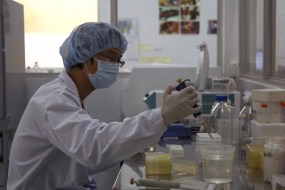 and media on the hitherto unknown COVID-19. Rightfully so, as we now have an outbreak with more than 100,000 cases confirmed globally.
Yet, I cannot help but wonder how the general public is dealing with such an onslaught of information, if I, as a trained physician, epidemiologist and a global public health practitioner, find it too much to take in and digest. How do we expect a lay person to sift through it all, separate the chaff from the grain, avoid fear mongering – No, you do not get COVID-19 if you receive a package from China, or eat in a Chinese restaurant – and stick with the most relevant information and the essentials for behavioral change? This is ultimately what counts the most:, arming people with the right messaging and instructions for compliance with the science-based best practice.
eC2: Key Factors for Successful Development of Offshore Wind in Emerging Markets
Deadline: 26-Mar-2020 at 11:59:59 PM (Eastern Time – Washington D.C.)

The scope of the assignment shall cover the major topics that need to be considered by policymakers and regulators when establishing a new market for offshore wind development. These shall include, but not be limited to, the following points:
To achieve peace and prosperity in the Sahel needs long term international solidarity
I have recently traveled across the Sahel region from Mali to Burkina Faso to Niger and  finally to Mauritania where I addressed the Sahel Alliance General Assembly and the G5 Sahel Leaders’ Summit. During my travels, I met mothers, fathers, engineers, economists, entrepreneurs and community groups. Before arriving in the Sahel, I was at the Munich Security Conference with diplomatic and military leaders.
Call for Innovation: Impacts of Port Development on West Africa’s Coastal Areas
The World Bank Group is launching a Call for Innovation under the West Africa Coastal 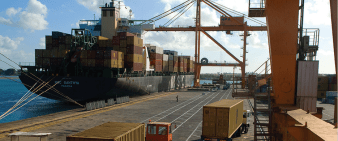 Areas Management Program (WACA) to bridge the gap between innovators and port developers/owners to build sustainable and integrated coastal management. The call is part of the WACA Resilience Investment Project (WACA ResIP), a multi-country regional project that aims to support present assets and strengthen the resilience of coastal communities for Benin, Côte d’Ivoire, Mauritania, São Tomé and Príncipe, Senegal, and Togo. The project supported them develop multi-sectoral investment planning processes, culminating in WACA Multi Sector Investment Plans (MSIPs).
THE CHALLENGE
The challenge is to identify innovative and feasible solutions to fight coastal erosion and flooding issues associated with the ongoing development of large commercial ports and maritime operations in the six countries. In most cases, existing ports were built with limited if no zero planning and considerations of potential exacerbation of coastal erosion. The significant threat is that this shortcoming is also occurring in the
design and construction of new ports. The scope is to identify innovations that allow to avoid, mitigate, and remediate the geomorphological and ecological impacts associated with existing and planned commercial ports in West Africa.
Newsletter March 2020: Development in Light of a Pandemic
NL4WorldBank March edition of the newsletter is out!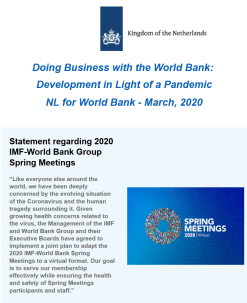
The newsletter ‘Development in Light of a Pandemic‘ headlines with the cancellation of the IMF and World Bank Group Spring Meetings. “Out of precaution World Bank Group events up to May have either been postponed or cancelled. We are still unclear on how the World Bank Group will proceed with events after May. In this blog post we selected the largest event messaging concerning COVID-19, The events include: 2020 IMF/World Bank Group Spring Meetings, Fragility Forum 2020, and the Land and Poverty conference.”
eC2: Strategic Assessment of Solid Waste Management Services and Systems with a focus on Plastic Waste and Marine Litter
Deadline: 26-Mar-2020 at 11:59:59 PM (Eastern Time – Washington D.C.) 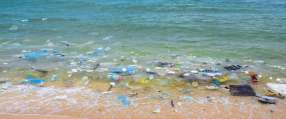
Objective of this assignment is to develop at a coherent state level strategy/roadmap for municipal waste/plastic waste comprising institutional,policy/regulatory & investment interventions required for improving solid waste management services in cities.Firm is expected to conduct a strategic assessment of SWM services,policies/regulations & institutional systems in partner state of Karnataka with a focus on plastic waste as part of municipal solid waste.The assessment will be carried out in two parts(i)an overall review of sector status of State across the entire value chain under National Missions,including institutional,policy & regulatory framework,financial resources & technical capacity,private sector engagement;(ii)in-depth diagnostics of twenty emerging cities(ten in each state)to assess service & infrastructure gaps,institutional arrangement,financial situation,to propose policy & institutional reforms as well as investments, interventions to address short&long term needs.
 Netherlands for the World Bank
You must be logged in to post a comment.